For the last time before Commonwealth Financial Network financial advisors move to LPL Financial, they gave the firm the top grade in satisfaction among independent brokerages.
But the below rankings from market research and consulting firm JD Power’s closelywatched annual U.S Financial Advisor Satisfaction Study displayed some novel differences with those of prior years, in the July 9 release of the latest results.
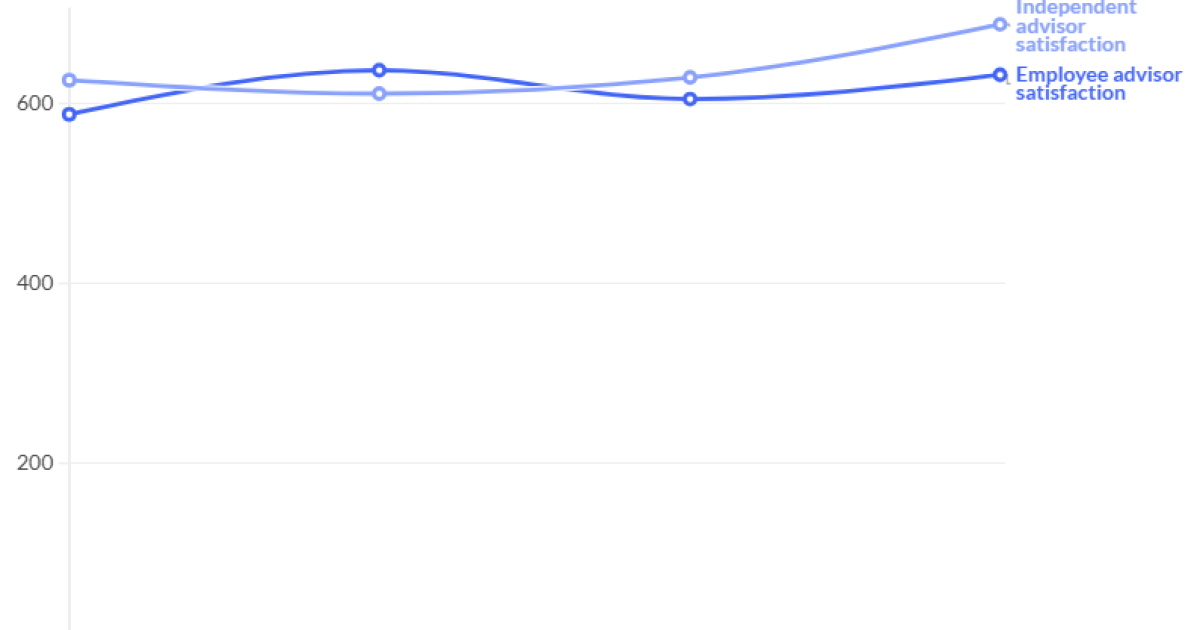
Commonwealth’s score on the satisfaction index surpassed that of other independent brokerages for the 13th straight time, but it was lower than that of the repeat winner in the employee channel, Stifel. And LPL — which purchased Commonwealth last year for $2.7 billion and plans to onboard the advisors in the fourth quarter — took a surprising second place in the independent channel with its highest position in the advisor satisfaction rankings in at least the past decade. The employee and independent units of Raymond James and another perennial leader in the rankings, Edward Jones, took the other spots in the top three in either channel.
Regardless of which particular firms came out on top, though, the study serves as a yearly reminder of how large wealth management firms must “attract advisors to stay with them” beyond the standard term of the industry’s seven-year recruiting loans, said Jeffrey Czajka, the founder of consulting company Advisor Growth Solutions. Continuing industry consolidation like LPL’s Commonwealth deal that helped drive an uptick in advisor moves last year is only making recruiting and retention more integral to the industry’s business. In turn, advisors’ choice of brokerage or RIA often affects their future growth and goals, Czajka said.
“Like it or not, they’re your partner,” he said. “They’re all looking at, how do they build a stronger infrastructure for advisors to provide value that keeps them there?”
READ MORE: Preview the The Complete Guide to Starting an RIA
New and continuing trends on the recruiting trail
This year’s survey results indicate that AI and teaming structures for advisory firms are playing a big role in that cost-benefit analysis. With 40% of employee advisors and 35% of their independent brethren operating in teams, advisor satisfaction generally reaches its highest levels among those with three or four on a team, which JD Power said is suggesting that midsize groups are finding the right balance of scale, collaboration and client service.
The survey also showed that advisor’s use of AI tools has jumped — particularly for employee advisors. And the satisfaction grades surged by more than 100 points on the 1,000-point scale in both channels among advisors who said they have deployed AI tools effectively through their brokerage firm.
“We’re now seeing AI move beyond the buzz and start to fundamentally change how advisors manage their practices and evaluate their firms’ ability to support their continued growth,” Mike Foy, managing director of the wealth management practice at JD Power, said in a statement. “When AI is rolled out smoothly, with proactive communication and effective training, advisors can take hours back from compliance and administrative work and reinvest that time in clients and new business development. The firms that get that formula right are the ones seeing the biggest gains in satisfaction, loyalty and productivity in their advisor populations.”
Questions around AI or other technology often act as a factor in advisors’ moves to a new firm, along with M&A consolidation, company policy changes, personality clashes with executives or big recruiting offers, Czajka said. However, any brash decisions by advisors may prove temporary before they switch over to yet another firm, he pointed out. Instead, they could find more staying power with their current or prospective brokerage or RIA by thinking carefully about the extent of their long-term growth goals, the degree that they would rather be with a larger or more midsize wealth management firm or other key priorities.
Czajka frequently compares the decision process to that of an advisor working with a client in putting together a financial plan that moves them toward their most important overarching goals.
“Advisors can almost take a similar approach to it,” he said. “Knowing that will help you better evaluate your options and who’s a better fit for you.”
With so many of those different dynamics at play in advisors’ moves and a lot at stake for LPL and Commonwealth specifically in retaining teams through the transition later this year, it’s no wonder that both firms issued press releases trumpeting their position in the JD Power rankings upon the release of this year’s study. Stifel posted one as well.
Scroll down the slideshow below to see which firms came in at the top and bottom of JD Power’s advisor satisfaction rankings in 2026.
For results from prior years, see our slideshows from 2025, 2024, 2023, 2022, 2021, 2020, 2019, 2018 and 2017. To see J.D. Power’s latest annual study ranking firms for full-service and do-it-yourself investor satisfaction, click here.
Note: The JD Power U.S. Financial Advisor Satisfaction Study measures the responses of 4.503 employee and independent advisors between December 2025 and April 2026. For each firm with at least 100 participating advisors, the research consultant releases a satisfaction index score on a 1,000-point scale based on six factors: “compensation; firm leadership and culture; operational support; products and marketing; professional development; and technology.”
READ MORE: Register for Financial Planning’s ADVISE AI conference