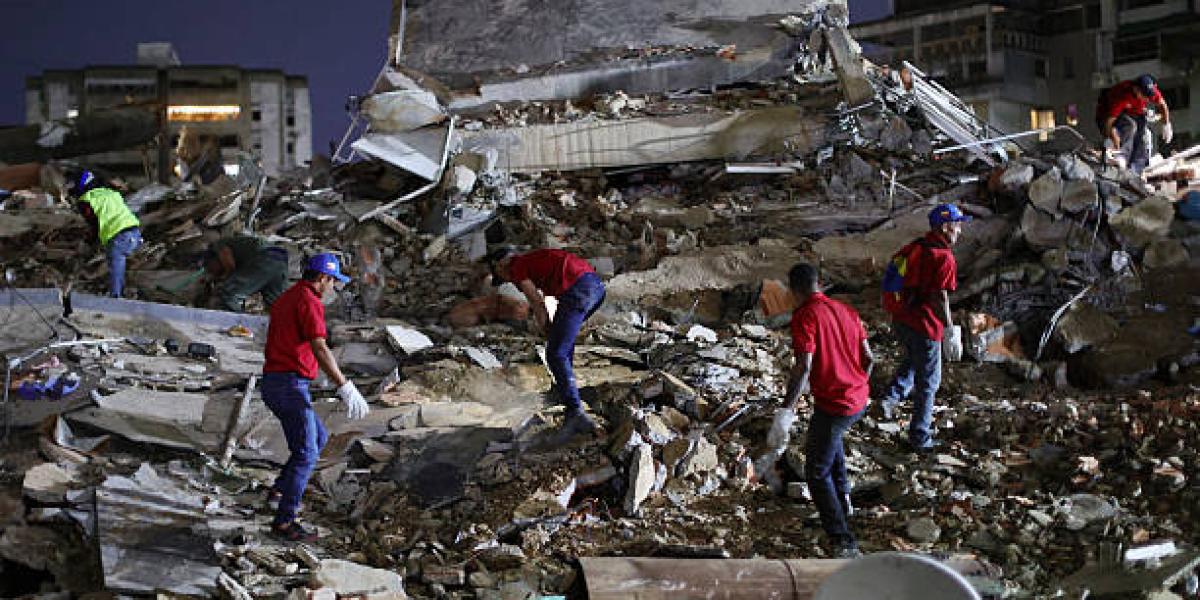
Months ago, as a result of the train accident in Adamuz, Spain, I wrote an article entitled “Bureaucracy increases accidents and risks“. And, precisely, now the earthquake in Venezuela had such serious consequences, not because of the geology that is part of nature known and preventable in advance by man, but because of this bureaucracy.
In that article I said that the idea that the market is something egocentric and perverse is a malicious deformation of something as natural as the gathering of all people, of a place, cooperating voluntarily, exchanging products and services, in order to improve their lives and collaborating with others, since all voluntary exchange only occurs if each one receives what serves him better than what he gives, this is how efficiency is produced.
But the greed of politicians and bureaucrats has caused the State to arrogate to itself the monopoly of violence with which they impose “laws” and “regulations” that, like all violence, it always destroys.
There are two things that disqualify bureaucrats. In the first place, people – the market – risk their own lives, but for the bureaucrat, the prevention of an accident is just another tedious expedient.
The market effectively regulates and prevents accidents, starting with competition between companies that forces them to improve safety, quality and prices. Then, in cases such as housing, no one would build in risk areas, and insurance costs would be another reason not to live there.
Second, the market works in real time and in a personal way, while bureaucrats respond to outdated and generalized regulations, laws, and protocols when each person and each situation is special.
The responsibility for this humanitarian catastrophe in Venezuela lies entirely with the State. In the first place, 80% of Venezuelans live in areas of high seismic risk, which began with colonization – without undermining the merits it had – which was a state company led by Spanish military and officials. And that location was maintained for political reasons and, as the state is omnipresent, companies and citizens are forced to live close to bureaucracy.
Then, in addition to the catastrophic socio-economic situation thanks to the enormous weight of the State, state interference in the entire economy, starting with fiscal costs and urban regulations, has prevented the construction of adequate anti-seismic infrastructures.
And, finally, the response of the state rescue entities has been so inefficient that many deaths are due precisely to it. There are countless complaints: “At 8 p.m. there were people alive down there, and they have not bothered to rescue them,” lamented the relative of a victim.
If the market were free without the omnipresence of the state, settlements would not be carried out in these areas, the infrastructure would be much more resilient and insurance companies could take charge, first, of prevention since they would lose money in case of accidents and then of rescue and reconstruction. But the insurance activity in Venezuela is facing a deep crisis, due to the weight of the State, such as the destructive Law of Insurance Activity.
USD 6,700 million were lost, UNDP estimates, equivalent to 6% of GDP, a lot for the shattered Venezuelan economy but little for the global insurance industry. Swiss Re estimated the contributions of global insurers, for catastrophes initiated by natural phenomena during 2024, at more than USD 135,000 million.