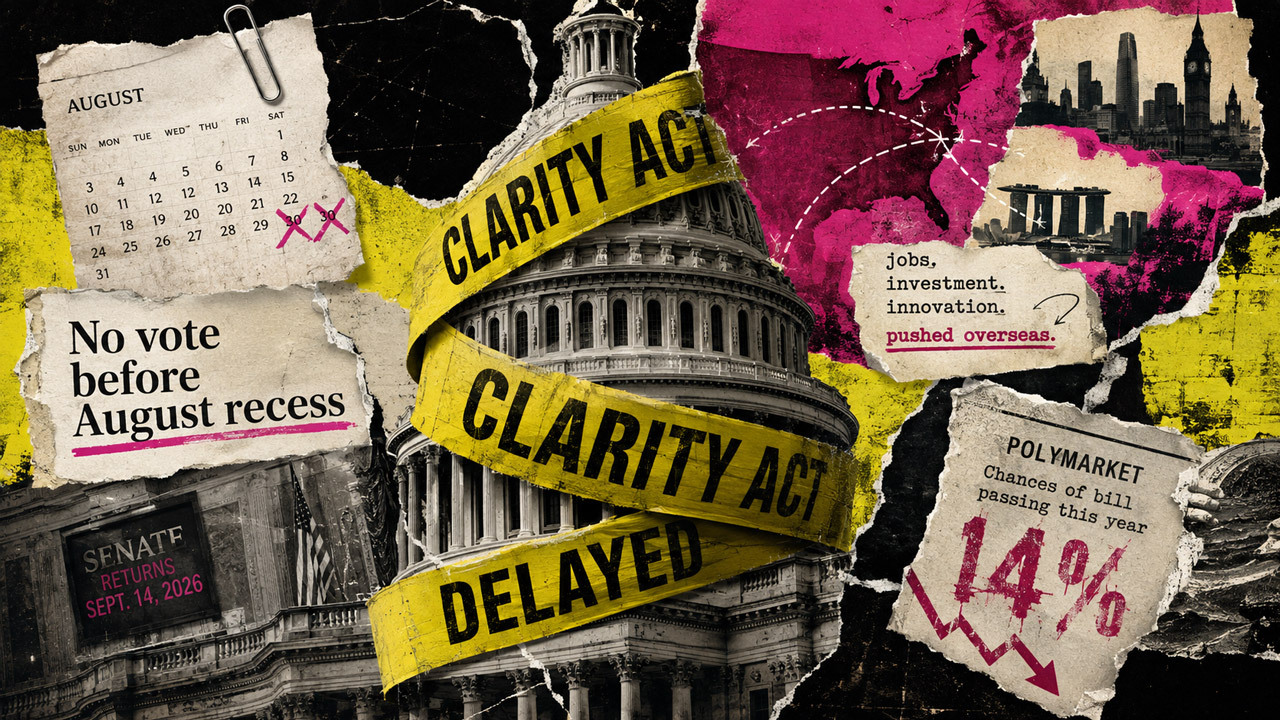
Some of the largest US crypto companies and advocacy groups are escalating a coordinated lobbying campaign to secure a Senate vote on landmark digital-asset legislation before lawmakers leave Washington for their August recess.
The industry’s push for the Digital Asset Market CLARITY Act comes as the Senate confronts a narrowing legislative calendar, and negotiations remain unfinished.
In view of this, Senate Majority Leader John Thune, who controls the chamber’s floor schedule, reportedly acknowledged that negotiators still have a route forward but warned that the opportunity is closing.
The warning has added urgency to an industry campaign years in the making. The bill supporters are now widening their effort across Washington, seeking to convert committee progress and bipartisan negotiations into floor action before the congressional calendar becomes more difficult.
A broad crypto coalition mobilizes
The campaign took a visible turn this week when Ripple sent a branded “Clarity Truck” through Washington, carrying messages in support of the legislation as lawmakers prepared to leave the capital.
Ripple presented the measure as a way to establish consumer protections, encourage responsible digital-asset development, and preserve the United States’ position in financial technology.
The truck is part of a broader operation involving cryptocurrency exchanges, blockchain developers, venture capital firms, trade associations, and grassroots organizations.
Earlier this month, a coalition of more than 200 companies and advocacy groups sent a letter to Thune and Senate Democratic Leader Chuck Schumer, urging them to schedule a floor vote for the CLARITY Act. Signatories included Coinbase, Ripple, Kraken, Circle, Binance.US, and Andreessen Horowitz.
The coalition argues that the absence of a comprehensive federal framework has left companies subject to competing interpretations from regulators and courts.
Supporters say clearer registration pathways would encourage businesses, capital, and technology jobs to remain in the United States while bringing more trading activity within the reach of domestic regulators.
Kristin Smith, president of the Solana Policy Institute, said talks involving Senate Republicans, Democrats, the White House, and industry representatives are continuing despite mounting anxiety about the bill’s progress.
Smith said lawmakers and their staff have held frequent in-person meetings, identifying Republican Sens. Cynthia Lummis of Wyoming and Bernie Moreno of Ohio and Democratic Sens. Kirsten Gillibrand of New York and Ruben Gallego of Arizona among those working to advance the proposal.
The industry has also expanded its political operation. Crypto-backed groups spent heavily during recent election cycles, while companies and trade associations increased their presence in Washington and developed relationships across both parties.
That work helped move the legislation through the committee. It has not yet secured a commitment from Senate leaders to bring the measure to the floor.
Clearing legislative hurdles
The House passed H.R. 3633 by a 294-134 vote on July 17, 2025. The Senate Banking Committee advanced a substantially revised version 15-9 of the CLARITY Act on May 14 after months of negotiations.
The Senate proposal would divide oversight responsibilities between the Securities and Exchange Commission (SEC) and the Commodity Futures Trading Commission (CFTC) based on the nature of an asset and the transaction through which it is offered or traded.
The SEC would retain authority over securities offerings and investment-contract transactions involving digital assets. The proposal would also create tailored disclosure rules for some token distributions while placing intermediaries that operate spot markets for digital commodities under CFTC supervision.
The framework is intended to replace a system shaped largely by enforcement actions, agency interpretations, and court rulings.
Cryptocurrency companies have argued that the current approach makes it difficult to determine which regulator has jurisdiction and whether particular tokens or trading activities can be offered legally in the United States.
The proposal also builds on the stablecoin framework established under the GENIUS Act. It would prohibit digital-asset service providers from paying interest or yield solely because a customer holds a payment stablecoin, while permitting rewards tied to transactions, platform use, liquidity provision, and other activities.
Stablecoin rewards had become a major point of contention. Banks warned that interest-like payments could draw deposits away from traditional financial institutions, while crypto companies argued that an expansive ban would restrict competition and prevent platforms from offering legitimate incentives.
Negotiators reached a sufficient compromise to secure the Banking Committee vote, but additional changes could emerge during floor consideration.
The committee’s proposal must also align with legislation within the Senate Agriculture Committee’s jurisdiction, which oversees the CFTC. Senate leaders would then need to assemble the bipartisan support required to overcome procedural barriers that typically take 60 votes.
Any Senate-approved version would probably have to return to the House because of changes made since the representatives passed their bill last year.
Lummis described the committee vote as evidence of how far the industry’s legislative campaign had come, saying:
“I have watched the digital asset community grow from the fringes to the floor of the United States Senate. Now let’s get the Clarity Act to the president’s desk.”
CLARITY Act’s illicit-finance dispute
Despite the progress in committee, CLARITY Act negotiations remain divided over how the bill would alter the perimeter of US anti-money laundering regulation.
The immediate dispute centers on Section 604, a provision known as the Blockchain Regulatory Certainty Act. The language is designed to prevent developers of noncustodial software and blockchain infrastructure from being classified as money transmitters when they neither hold customer assets nor directly control transactions.
Industry groups say the protection is necessary because a developer who publishes code should not automatically face the same licensing and reporting obligations as a financial company that takes possession of customer funds.
However, four law enforcement organizations recently sent a joint letter to administration officials warning that the provision could create gaps in oversight and accountability.
The National District Attorneys Association, the National Association of Assistant United States Attorneys, the International Association of Chiefs of Police, and the National Sheriffs’ Association argued that broad exemptions could shield some crypto participants from know-your-customer and anti-money-laundering requirements.
The groups said they support protections for developers who merely write or publish software. Their concern is that the provision could also cover operators that actively facilitate digital-asset transfers without formally taking custody of customer funds.
That disagreement has become one of the central sticking points in negotiations involving Congress, the administration, industry representatives, and law enforcement.
In response, Lindsay Fraser, chief policy officer at the Blockchain Association, said the criticism reflects a misunderstanding of the legislation.
Fraser said Section 604 narrowly protects developers who neither custody assets nor control transactions and does not prevent authorities from prosecuting fraud, money laundering, sanctions evasion, or terrorism financing.
Other provisions would apply the Bank Secrecy Act and sanctions obligations to digital-commodity brokers, dealers, and exchanges. The bill would also expand information sharing between private companies and federal agencies, strengthen seizure and forfeiture powers, and give the Treasury Department additional tools to target illicit financial activity.
It would create a safe harbor allowing stablecoin issuers and digital-asset service providers to place temporary holds on transactions when they reasonably suspect unlawful activity or receive a written law-enforcement request.
Fraser said those measures would expand compliance obligations while ensuring that noncustodial developers are not treated as financial intermediaries solely because they created software.
The Blockchain Association has also sought to show that the legislation has support from within the national security community.
Earlier this month, it released a letter signed by 160 former national security, intelligence, and law enforcement professionals urging Thune and Schumer to advance the bill.
The former officials argued that bringing more digital-asset businesses under US oversight would give investigators stronger private-sector partners and discourage companies from moving activity to offshore jurisdictions with weaker transparency requirements.
The competing letters reflect a narrower disagreement than the broader debate over whether cryptocurrency markets need federal rules. Both sides say investigators require stronger tools.
They differ over whether Section 604 draws an effective boundary between neutral software development and the operation of a financial service.
Ethics roadblocks remain
A separate political dispute over the CLARITY Act concerns ethics restrictions on senior government officials and their families.
Democrats have sought stronger provisions addressing crypto holdings and commercial relationships involving officials who influence digital-asset policy. Scrutiny has intensified because of President Donald Trump’s family connections to cryptocurrency ventures.
The Senate Banking Committee rejected an ethics amendment during its May markup, but the issue is expected to return before any floor vote. Republican leaders will need Democratic support to assemble the votes required to advance the legislation.
Reid MacInnes Cuming, chief executive officer of research firm Ground On-chain, said negotiators had made progress on several difficult technical questions, including stablecoin rewards and the treatment of decentralized finance.
The ethics provisions present a more politically sensitive challenge, he said.
According to him:
“House and Senate reconciliation still has rough edges, and significant rulemaking remains. But the ethics provisions are the real obstacle; if unresolved before August, the bill stalls past the midterms and innovation pays the price.”
A stronger ethics provision could help attract Democratic votes but may face resistance from Republicans, the White House, or parts of the industry. Failure to reach a compromise could leave Senate leaders without enough support to justify using scarce floor time on the bill.
Rules for decentralized-finance platforms also remain under discussion. Lawmakers are attempting to distinguish genuinely decentralized software from services that retain significant control while presenting themselves as autonomous protocols.
Those questions overlap with the Section 604 fight because both involve determining when software developers or protocol operators should be treated as regulated intermediaries.
The legislative window narrows
The Senate calendar now magnifies each unresolved issue surrounding the CLARITY Act.
Lawmakers are scheduled to return from their current recess on July 13 and remain in session through Aug. 7 before beginning the state work period on Aug. 10. The dates do not create a legal deadline, but they establish a difficult political cutoff.
A delay beyond the recess would push the legislation deeper into the midterm election cycle, when floor time becomes scarcer and lawmakers are often less willing to cast votes on disputed financial legislation.
Even a passage before August would leave additional work. The Senate must complete a combined market-structure package, reconcile its language with the House, and send an agreed measure to the president.
However, Smith said the four weeks between the Senate’s return and the August recess provide enough time for leaders to schedule the bill and resolve the remaining disputes. Congressional deadlines often force compromises that negotiators resist when more time appears available, she said.
The crypto industry is betting on that pattern. Companies and trade groups have spent years building a political campaign capable of moving the legislation this far, and their latest efforts are intended to ensure it does not lose momentum in the final stretch.