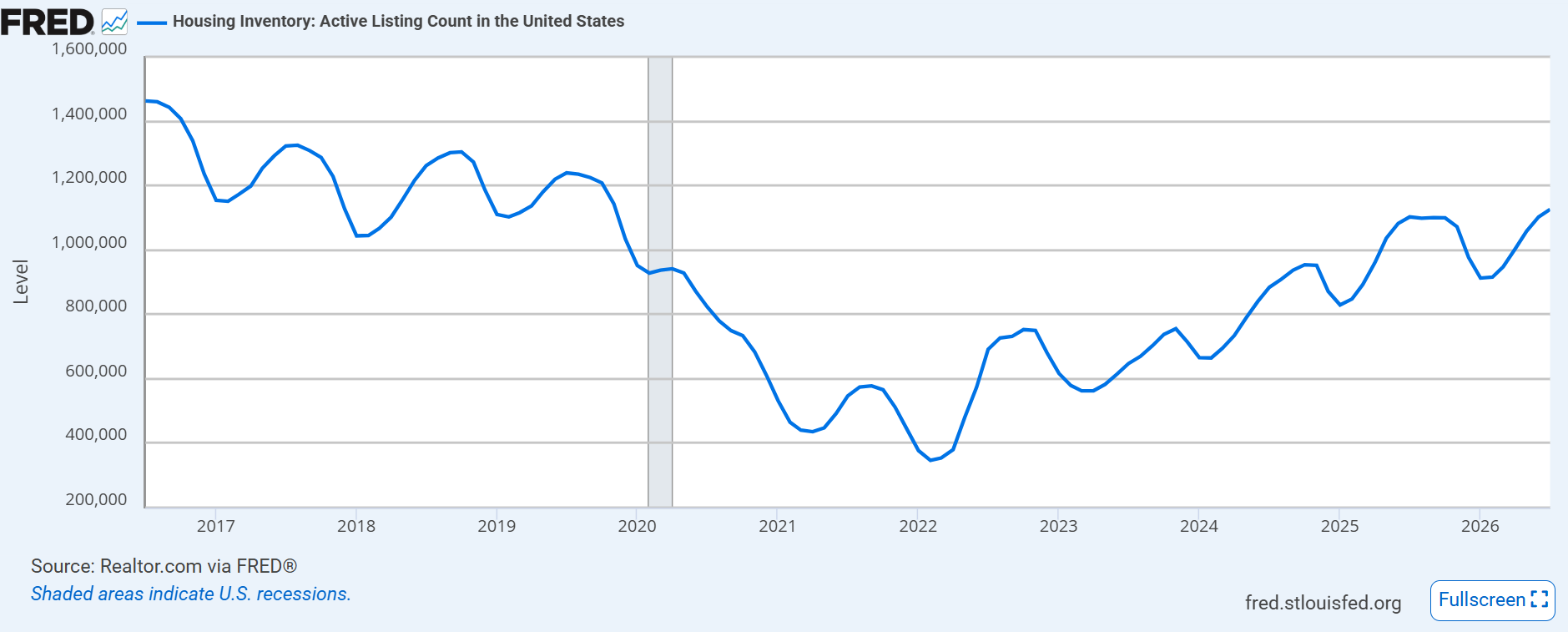
Dave:This isn’t the housing market anyone really wants. At the beginning of the year, most investors and industry professionals were hoping for a rebound in home sales and activity and maybe even price growth. Unfortunately, that hasn’t happened and it’s understandably got people frustrated, but the market isn’t as bad as it seems. In fact, new data shows encouraging signs that we may have found a floor that fears of a crash are well overblown and that demand is actually solid. Today on the show, I’m going to share with you recent data that uncovers what housing market activity looks like in June 2026 and where we’re heading the rest of the year. Plus, we’re going to talk about how things could turn around specifically about the war in Iran and what could happen with mortgage rates if a long-term peace deal is struck. This data, it can help you weather the slow market we’re in.It can also help you take advantage of the opportunities that exist when everyone else is sitting on the sidelines. This is On The Market. Let’s jump in.Hey, everyone. It’s Dave. Welcome to On the Market. Today we’re going to recap a whole slew of new housing market data that’s been published in just the last week. And this data can give us key insights into what’s happening in the spring market or what’s not happening in the spring market. As I won’t lie to you, it’s not all good, but you already know that, but it is better than I bet you think, or better at least than the headlines suggest. And today I am going to show you the complete picture. Plus, I want to talk a little bit more about what’s going on with the war in Iran and how that’s impacting the housing market. If you listened to our show last week where Jay Scott was on, we talked a lot about this. And although as of this recording, Israel and Iran are shooting rockets at one another and a peace deal remains elusive, I want to talk about how the market and specifically mortgage rates might react if a long-term deal is implemented.Let’s get to it. We’re going to start with some good news. We did a lot of frustrating headlines, not the best news on this show. That’s just where we’re at right now. But today we’re going to start with some good news and that good news is that housing demand. The amount of people who want to buy homes is positive. I know this is hard to believe, but housing demand is actually up for the year. If you look at this in a couple of different ways, you see consistently that people still want to participate in the housing market no matter what you hear elsewhere. The first way we know this is that pending sales, actual homes that are going under contract and selling are up. They’re up 9% year over year. That is a meaningful improvement from the previous year. And although it’s been very volatile this year, we’ve had good months, we’ve had bad months.This I think is pretty encouraging because we’re starting to see pending sales go up even during a time when as of this recording, market rates are like 6.6%. And so what that tells us is that even though rates have gone up, even though there’s so much noise about the economy and inflation and all this stuff and some of it’s real, that is important information. But despite that, the number of people still going out and buying homes is not just flat, it is actually up. And I personally find that encouraging. Now there’s another way that we can measure housing demand in the market and that’s by something called the Mortgage Purchase Index. So basically the Mortgage Bankers Association tracks how many people apply for new mortgages in a given week. So this doesn’t count refinances or anything like that. People are going out to buy a new home.And this is more of a leading indicator. Pending sales, the stuff I was just talking about tells us what’s actually happening. But purchase applications tells us what might be happening two or three months down the line because that’s when people apply. They apply several weeks or months before they actually go up and buy. Purchase applications year over year are up 7%. There are more people right now applying for mortgages to go out and buy a home than there were last year. And so that’s the good news I wanted to share upfront because yes, it is frustrating this market that we’re in and I know people are saying all sorts of negative things about the housing market, but this is a positive sign about the market today. And I also think it’s a positive sign of things to come because if rates do come down, if affordability does start to get better, then I can start to imagine things getting better in the housing market.It’s not going to happen quickly. It’s not going to happen all at once, but this shows that there is pent up demand that people still want to be in the market and that’s good news. With that, let’s move on to another key indicator that we have to track if we truly want to understand what is going on in the market right now and that is inventory. Inventory, if you’re not familiar, is basically just a measure of how many homes are for sale at any given point in time. And it’s so important for understanding the market because it shows us the balance between supply and demand. When inventory is going up, that means there are more sellers than buyers. That means that we’re in a buyer’s market and typically that puts downward pressure on pricing, right? Because if there are more sellers than buyers, those sellers have to compete for the buyers that are in the market and they do that by lowering prices.The opposite is also true if inventory is going down, there are more buyers than sellers and those buyers have to compete for the homes on the market and that usually pushes up prices. So that’s why we track inventory because it tells us so much in just on simple metric. And what inventory is telling us right now is that it’s basically flat. It’s actually slightly down year over year by like a percentage point or two. I would call that flat. I don’t want to nitpick these things. It’s basically flat. And I think although that’s not a sign that things are getting better anytime soon, I do think this matters a lot for our understanding of the market and helps guide both what I’m doing with my investing and what I think you should be doing with your investing. Because first and foremost, flat inventory at this point where we are in the broader economy is just another knock against this crash thesis that we hear that prices are going to go down dramatically and that we’re going to see a 2008 style crash.That’s not happening. Inventory would be rising. I was just explaining that, right? Inventory would be rising if things were moving closer to a crash and that’s not happening, right? We are not seeing inventory rise. They’re actually down a little bit. Now that means there aren’t as many good deals when inventory is down, but that means that the market is pretty stable. And actually, if you think about it, the fact that it’s trending negative means that in the last few weeks at least, we’ve gotten further away from the prospect of a crash than we were a couple of weeks ago and I don’t think we were that close to a crash then. So I think if you were worried about prices going down dramatically, at least on a national basis, this is encouraging. Of course, on a regional basis, you should be looking at inventory in your area.You can look this up for free on Redfin or Zillow or realtor.com or whatever. You can go and find this, but on a national basis, the idea that we’re moving towards a crash is just not true. The other metric similar to inventory that we should be looking at as well, something called new listings. So when I said inventory before is a measure of how many homes are for sale at any given point, that can move up and down based on both supply and demand. Inventory can go up because no one’s buying inventory can go down because people are buying a lot. It doesn’t necessarily only have to do with supply and how many people are putting their homes for sale on the market. There’s a different metric called new listings, which measures just how many people are putting their homes for sale in a given month.And that tells us a lot about sellers. It’s very targeted at what sellers are doing. And what we see right now is that new listings are up but only about four and a half percent over the last couple of months. And that’s just on a weekly basis. The week before it was down. So honestly, I would call it close to flat. If you look at the big picture about what’s happened so far in 2026, it’s not going up that mu. And to me, that tells us two things. One, that the lock in effect is still here. People are still staying in their homes. They are not motivated to be moving. And the second thing that perhaps more importantly when we’re talking, relating back to my previous point about a potential crash, is that there are no signs of forced selling in the market. I talk about this on the show a lot, but forced selling is something that would really indicate to us that a crash was coming because forced selling means people are falling behind on their mortgages and rather than being locked in, which isn’t great for the housing market, but for a seller, if you’re locked in, that’s a fine position to be in as long as you’re making your mortgage payments.But when it tips from it being a lock in effect to being worrisome about a crash is when people no longer have the choice to sell. They are being forced to sell because they’re not making their mortgage payments. They’re underwater on their mortgage. The bank is going to foreclose and there is no sign that that is happening. I have covered in recent episodes, you can go check it out. Two weeks ago I talked all about stress in the housing market and foreclosures and delinquencies on mortgage rates. We know that that’s not that bad. It’s up from pandemic lows, but it’s right about pre-pandemic levels. So there’s not a lot to worry about there. The other place we might see this is if we saw new listings start to shoot up. If we saw all of a sudden tons of people despite high mortgage rates starting to sell, that would be a little bit concerning.But again, that is not happening. And so when you look at the big picture of what’s happening in the market, it really is what I’ve been calling it for years now. It is the great stall. We are stuck. Everyone on social media or in the mainstream media, they like to predict huge dramatic swings one way or the other. Some people say, “Oh, we’re going to get massive appreciation because there’s more inflation.” No. Some people say there’s going to be a crash because inventory has gone up a little bit or mortgage rates are up a little bit. No, that is not what’s happening. We are stalled out and although that doesn’t make great headlines, that’s exactly where we are. And frankly, it’s exactly what I’ve been saying for years now was going to happen. I just say this and I do these episodes to reassure people because I get questions every single day about, is the market going to crash?Is it a good time to buy? And what I try and reinforce in these episodes is that not much has changed. For three or four years, not much has changed. If you can find good deals, you should still go out and buy them. But if you’re waiting around thinking that something is going to change dramatically where you’re all of a sudden going to get way cheaper pricing or way more affordable housing, or you’re going to see runaway appreciation and you got to buy now, that’s not what’s happening. I just want everyone to remember that, that this is the great stall and it could take years to resolve. A lot of how long it will take will depend on inflation, the war in Iran, how that impacts prices and the global economy. A lot will depend on AI fears or dreams and which one actually comes true.But as we’ve seen all of these variables, the war in Iran, inflation, AI, these are not questions that get answered easily or quickly. We’ve been doing this for four years now and we still don’t have a line of sight on when things are going to get better. And so I want to encourage people to just accept that this is where we are. Could it change dramatically in a month or two? Sure. Something crazy might happen, but people have been saying since 2022, the market’s going to crash or it’s going to start blowing up again. No, it’s been in the great stall for four years now and I would count on that for the foreseeable future. Now this isn’t negative, right? It’s neutral. I’m just saying what is. There are positive things, right? Housing demand is going up a little bit. Is it lower than normal housing demand?Yeah. Is it way lower than COVID demand? Yeah, absolutely. It’s down like 50%, but has anything changed in the last three or four years since interest rates up? Has demand really changed? No, it has remained consistent and that to me signals that way might just be at the floor. We found basically the lowest that home sales are going to go. Now I should say, like I said before, I will just reiterate, could they go lower? Yes. But I think for that to happen, for us to break through this floor that we’ve been at for four years, we basically need one of two things to happen for demand to really go down. I think one is if mortgage rates go up back above 7%, right? People seem to get sensitive. If you look at the data, people stop buying as much around 7%. They actually get sensitive more around like 6.7, 6.8.So we’re getting close to that. So if inflation keeps going up and we get above that, we could see demand go down more. The second thing that could impact demand negatively is unemployment going up. If unemployment goes up a lot, if we start to see it in the fives or 6%, we could see even slower home sales. I don’t necessarily think that means we’re going to see huge price declines, but it could slow the market even more. But as of now, that’s not happening. We got a jobs report last week that showed that hiring was strong in May and it showed that unemployment stayed steady at 4.3%, which historically is really low, even though it’s a little bit higher than where it was during COVID. So unless one of those two things happens, I think this is just where we’re at. I’m not trying to be overly optimistic about this.If you listen to this show, I’ve been saying we’re in a correction for years. I’ve been telling people it’s not going to get better for years, but I also don’t think it’s getting worse. I do think that is worth saying because there is so much negativity about the housing market and there’s some good reason for that. Affordability is super low. It is hard to make deals pencil, but it is not getting worse. And I do think that is important because for things to get better, it has to hit a bottom. And although there are some scenarios where we could see transactions go even lower, for right now it does feel like we found a bottom. And to me, that is an environment where you can invest in because it’s actually kind of stable. As an investor, I just want things that are predictable. And although the economy is so confusing, if you look back at it, the housing market has been kind of predictable for the last couple of years.I’ve been saying that we’d be in this great stall and we are and you can make decisions based on that. That is the thing you should take away from this information and this news is that this is where we’re at. It’s probably where we’re going to stay. And if you can make deals pencil with that, go do it. If you can’t, then maybe you wait. But I know people, I know many people, I personally am finding deals in this kind of market and because things are relatively stable and demand is actually going up, I feel confident that I can underwrite my deals well and I can make strong decisions about my investments and there’s really not much more you can ask for than that. So that’s the data I wanted to share with you guys, but I do want to talk about mortgage rates a little bit because I said they could go up if inflation goes up, but I also want to talk about the other direction.Could mortgage rates go down if the war in Iran ends and we get a lasting peace deal? We’re going to talk about that, but we got to take a quick break. We’ll be right back Welcome back to On the Market. I’m Dave Meyer. Before the break, we talked about housing demand and inventory, but I want to move our conversation to mortgage rates because one thing that could potentially move the market in either direction, honestly, is the war in Iran and whether or not there is a resolution. Because remember, before the war rates were in the best position we’ve seen in a while, they were right around 6%. So I went through a little bit of a thought exercise. If the war ended today, we’ve been hearing a lot about a peace deal, hasn’t materialized yet, but if it happened, would we get lower rates? Could they go back down to six?Could they go lower than that? Sort of conversely, if we don’t get a resolution, could we see higher mortgage rates and above that 7% mark I talked about earlier? Let’s dig into this because I do think, although like I said before, we are in the Great Stall, the thing that could change that and could really move the market in one way or another is if mortgage rates change meaningfully. So let’s talk about the realities of that. Just background here, rates are really comprised of two things, mortgage rates. Number one, 10 year yields. This is the yield on a US treasury. This is basically people, investors going out and lending money to the US government for 10 years and the yield is how much interest you earn on that. Right now it’s in the mid 4%. It’s about 4.6 as of this recording. Meaning if you went out, bought a treasury bill and lent money to the US government, you would earn about 4.6% on that money every year for the next 10 years.That’s one really important factor. I’m not going to fully get into why it’s so important. I’ve done other episodes on that, but just trust me for this episode, 10-year yields, super, super important. The second thing here is known as the spread and the spread is basically the amount difference between 10-year treasuries, like I just said, the yield on the 10-year US treasury and mortgage rates. So if a yield on a 10-year right now is 4.6, mortgage rates right now are about 6.6, that means the spread is 2% or 200 basis points. You may hear them described either way, basis point is one 100th of a percent. So those are the two variables, spreads in yield. So when we think about if rates could fall or go back up, we got to ask ourselves what happens with these two variables. And we’ll start with spreads because spreads have actually been the good news in the mortgage market over the last couple of years.I’m not really going to get fully into why spreads are the way they are. There could be a whole long conversation. They’re somewhat complicated, but it’s basically just investors in mortgage-backed securities weighing how valuable mortgages are compared to buying a bond. They have those two choices where they’re going to put their money and if they don’t think mortgages are good, the spread is going to go up. If they’re excited about mortgages, the spreads come down. And the people who buy this stuff, the people who buy mortgage-backed securities or invest in bonds, they’re very sensitive to inflation. And so if they have fear of inflation or rate hikes, spreads tend to go up. If inflation fears ease or monetary policy loosens, we usually get lower spreads. The good news, like I said, is that over the last couple of years, spreads have really come down a lot.It’s like basically the whole reason why mortgage rates have come down from the highs they were recently at around eight, a couple of years ago to around six before the war is because spreads have compressed. Before COVID, the long-term average from the spread was about 190 basis points. Then they shot up to about 300 in 2024 and that was largely due to the Fed’s tightening cycle. But once the Fed paused raising interest rates, inflation started to get under control a little bit, it came back down to the average, which is where we are right now around 190 basis points. You could put this another way. Basically if spreads, I know this sounds like esoteric, but if the spread hadn’t come down, rates right now would be around seven and a half instead of 6.6 where they were this morning. And getting to our question about what happens if the war in Iran ends, I think this is good news.I think that lowers inflation fear. I think it lowers fear of Fed rate hikes, which by the way, people are worried about that now. There are genuine concerns that the Fed’s going to start hiking rates again, but if the war ends, those fears will be pushed aside a little bit and spreads are probably going to stay good. So good news there. But what about yields, our second variable? This in my opinion could be harder. It will probably, if the war ended today, they would start to come down, but they will probably take a little bit longer. Yields will take longer to adjust and I think it won’t happen fully. It might come down a little bit. If there was a ceasefire announced today, we’d probably see yields fall a little bit, but we still don’t have a line of sight of when inflation is going to get under control and when the federal funds rate will start to come down.Because even if a ceasefire went into place and it was permanent today, inflation is forecasted to pick up throughout the year, even if it ended today. And so it’s not like bond investors and mortgage-backed security investors are going to snap back to their expectations before the war. Inflation is enduring. It’s still here. Hopefully we’ll get under control quickly, but until it is under control, we are not likely to see Fed rate cuts. Actually, just last week, Christopher Waller, who votes on interest rate policy, he’s normally someone who wants to lower interest rates. He changed his course and said that he thinks we need to be hawkish and really go after inflation. So the chance of Fed rate cuts has gone down a lot, that’s going to impact yields and inflation has been continuing to go up. Hopefully it will peak soon, but until it peaks and starts to come down, we’re not going to get yields coming down.So I think even if the war ended today, it will take months maybe into 2027 for rates to get back down to that 6% that we had before the war. And the longer the war goes on, the longer the recovery will take because every day of the war inflationary pressure builds. It is not a rubber band. It does not just snap back. Because oil production is down, it takes longer to boost those things back up. The fertilizer that’s been stuck in the strait of hormones for months, that goes into crops that are planted right now. So the price of those crops are going to be high until next year when there’s a new set of crops, right? It doesn’t snap back. It takes time. So this is why I say we’re in this for a while. Even if the war ended today, it’s going to be months at a minimum for rates to get back down.Now what happens if there is no seas fire if the war keeps going? I really do think things could get worse. I said a lot before about how we found the bottom. That’s sort of presuming the status quo where mortgage rates stay relatively unchanged. And because we’ve been hearing that a deal is going to come, we don’t know, but we’ve been hearing that that’s going to happen, things have sort of flattened out and stabilized for a little bit. But if inflation really starts to go a lot higher, if we start to see inflation go above four into the fives, which definitely could happen if the straight or formulas doesn’t open up, we are going to see mortgage rates go up. We will see the federal funds rate probably go up. We could hit that 7% mortgage rate I talked about before where I think we see demand start to pull back and we start to see even less activity in the housing market.Again, not a crash scenario but a slower market. I don’t know what it will do for pricing, probably put some downward pressure pricing on them, not a crash, but I think it will just slow down the market even more. And so if you’re looking at mortgage rates and you want the housing market to speed up, we should hope for a permanent solution to the conflict in Iran that will ease inflationary pressure, that will bring down bond yields, it will keep spreads where they are and will hopefully put us back on the path we were on a couple months ago to lower mortgage rates, not in the floors, but could we get back if the war ended today, could we get back to six in the next six months? I hope so. Maybe it could go even lower from there, but we need a ceasefire. We need this inflationary pressure to get out of the market for that to happen.So that’s my forecast for mortgage rates. Those are the things you should be looking at. Again, the longer the war goes on, the higher the risk to mortgage rates, the sooner it ends, the faster we can get back to lower mortgage rates. All right, we got one more thing to talk about before we get out of here and that is new construction because a lot of what happens in the broader housing market depends on construction trends. And I want to share with you some interesting information that’s going on here because there’s some opportunity here for investors. We got to take one more quick break though. We’ll be right back Welcome back to On the Market. I am Dave Meyer. We’re going to move our conversation now to new construction because we talk a lot mostly on the show about the existing home sales market because that’s the majority of the market, right?It’s somewhere between 80 and 90% of the market, but a lot of what happens does depend on construction trends. It’s not as important as inventory or new listings for what’s going on in the next month or maybe even in the next years because construction, super slow moving boat, right? But it does matter in the big picture because it really will tell us how well the country as a whole reacts to the current supply shortage that we have. It will tell us how the market evolves as our population stagnates and likely starts to decline. That stuff really depends on construction trends. So following this stuff really does matter. New construction also can make for really good buys right now for certain types of investors. Depending on your strategy, it can make for really good buys. So I want to share with you just a little update on what’s going on with new construction.So big picture, we’ve talked about this, but there’s an estimated housing shortage in the United States somewhere between one and 10 million. That is a big range. I know the White House says it’s 10 million. That’s a lot bigger than most other estimates that I’ve seen. Freddie Mac estimates about 3.7 million, realtors pretty similar. The National Association of Home Builders notably. On the low end, they estimate a modest 1.2 million unit shortage. So the question I often get, and it’s a good question, is if there is a shortage, then why aren’t builders building more? Why don’t we just have that massive construction drive in this country and solve the supply shortage once and for all? Because a lot of people believe that if you just built more homes, home sales would pick up. We’d get off this floor I was talking about. The housing market will cover, that will contribute to GDP.More people will become homeowners and everyone is happy, but that is not how it works, right? Builders are not philanthropists. They are private companies. They build when the margins are there and they stop when they’re not. And even if they could, builders wouldn’t just go out and build five million homes even though there’s a shortage. It’s not like there are five million people looking to buy homes today. That shortage is broad, but like circumstances and affordabilities limit the amount of demand at any one given point in time. And these companies are super sophisticated and are good at forecasting how many people want to buy a new home at any given time, even if there’s a supply shortage. I know it’s a little confusing, but these two things can and do exist at the same time. You can have too much new construction at any given month or any given week.Well, big picture, we may not have enough units to meet the full demand over the next several years for the entire United States population. So what are builders up to? The short answer is we’re back to pre-pandemic levels. There was a building boom during the pandemic. There was so much demand for housing. These companies that are good at forecasting were like, “Hey, we’re going to start building as much as we can. ” They’re often sitting on land, sitting on materials, and they just start building more and more. And a lot of people thought during COVID that this was going to be the beginning of a great American construction boom that would lead to the end of the shortage, but that is not really materializing. Like I said, new construction, at least on single family homes, has come back down to pre-pandemic levels. Now that’s not terrible because that’s higher than it was in the 2010s because in 2010s it was awful.We had really, really low building, which is what made this shortage in the first place. But even though we’re at pre-pandemic levels, even in 2019, that was below most of where we were in the 80s and the 90s and the early 2000s. We’re actually seeing right now the number of homes completed and actually put for sale on the market is down. It’s down 7% year over year because this probably isn’t a surprise to you, but builders and new construction is kind of getting hammered right now, right? Prices are down for existing homes five to 6%. So they’re in a way bigger correction than existing homes. Builders, if you look at inventory, months of supply for new homes, way, way higher than it is for existing homes. So builders who need to sell their homes quickly to take that money and build new homes, they’re sitting on a lot of inventory which is very expensive.And at the same time, construction costs have gone up with tariffs and general inflation. This is a trifecta that is not good for builders. Prices being down, construction costs being up and already having a lot of inventory that they’re sitting on. Would you build in a situation like that? I don’t think so. I mean, even the small builders I know aren’t really building. I’m talking to James Daynert, co-host on this show. He does everything. He flips, he builds, he buys rentals and he said that the part of his business that’s doing the worst is building right now. So it’s not just the big Toll Brothers or D.R. Horton, it’s everyone is struggling to build. And I don’t think this is going to change. There are lead indicators, there are confidence surveys that the National Association of Home Builders puts out and they don’t look good.Home builder confidence remains extremely low. Their outlook for the next six months remains extremely low. They track things like prospective buyers who are coming to open houses. That remains extremely low. So what we’re going to see is lower construction for new homes. And here’s what this means for you as a real estate investor. Number one, try to get a screaming deal from a builder. That is something you can absolutely do right now to move that inventory that builders need to move. They’re doing rate buydowns. They’re doing seller concessions. They begrudgingly will even lower the price if they want to. If you’re negotiating for these things, try and get rate buydowns and seller concessions. They really don’t like lowering prices because that lowers comps for all of their other homes, but they might be willing to do that. Of course, don’t just go out and buy any of these things because they’re sitting on the market.So the prices could go down more in the future. So make sure if you’re going to do this, and I really do think this is a good opportunity, make sure they’re in good locations and that there’s demand for rentals because if a lot of them are sitting vacant, you’re not going to be able to rent that out easily. But if you buy in good locations, if you buy in areas of high demand and you can get good concessions from builders, there are great opportunities out there. So that is something people should think about. You can get lower prices. You can get lower rates. You can get lower CapEx and maintenance because it’s a brand new property. And if you can buy in a good location, that can be pretty darn compelling. So think about it. The other thing is, and this is kind of the theme of the episode, is less construction overall going into the next few years sort of puts a little bit of a floor on the market.It sort of limits how far prices can go. Now, of course, there’s always black swan things, but just assuming nothing absolutely insane happens, this helps stabilize the price of existing homes. If builders are putting less inventory on the market, it means overall inventory. When you combine existing homes, which is the stuff we talked about before, if we combine that with new home inventory, it’s overall lower. So even if demand slips, for example, if there’s less new construction inventory, that can get partially offset because there is less total inventory. Or if demand stays the same, you will probably see prices get a little bit firmer because you are not competing against as much new construction. So that’s an important thing to remember as you manage your own portfolio. The third thing, and this is probably self-evident at this point, but I’m just going to say it, be careful in new development.It can truly be an amazing way to make money, don’t get me wrong, but it’s risky right now. New construction prices, like I said, they’re dropping, costs are going up. So if you’re going to do it, you better get the land, you better get that dirt pretty cheap because everything else is kind of conspiring against you. If you can find a great deal, great, but don’t push for new construction just because a lot of people are talking about it on social media or a lot of your friend’s uncle is doing it. Make sure that you understand the fundamentals of this industry. It is hard. It takes a long time and even the big guys are struggling to do it profitably right now. So be very careful if you’re going to go out and do this yourself. All right everyone, that is our show for today.Thank you so much for watching this episode of On The Market. I’m Dave Meyer. I’ll see you next time.
Help us reach new listeners on iTunes by leaving us a rating and review! It takes just 30 seconds and instructions can be found here. Thanks! We really appreciate it!
Interested in learning more about today’s sponsors or becoming a BiggerPockets partner yourself? Email [email protected].