

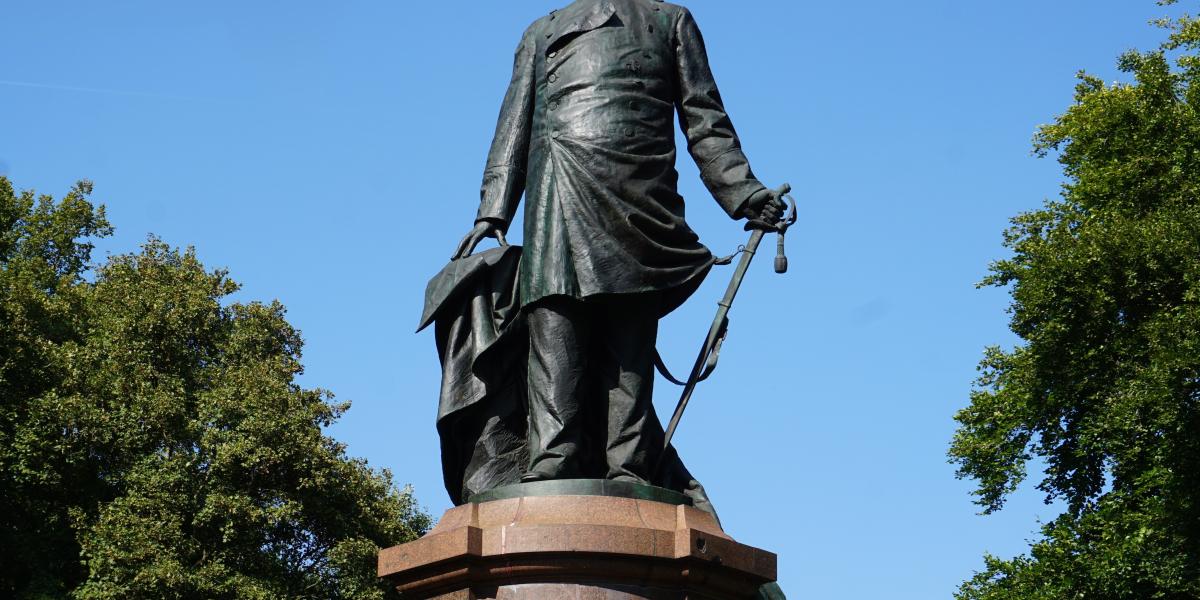
There are two types of human beings in this world: those who wait for someone to tell them what to do, and those who build structures that force the world to move at their rhythm. Modern state-monopolized education is engineered exclusively for the former. The contemporary school system operates as a direct administrative descendant of the nineteenth-century Prussian factory model.
As Murray Rothbard detailed in Education: Free and Compulsory, King Frederick William III designed this paradigm to produce obedient soldiers and compliant civil servants. It treats individuals as homogeneous inputs on an assembly line, penalizing independent critical analysis and rewarding intellectual docility. To break this cycle of dependency and recover individual liberty, we must completely separate school and state.
In my book Panorama de un Estado, I warned that the centralized educational apparatus is not an engine of enlightenment, but a tool for manufacturing obedience and dependency. More than half of the youth in Latin America and the Caribbean cannot comprehend what they read, yet governments continuously expand their regulatory reach under heavily-politicized funding schemes. This systemic failure is not an accident; it is by design. The state curriculum treats knowledge as a static commodity to be injected via rote memorization, stripping education of its practical, value-generative context. This structural manipulation actively conditions the developing mind to seek validation from a central planner, transforming potential independent market producers into risk-averse cogs who view the free market with deep institutional suspicion.
To de-Prussianize education, we must return to first-principles thinking and Austrian praxeology. As Ludwig von Mises masterfully argued in Human Action, all purposeful human action is driven by an individual’s desire to alleviate felt uneasiness. Therefore, true education cannot begin with isolated data points. Following the framework popularized by modern market innovators like Elon Musk, we must understand the “trunk” of reality before adding the branches and the leaves. In a sovereign educational architecture, this trunk consists of five non-negotiable pillars:
Self-Knowledge: Understanding one’s natural talents and subjective utility scale;Critical Thinking: The analytical armor required to dissect state rhetoric and reject institutional manipulation;Economic Freedom: The technical mastery of money, asset creation, and financial capital;Physical and Mental Discipline: The stoic subjugation of short-term impulses in pursuit of long-term wealth accumulation;Technology and Global Code: Dual fluency in digital architecture and global languages to bypass geopolitical barriers
True wealth is an internal state of evolution that determines what an individual is capable of creating, sustaining, and multiplying. Most people advance without a defined destination, falling into what I define as the lower tiers of personal development: Level 1 (survival without purpose, relying on hollow diplomas) and Level 2 (the illusion of progress, trapped by Parkinson’s Law where expenses grow alongside income). True education must elevate human consciousness to Level 3: the creator elite. These are the individuals who practice rational action, building private systems, solutions, and assets without expecting a state rescue.
The persistent interventionist claim that specialized education requires public management is a severe economic fallacy. In an unhampered market, high-performance human capital can be completely privatized through closed-loop corporate architectures. This is the exact operational matrix I have institutionalized through Helping Security Binet and its Bilingual & Business School Binet.
When a private business ecosystem integrates its own self-sustaining training structures, education ceases to be a net extraction of capital and becomes an appreciate-yielding asset. By funding development directly from operational surpluses and training personnel under a unified ethical framework, private enterprise establishes a robust competitive moat that renders state qualifications totally obsolete.
Ultimately, civilizational liberty will only be secured when the state is stripped of its educational monopoly. The ruling aristocracy will never willingly utilize its apparatus to teach citizens to question political privilege or outgrow the welfare state. True prosperity demands that we abandon the political machinery and build private, resilient alternative structures. We do not train docile employees or obedient pieces of a broken gear; we forge leaders who construct their own economy. When the youth are educated for sovereignty and not for submission, the myth of the state collapses under its own bureaucratic weight. The future does not belong to the cogs of the Prussian apparatus; it belongs to the sovereign individuals who have the clarity to construct their own freedom.





















