No Result
View All Result
  • Login
Wednesday, September 9, 2026
FeeOnlyNews.com
  • Home
  • Business
  • Financial Planning
  • Personal Finance
  • Investing
  • Money
  • Economy
  • Markets
  • Stocks
  • Trading
  • Home
  • Business
  • Financial Planning
  • Personal Finance
  • Investing
  • Money
  • Economy
  • Markets
  • Stocks
  • Trading
No Result
View All Result
FeeOnlyNews.com
No Result
View All Result
Home Markets

AI Is Changing the Definition of Privacy

by FeeOnlyNews.com
3 months ago
in Markets
Reading Time: 5 mins read
A A
0
AI Is Changing the Definition of Privacy
Share on FacebookShare on TwitterShare on LInkedIn


In our last issue, I talked about how researchers recently found that ordinary Wi-Fi routers could identify individuals with 99.5% accuracy.

But that shocking revelation only hints at a much bigger privacy concern.

Cities around the world are beginning to fill themselves with connected technology designed to make daily life run more smoothly.

We call them “smart cities.”

Places where traffic lights adjust automatically, sensors reduce congestion and connected streets help emergency responders react faster. Some systems can even direct drivers to the nearest open parking spot before they start circling the block.

But all this tech-driven convenience is creating an entirely new challenge:

Who owns all the information these systems create?

AI is changing the answer.

And as it becomes even more powerful, privacy could soon mean something very different than it does today.

The Privacy Problem Comes to Town

One of the most famous smart city experiments started in Toronto.

In 2017, Sidewalk Labs, a sister company to Google, announced plans to help build a futuristic neighborhood along the city’s waterfront.

Image: Waterfront Toronto

The idea was to use sensors, connected infrastructure and data to make urban life cleaner, safer and more efficient.

On paper, it sounded like exactly the kind of project cities should want. It promised less traffic, lower energy use, better public transit and more efficient buildings.

But the project quickly ran into a problem that had nothing to do with whether the technology worked.

Instead, people wanted to know what would happen to all the data these systems collected. Ann Cavoukian, Ontario’s former privacy commissioner, even resigned as a consultant after raising concerns that the project wouldn’t require data to be de-identified at the source.

That concern eventually helped derail the project.

That concern eventually helped derail the project.

And it highlights something investors should pay attention to.

Building smarter cities is hard. Building them while protecting privacy may be even harder.

If a city can collect data from traffic cameras, parking sensors, public Wi-Fi, streetlights and connected buildings, then privacy has to be built into the system from the beginning.

Depending on the estimate, the global smart cities market is already approaching $1 trillion. And it could grow dramatically over the next decade.

Some estimates project smart city growth to reach as high as $3.8 trillion by 2030.

Turn Your Images On

Image: grandviewresearch.com

But cities are already spending serious money to become more connected, more automated and more data-driven.

And I’m not saying that’s a bad thing.

A city that understands traffic flow can reduce congestion. A city that monitors water systems can catch leaks before they become disasters. A city that tracks energy use can lower waste. And a city that uses sensors to monitor bridges, roads and public infrastructure can spot problems before they become dangerous.

That’s the promise of smart cities.

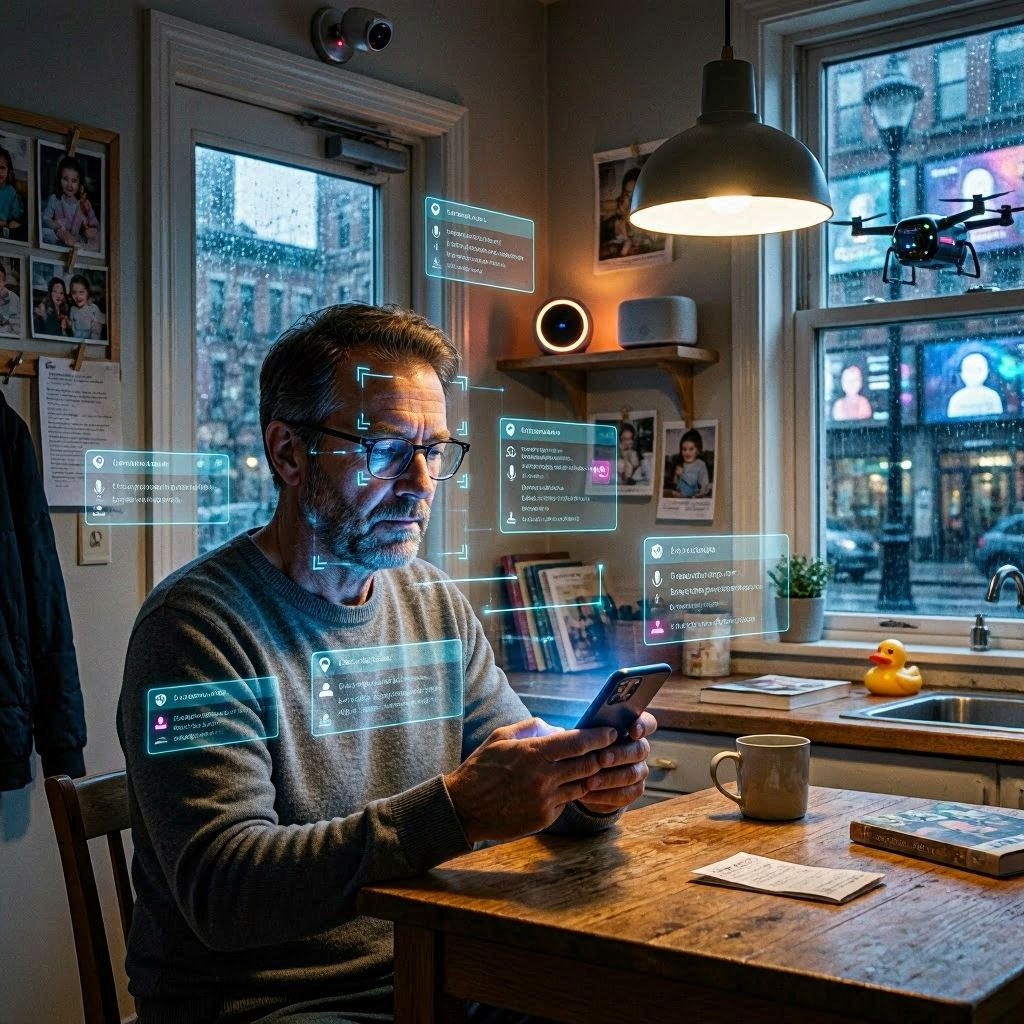
But AI adds a new layer of complication. Because older systems mostly collected information.

AI can interpret it. And that makes a huge difference.

A camera used to simply record video. Now AI can scan that video for license plates, faces, movement patterns or unusual behavior.

A traffic sensor used to count cars. Now AI can connect thousands of individual observations into a detailed map of how people travel, work and live.

A connected building used to track energy use. Now AI can learn when people arrive, where they gather and how they move through the space.

In other words, AI doesn’t just help cities collect more data. It helps them turn ordinary activity into information.

And that’s increasingly becoming a privacy concern.

Flock Safety, a company that makes automated license plate reader cameras, is one of the most visible examples. Its cameras are designed to help police identify stolen vehicles, wanted suspects and cars connected to crimes.

Turn Your Images On

Image: Sumner Police Department Facebook page

Obviously, that sounds like a good thing at first blush. But across the country, some communities are pushing back on implementing these systems.

California cities including Mountain View and South Pasadena have paused or shut down Flock systems amid concerns regarding misuse, immigration enforcement and public trust.

In Bandera, Texas, a town of about 900 people, the city council recently voted to terminate its Flock contract after months of privacy concerns and public opposition.

And at least 53 other jurisdictions across 20 states have discontinued similar AI-driven surveillance systems in recent months.

That proves the privacy debate isn’t only happening in big cities filled with activists and tech lawyers.

It’s happening in small towns too.

I’ve been watching this trend for years.

Back in 2019, I recommended Verra Mobility (Nasdaq: VRRM) to my Strategic Fortunes readers. The company helps build and operate the connected transportation networks that are becoming a key part of smarter cities. We eventually exited the position with a gain of around 24%.

Today, AI is building on top of that same infrastructure.

And I believe the opportunities this creates could be much bigger.

Here’s My Take

Smart cities create information in the background.

When you drive past a camera or walk through a train station or enter a building filled with sensors, you may not even be aware that you’re sharing anything.

But the system is still learning from you.

As cities continue filling themselves with connected infrastructure, sensors and intelligent systems, privacy may no longer just be about protecting the information we intentionally share.

It may become about protecting our information from the environment around us.

And solving that problem may create one of the fastest-growing new technology markets in the world.

In our next issue, I’ll show you just how big that opportunity could become.

Regards,

Ian King's SignatureIan KingChief Strategist, Banyan Hill Publishing


Source link

Tags: ChangingDefinitionPrivacy
ShareTweetShare
Previous Post

10 Benjamin Graham Stocks With High Dividend Yields

Next Post

6 Markets Where You Can Launch a Real Estate Investment Career With Homes Under $300,000

Related Posts

All signs are pointing to the total and imminent collapse of the United States housing market.

All signs are pointing to the total and imminent collapse of the United States housing market.

by FeeOnlyNews.com
August 7, 2026
0

All signs are pointing to the total and imminent collapse of the United States housing market.What is about to happen...

Cities holding up to 3 million people found under Amazon rain forest

Cities holding up to 3 million people found under Amazon rain forest

by FeeOnlyNews.com
August 7, 2026
0

Archaeologists have officially discovered a massive, completely lost ancient civilization hidden deep beneath the Amazon rainforest using advanced LiDAR laser...

nLIGHT Releases Q2 2026 Financial Results

nLIGHT Releases Q2 2026 Financial Results

by FeeOnlyNews.com
August 7, 2026
0

AlphaStreet Newsdesk powered by AlphaStreet Intelligence LASR|EPS $0.15 vs $0.14 est (+7.1%)|Rev $82.6M|Net Loss $1.3M Q2 2026 non-GAAP earnings at...

The  Burrito Debate Reveals GOP’s Affordability Rift

The $20 Burrito Debate Reveals GOP’s Affordability Rift

by FeeOnlyNews.com
August 7, 2026
0

Sometimes a burrito isn’t just a burrito. What started as a complaint about a $20 burrito has turned into one...

Doximity shares double. Here’s what’s driving it 

Doximity shares double. Here’s what’s driving it 

by FeeOnlyNews.com
August 7, 2026
0

Doximity at the New York Stock Exchange for its initial public offering on June 24, 2021.Source: NYSEShares of medical platform...

E.W. Scripps Q2 2026 Loss Widens to -.68/Share, Revenue Down 9%

E.W. Scripps Q2 2026 Loss Widens to -$12.68/Share, Revenue Down 9%

by FeeOnlyNews.com
August 7, 2026
0

AlphaStreet Newsdesk powered by AlphaStreet Intelligence SSP|Loss Per Share $12.68 vs -$0.40 est (-3070.0%)|Rev $490.4M|Net Loss $1.15B Stock $2.95 (+2.8%)...

Next Post
6 Markets Where You Can Launch a Real Estate Investment Career With Homes Under 0,000

6 Markets Where You Can Launch a Real Estate Investment Career With Homes Under $300,000

FTX Co-Founder Bankman-Fried Requests Trump Pardon–FTT Soars 45%

FTX Co-Founder Bankman-Fried Requests Trump Pardon–FTT Soars 45%

  • Trending
  • Comments
  • Latest
Bitcoin and ethereum prices today, Friday, August 7, 2026: Crypto prices moving higher following July jobs report

Bitcoin and ethereum prices today, Friday, August 7, 2026: Crypto prices moving higher following July jobs report

August 7, 2026
MEXC Lists Ondo Yield Asset As Tokenized Treasury Demand Grows

MEXC Lists Ondo Yield Asset As Tokenized Treasury Demand Grows

July 3, 2026
Delek Logistics Partners Reports alt=

Delek Logistics Partners Reports $0.54 EPS for Q2 FY26

August 5, 2026
Onkure Therapeutics Releases Q2 2026 Financial Results

Onkure Therapeutics Releases Q2 2026 Financial Results

August 4, 2026
Thryv outlines M run-rate savings while revising 2026 SaaS adjusted EBITDA to M-M (NASDAQ:THRY)

Thryv outlines $60M run-rate savings while revising 2026 SaaS adjusted EBITDA to $42M-$44M (NASDAQ:THRY)

August 4, 2026
My Thoughts on Going All In

My Thoughts on Going All In

August 4, 2026
Advanced Micro Devices (AMD) Price Prediction: How Much a ,000 Investment Could Be Worth by 2031

Advanced Micro Devices (AMD) Price Prediction: How Much a $5,000 Investment Could Be Worth by 2031

0
Cities holding up to 3 million people found under Amazon rain forest

Cities holding up to 3 million people found under Amazon rain forest

0
Republican Party Displacement | Mises Institute

Republican Party Displacement | Mises Institute

0
Bybit Uses Tokenised Equities as Underlyings for Structured Yield

Bybit Uses Tokenised Equities as Underlyings for Structured Yield

0
Explained: How BSE traded fewer contracts after CAS but premiums rose 75% in first week

Explained: How BSE traded fewer contracts after CAS but premiums rose 75% in first week

0
Vaxart outlines Phase IIb COVID-19 top line data in first half of 2027 backed by BARDA funding (OTCMKTS:VXRT)

Vaxart outlines Phase IIb COVID-19 top line data in first half of 2027 backed by BARDA funding (OTCMKTS:VXRT)

0
Advanced Micro Devices (AMD) Price Prediction: How Much a ,000 Investment Could Be Worth by 2031

Advanced Micro Devices (AMD) Price Prediction: How Much a $5,000 Investment Could Be Worth by 2031

August 8, 2026
Republican Party Displacement | Mises Institute

Republican Party Displacement | Mises Institute

August 8, 2026
Vanguard Chief Economist: AI and jobs, still in an ATM phase

Vanguard Chief Economist: AI and jobs, still in an ATM phase

August 8, 2026
Explained: How BSE traded fewer contracts after CAS but premiums rose 75% in first week

Explained: How BSE traded fewer contracts after CAS but premiums rose 75% in first week

August 8, 2026
Democrats’ Affordability Message Misses a Key Expense—Student Debt

Democrats’ Affordability Message Misses a Key Expense—Student Debt

August 8, 2026
Banks or NBFCs? DSP’s Preethi R S explains where she sees the best opportunities

Banks or NBFCs? DSP’s Preethi R S explains where she sees the best opportunities

August 8, 2026
FeeOnlyNews.com

Get the latest news and follow the coverage of Business & Financial News, Stock Market Updates, Analysis, and more from the trusted sources.

CATEGORIES

  • Business
  • Cryptocurrency
  • Economy
  • Financial Planning
  • Investing
  • Market Analysis
  • Markets
  • Money
  • Personal Finance
  • Startups
  • Stock Market
  • Trading

LATEST UPDATES

  • Advanced Micro Devices (AMD) Price Prediction: How Much a $5,000 Investment Could Be Worth by 2031
  • Republican Party Displacement | Mises Institute
  • Vanguard Chief Economist: AI and jobs, still in an ATM phase
  • Our Great Privacy Policy
  • Terms of Use, Legal Notices & Disclaimers
  • About Us
  • Contact Us

Copyright © 2022-2024 All Rights Reserved
See articles for original source and related links to external sites.

Welcome Back!

Sign In with Facebook
Sign In with Google
Sign In with Linked In
OR

Login to your account below

Forgotten Password?

Retrieve your password

Please enter your username or email address to reset your password.

Log In
No Result
View All Result
  • Home
  • Business
  • Financial Planning
  • Personal Finance
  • Investing
  • Money
  • Economy
  • Markets
  • Stocks
  • Trading

Copyright © 2022-2024 All Rights Reserved
See articles for original source and related links to external sites.