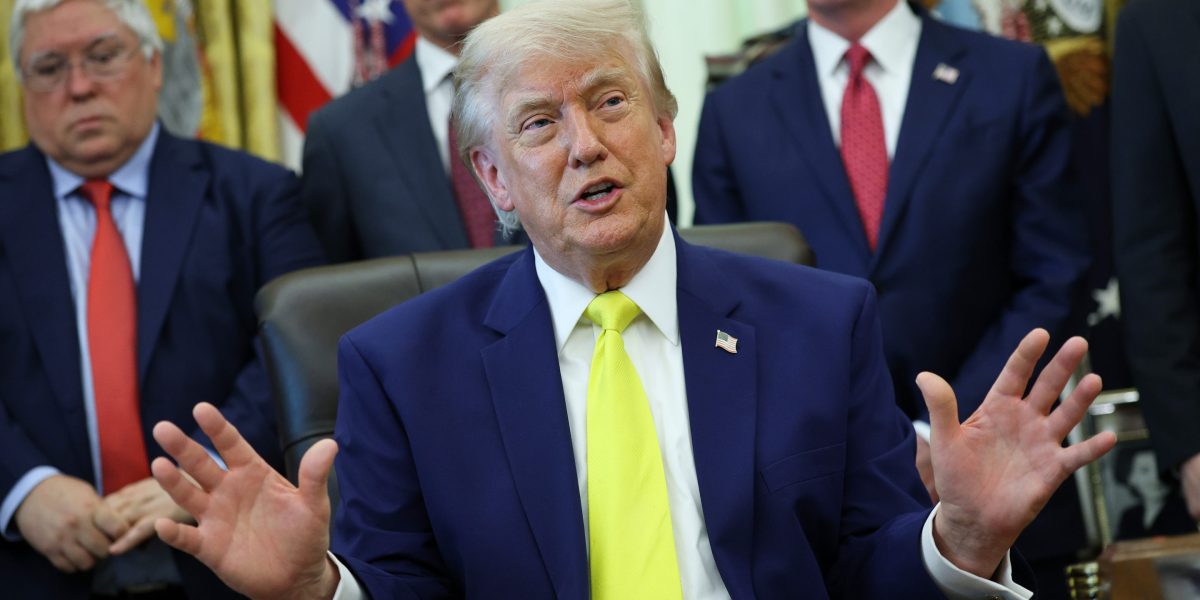
The strangest political convergence of 2026 just got stranger. Donald Trump said Friday that the U.S. government may take direct equity stakes in AI giants like OpenAI, Anthropic, and xAI — essentially endorsing the populist logic that Sen. Bernie Sanders articulated just days earlier, and validating the fears that have been building inside his own MAGA base for months.
“You make them a partnership in this revolution,” Trump told reporters Friday. “It would be a beautiful thing.”
The MAGA revolt no one saw coming
For months, Trump tried to hold two contradictory positions simultaneously: champion of AI deregulation and defender of American workers threatened by AI disruption. That tension is snapping under pressure from an unlikely combination of forces — his own base, a Vermont socialist and Silicon Valley CEOs who read the writing on the wall before their own allies did.
Steve Bannon’s War Room has been running episode after episode attacking AI companies for copyright theft, algorithmic job destruction, and the concentration of civilization-altering power in the hands of a handful of unelected technologists. Republican strategists were watching polling showing mounting disquiet about AI among MAGA voters in real time. Republican lawmakers had tried repeatedly to introduce legislation constraining the industry on job losses and child safety grounds — and been rebuffed by the White House each time.
Meanwhile, Anthropic issued a stark public warning this week that its systems are advancing so rapidly they may soon be capable of self-improvement without human oversight, joining forces with archrival OpenAI in asking for more safeguards from Congress.
Trump’s response has been a June 2 executive order asking — not requiring — AI companies to voluntarily submit advanced models to a 30-day government review before public release. Trump had bailed on signing another, reportedly stronger, order weeks earlier. But this all may be a prelude to a giant taxpayer investment in massively unprofitable startup companies that are set to have mega-IPOs later this year.
Sanders lit the match — was Altman building the fire?
The political moment Sanders seized this week had actually been in the making for months. As first reported by Notus and confirmed by the Wall Street Journal and Financial Times, OpenAI CEO Sam Altman had been privately pitching the idea of a government ownership stake to administration officials well before Sanders went public, and had outlined in April a formal proposal for a U.S. public wealth fund to give citizens a stake in AI-driven economic growth. The FT also reported that Altman has since spoken directly with Sanders about the overlapping frameworks and was in Washington this week meeting with lawmakers and Trump administration officials.
Sanders’ June 2 announcement of the American AI Sovereign Wealth Fund Act presented a bill that would impose a one-time 50% equity tax on the stock of the largest AI firms — payable in shares, not cash — channeling the proceeds into a public fund granting ordinary Americans voting rights, corporate board representation, and financial dividends from AI’s gains. “The trillions created by AI should be used to improve the lives of all of us,” Sanders wrote in a New York Times op-ed.
The proposal drew immediate fury from David Sacks — Trump’s former AI and crypto czar. “Nationalization of AI will accelerate the corporate-government fusion we’re already sliding toward,” Sacks wrote Friday morning. “America won’t win the AI race if we beat China but end up with a CCP-style social credit system in the U.S.” Hours later, Trump effectively endorsed the premise anyway.
Close watchers of the Trump White House are less surprised, as he has been nationalizing sections of the economy at an unprecedented rate for a Democrat or a Republican. The Cato Institute estimates the Trump administration already holds ownership stakes in roughly 20 private companies — via equity, warrants, and “golden” shares — spanning mineral firms like MP Materials, semiconductor companies like Intel, and quantum computing players like IBM and GlobalFoundaries. AI would be the next entry on a list that has been quietly growing since January 2025.
A beautiful thing — for whom?
Before taxpayers celebrate becoming AI shareholders, there’s a number worth examining: $44 billion. That’s how much OpenAI’s own internal documents project it will lose between 2023 and 2029, with a $14 billion loss projected for 2026 alone, The Information reported. Meanwhile, Elon Musk’s xAI lost $6.4 billion from operations on just $3.2 billion in revenue in 2025 — spending $2 for every $1 brought in — and that gap is widening.
Anthropic is the lone partial exception: the company is on pace for its first profitable quarter, with annualized revenues approaching $47 billion as of May, a 47-fold increase from early 2025. But even Anthropic’s profitability remains fragile, built on a cost structure that has already consumed billions in training expenses.
The question neither the White House nor Capitol Hill answered Friday is the obvious one: a stake in companies burning tens of billions of dollars a year is not a sovereign wealth fund — it’s a bailout in a blazer. Sanders’ proposal would at least collect equity before the cash burn continues, via the stock tax.
Palantir’s Alex Karp warned his peers in an appearance on TBPN this week that “the momentum is on the side of people who want to nationalize” these AI frontier labs. “Too many of us are chill, waxing like, ‘oh, like nationalization. It can’t happen. America would never do that.’”
Karp said he started calling “the titans of this world,” presumably the big tech CEOs: “I’ve been telling them for six months we’re going to be nationalized.” Without saying it explicitly, he bemoaned the practice of AI washing, or laying off workers and blaming AI for it and getting a stock-price bump from investors. The political anxiety has a quantifiable foundation. Tech layoffs in 2026 have already surpassed 142,000, with several companies citing AI investment as the reason. Meanwhile, software developer employment for workers aged 22 to 25 has fallen roughly 20% from its 2024 peak.
“We have to be very careful to be more disciplined on the corporate side,” Karp said. “Like if you run around saying AI allowed you to fire two-thirds of your workforce and you did it because maybe your competitor’s kicking your ass … you might as well just go sign up for Bernie Sanders’ manifesto.”
“These things are very, very explosive,” he added. “The American people sense that there is something dangerous here.”
For this story, Fortune journalists used generative AI as a research tool. An editor verified the accuracy of the information before publishing.