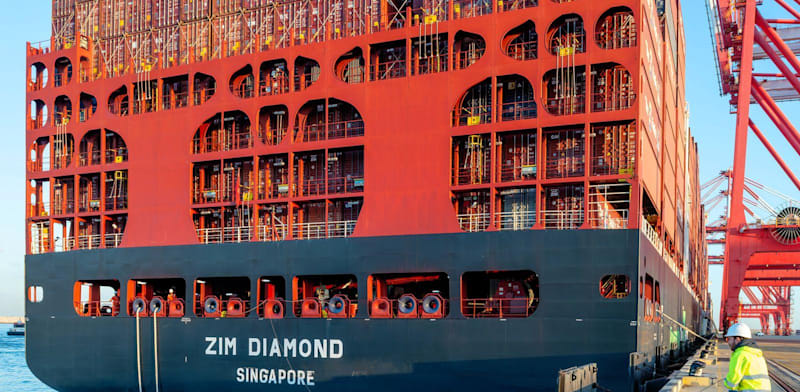
The share price of Zim Integrated Shipping Services (NYSE: ZIM) unexpectedly jumped 9.5% on Wall Street yesterday on a high trading turnover. The reason was reports on Israeli websites about a “dramatic offer that changes the picture” by Israeli businessman Haim Sakal who had told ZIM Chairman Yair Seroussi that he is interested in acquiring the shipping company for $4.5 billion in cash. This would be much higher than the $4.2 billion joint offer by Hapag-Lloyd and FIMI fund, which was approved last week at ZIM’s shareholders’ meeting by an overwhelming majority.
In addition to the question of timing, the submission of the bid by Sakal (whose has been unavailable for a response) raises a number of other issues, related mainly to his ability to finance such a huge deal, and also to ZIM’s legal possibility of accepting it, after the shareholders had already approved the Hapag-Lloyd deal.
ZIM said, “ZIM’s board of directors has signed a binding agreement to merge ZIM with the Hapag-Lloyd shipping company, and the agreement was approved by a majority of 97% of the shareholders last week. The deal is binding on the company.”
Sakal’s big appetite
Reports on Sakal’s ZIM bid and his ability to obtain financing follow reports earlier this week that he is eyeing acquisition of control of Arkia Airlines from the Nakash brothers.
Haim Sakal (55) is the son of Solly Sakal, who, together with his brother Meir, founded the Sakal Group, which imported and marketed consumer goods and operated fashion, sports and electronics retail chains. The Group previously held the franchise for duty-free stores. Sakal has an indirect historical connection to ZIM: the Group’s Layam company, which supplied equipment and services to ships, was acquired in 2002 from ZIM, which was then controlled by the Israel Corporation.
In 2005, the Skaal Group collapsed, partly due to a delay in the opening of Ben Gurion Airport in 2000 and the Second Intifada. Haim Sakal was then vice chairman of the Group, which was sold in 2018 to Teddy Sagi for $40 million. Over the years, the Group has repaid hundreds of millions of shekels in debts to banks, and the sale of its duty-free activities in 2018 was intended to help it repay the debt. In an interview with “Globes” in 2015, Sakal spoke about the difficult years: “As a person, and also as a family, we were raised to stand behind our obligations. It was clear to us that if it was the house or standing behind the obligations, we stand behind the obligations and move to renting an apartment, plain and simple.” He added at the time about the crisis in the group: “We reduced our activity from a billion shekels to zero within a day,” but “the suppliers immediately received all their money, and we did not ask for a reduction of a shekel from the debt.” Later, Sakal set up a luxury brand retail complex and marketed international brands. .
RELATED ARTICLES
ZIM CEO Eli Glickman quits over failed bid
Hapag-Lloyd, FIMI sign $4.2b ZIM acquisition deal
An offer that sounds too good
How do we get from here to offers for huge acquisitions of a multi-billion dollar shipping company and an airline? The letter from Sakal to the ZIM board of directors that was leaked did not provide details on how the deal would be financed, whether and who Sakal’s partners are etc. A spokesperson for Sakal did not provide further details, and Sakal himself is unavailable for comment.
According to the details sent to the ZIM chairman, the offer is for $37.5 per share in cask (higher than the $35 in the Hapag-Lloyd and FIMI deal). The financing has been arranged, but no details have been provided. Sakal is also offering $250 million for the benefit of employees and in recognition of their contribution. The workers’ committee issued a statement welcoming the offer, and a spokesperson on its behalf wrote that it is a significant expression of trust in the company, its activities and its employees, and that it is an improvement in terms of value and in conditions for the employees.
Workers committee chairman Oren Caspi told “Globes” that the employees were surprised by the offer, and that they were not contacted by Sakal, so he does not know how serious the offer – which sounds too good to be true – is. But he believes it is a positive move that shows the government that there is an “Israeli alternative” to the Hapag-Lloyd and FIMI offer. The government has a “golden share” in ZIM to preserve the state’s interests. Completing the deal requires state approval, and the process has already begun but will take several months.
The board of directors has no discretion
The deal approved last week divides ZIM into two companies, with the Israeli operations (including responsibility for meeting the conditions of the golden share) remaining in the hands of the “new ZIM” that will be owned by the FIMI fund, headed by Ishay Davidi. FIMI previously said in a discussion in the Knesset Economic Affairs Committee that the sale of FIMI would only strengthen the state’s position, and create a large, strong and stable Israeli shipping company that would meet all the requirements of the State of Israel and would be profitable from day one. Furthermore, as Davidi said in the same discussion, “ZIM is traded in New York today without a controlling shareholder, and tomorrow someone could buy 20% of the company without asking anyone, it could be any party” – that is, even parties hostile to the State of Israel.
Another issue that emerges from ZIM’s reports is that in the event of cancellation of the deal with Hapag-Lloyd and FIMI following receipt of a superior offer, the company (or the new buyer) will pay a fine of $150 million to the buyers whose deal is canceled. But that was true until the approval of the shareholders’ meeting last week. Theoretically, ZIM can accept offers of higher amounts, but the board of directors has no discretion to discuss them because the approved agreement is binding. Only if the deal is not completed on time and the agreement is not extended can the board of directors then discuss other offers,
Published by Globes, Israel business news – en.globes.co.il – on May 6, 2026.
© Copyright of Globes Publisher Itonut (1983) Ltd., 2026.