Updated on April 15th, 2026 by Josh Arnold
Monthly dividend stocks distribute their dividends on a monthly basis, providing a smoother income stream to their shareholders.
In addition, many of these companies are shareholder-friendly, i.e., they do their best to maximize their distributions to their shareholders.
As a result, many of these stocks are great candidates for income investors’ portfolios.
You can download our full Excel spreadsheet of all monthly dividend stocks (along with metrics that matter, like dividend yields and payout ratios) by clicking on the link below:

In this article, we will analyze the prospects of Phillips Edison & Company (PECO), a relatively new monthly dividend stock in the public markets.
Business Overview
Phillips Edison & Company is an experienced owner and operator exclusively focused on grocery-anchored neighborhood shopping centers. It is a Real Estate Investment Trust (REIT) with an interest in 324 shopping centers. This portfolio comprises about 34 million square feet spread across well over half of the United States.
Phillips Edison has a 35-year history, but it began trading publicly only in the summer of 2021. Its management owns 8% of the company, and its interests align with the shareholders.
Shopping centers are experiencing a secular decline due to the shift of consumers from brick-and-mortar shopping to online purchases, which has accelerated during the COVID-19 pandemic.
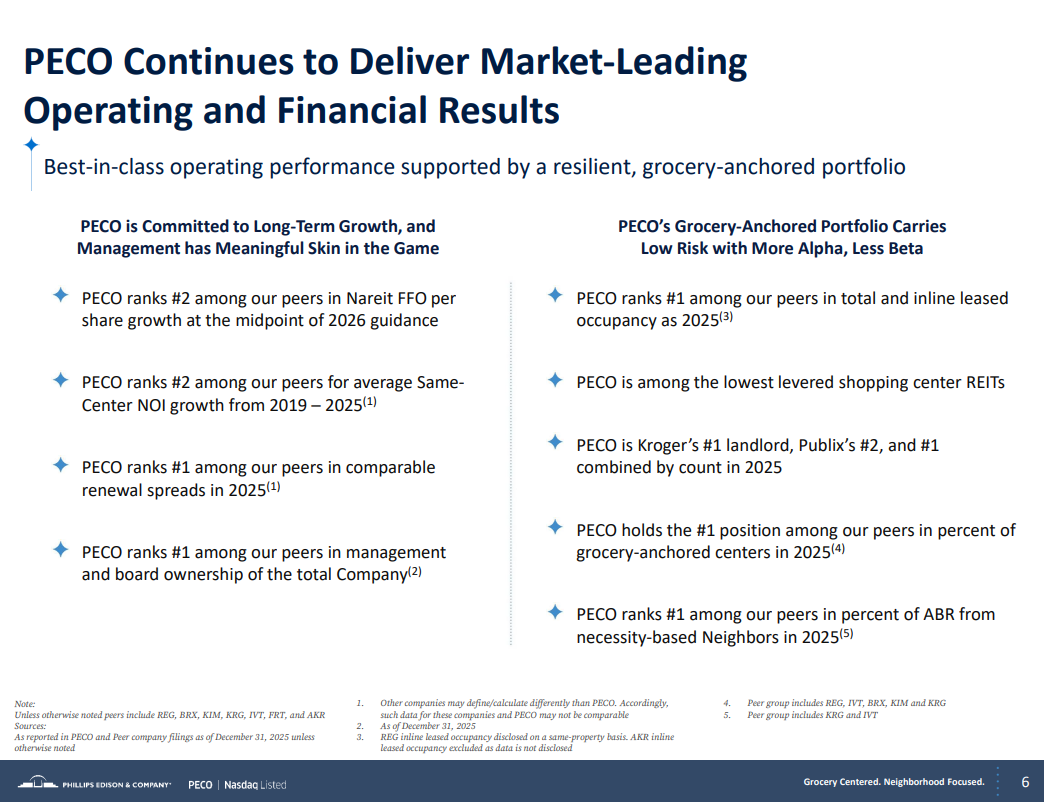
However, Phillips Edison is well-protected from this trend. It generates ~70% of its rental income from retailers that provide necessity-based goods and services and has minimal exposure to distressed retailers.
The strong foot traffic is a testament to the strength of the REIT’s business model, which also enables the trust to increase its rents on a regular basis.
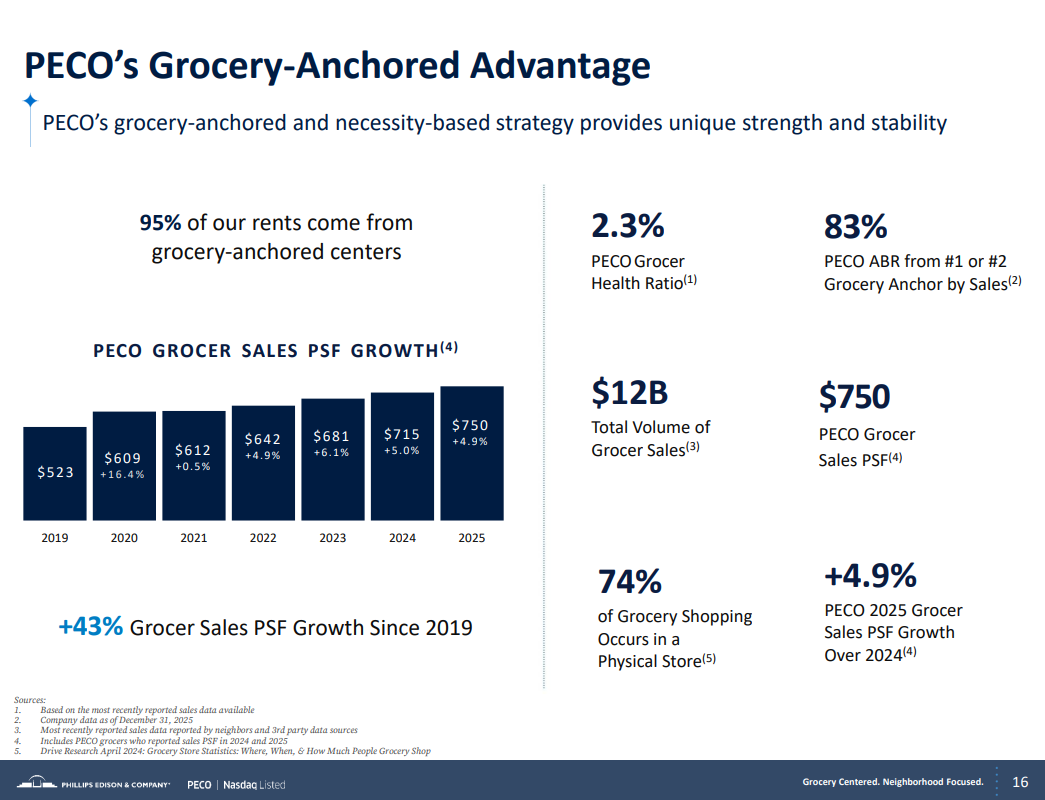
Source: Investor Presentation
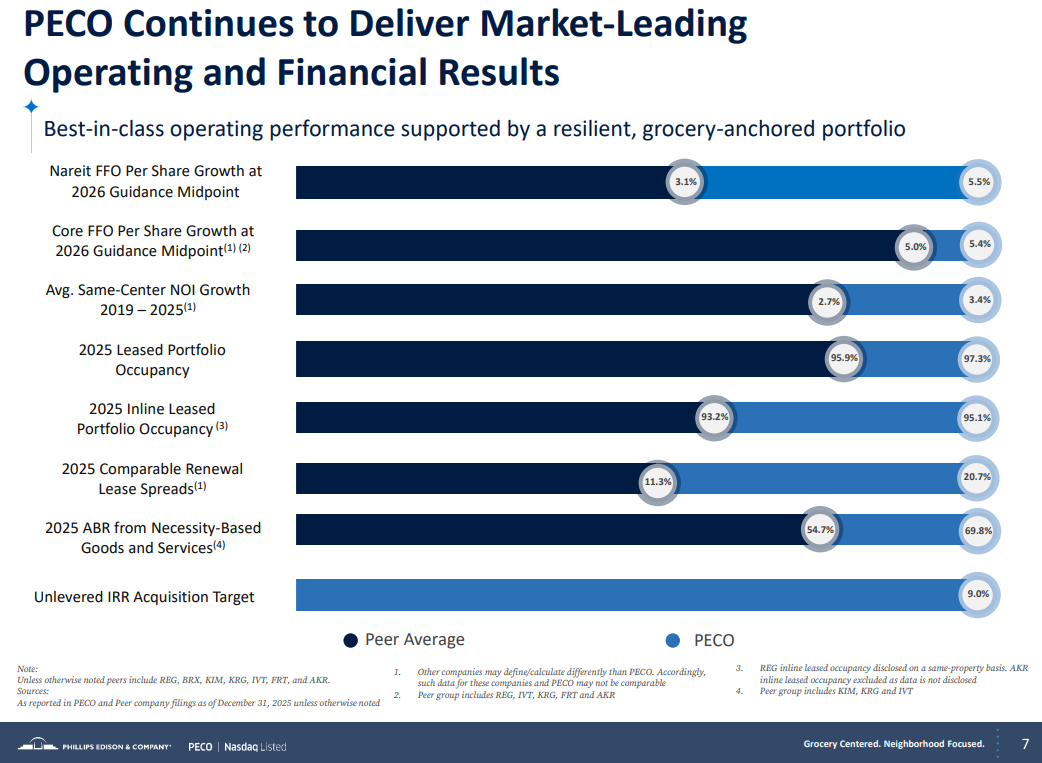
On February 5th, 2026, Phillips Edison & Company released its fourth quarter and full-year results, which were quite strong. Revenue was $188 million for the quarter, up 8.6% year-over-year. Same-center NOI was up 3.2% to $116 million, while comparable new and renewal lease spreads were 34.3% and 20%, respectively. FFO was up 5.9% year-over-year to $88.8 million, and on a per-share basis rose from 61 cents to 64 cents.
We estimate $2.74 in adjusted FFO-per-share for 2026, which would mark a strong improvement from 2025’s $2.54, if achieved.
Source: Investor Presentation
Growth Prospects
As Phillips Edison became public only recently, it has a very short performance record, and it is somewhat challenging to forecast its future growth with any degree of precision.
On the other hand, the REIT has several growth drivers in place.
First, it pursues growth by raising its rent regularly. Rent hikes are included in its leases, and the trust raises its rents faster when it leases a property to a new tenant.
It also pursues growth by redeveloping its properties when the returns are attractive.
As Phillips Edison currently owns just 324 properties, it obviously has immense growth potential, though it will have to issue plenty of new units to fund its acquisitions.
Overall, Phillips Edison has several growth drivers in place and ample room for future growth, but it is prudent to keep somewhat conservative expectations due to the trust’s short performance record.
Source: Investor Presentation
Based on the company’s historical leasing margins, same store NOI growth, and portfolio composition, we forecast FFO/share growth of 3% through 2030.
Competitive Advantages & Recession Performance
Phillips Edison’s competitive advantage lies in its focus on retailers that provide necessity-based goods and services. This focus renders the REIT more resilient to the secular decline of shopping centers than other retail-focused REITs and more resilient to recessions than most of its peers.
On the other hand, Phillips Edison performed its IPO only a few years ago, so it has not been tested during a recession. Therefore, its defensive business model has yet to be tested.
Dividend Analysis
Phillips Edison pays its dividends monthly and currently offers a 3.4% dividend yield. The trust’s expected payout ratio is 47% for 2026. It has an investment-grade balance sheet and a BBB credit rating from S&P, with a stable outlook.
Moreover, it has well-laddered debt maturities and no material debt maturities for the next couple of years. Furthermore, most of its total debt has a fixed rate, insulating it from potentially higher rates. Therefore, the dividend should be considered safe for the foreseeable future.
As a side note, while Phillips Edison has an investment-grade balance sheet, its leverage ratio (Net Debt to EBITDA) currently stands at 5.2. This is at the very upper limit of our comfort zone (5.0) and reveals the eagerness of management to invest in the aggressive expansion of the trust.
Nevertheless, we believe that a lower leverage ratio is necessary to make the REIT more resilient to unexpected downturns.
Additionally, the 3.4% dividend yield of Phillips Edison is somewhat lower than the median dividend yield of the REIT sector. However, the 47% payout ratio of the stock is lower than the median payout ratio of the REIT sector.
This means that Phillips Edison prefers to retain a greater portion of its earnings in order to invest more aggressively in its expansion. Overall, Phillips Edison’s dividend proposition is in line with the average stock of the REIT sector. With this in mind, it isn’t a pure income stock, but one that attempts to balance capital appreciation and income.
Final Thoughts
Monthly dividend stocks are attractive because they enhance the positive effect of compounding. However, some of these stocks are highly speculative, with high payout ratios and vulnerability to recessions. Therefore, investors should perform their due diligence carefully before investing in this group of stocks.
Phillips Edison seems much better than a typical monthly dividend stock, as it has a healthy payout ratio and a fairly resilient business model. Nevertheless, its short history and somewhat leveraged balance sheet create some uncertainty.
Overall, we have fairly low total return expectations for PECO, but we see the appeal of the stock for its yield and monthly payouts. We have a hold rating on the stock due to the fact that we see it as overvalued, but the yield is about double that of the S&P 500.
Don’t miss the resources below for more monthly dividend stock investing research.
And see the resources below for more compelling investment ideas for dividend growth stocks and/or high-yield investment securities.
Thanks for reading this article. Please send any feedback, corrections, or questions to [email protected].