For the second month in a row, the ongoing war in Iran has pushed financial advisor sentiment further into negative territory, even as many advisors report holding steady or increasing their allocations to foreign equities.
Processing Content
The overall score for April’s Financial Advisor Confidence Outlook (FACO) survey, which polled more than 200 advisors about their sentiment across a variety of factors on a scale from 100 to minus-100, is now at its lowest point in nearly a year. Last month’s overall sentiment was down six points, from a score of 0 in February to minus-6 in March. In April, that figure fell even further, to a score of minus-8.
The last time advisor sentiment was this low was in May 2025, when it dipped to a score of minus-18, as concerns over President Donald Trump’s tariffs weighed heavily on the minds of advisors.
This month, the Trump administration’s policies were again top of mind for advisors, who frequently expressed negative feelings about the government in the April poll.
“Unhappy with the current POTUS [president of the United States] and his administration [regarding] self-dealings, conflicts of interest among his inner circles and the outright lies that the POTUS and his administration tell the American people and the world,” wrote one advisor who responded to the anonymous FACO survey. “I’m not registered to any political party, therefore I’ll call out any politician when needed, but this [administration] is way off course and way off the charts and is hurting the masses.”
READ MORE: How financial advisors can buy a wealth book of business
Geopolitical tensions, particularly the war in Iran, dominated advisors’ concerns and what they’re hearing about from clients.
“I would say the conflict in the Middle East is causing a lot of uneasiness,” wrote one advisor, which was typical of many of the verbatim responses. “I definitely feel there will be a ripple in the economy and clients are definitely concerned.”
Several survey subcategories that feed into the overall FACO score dragged down overall sentiment.
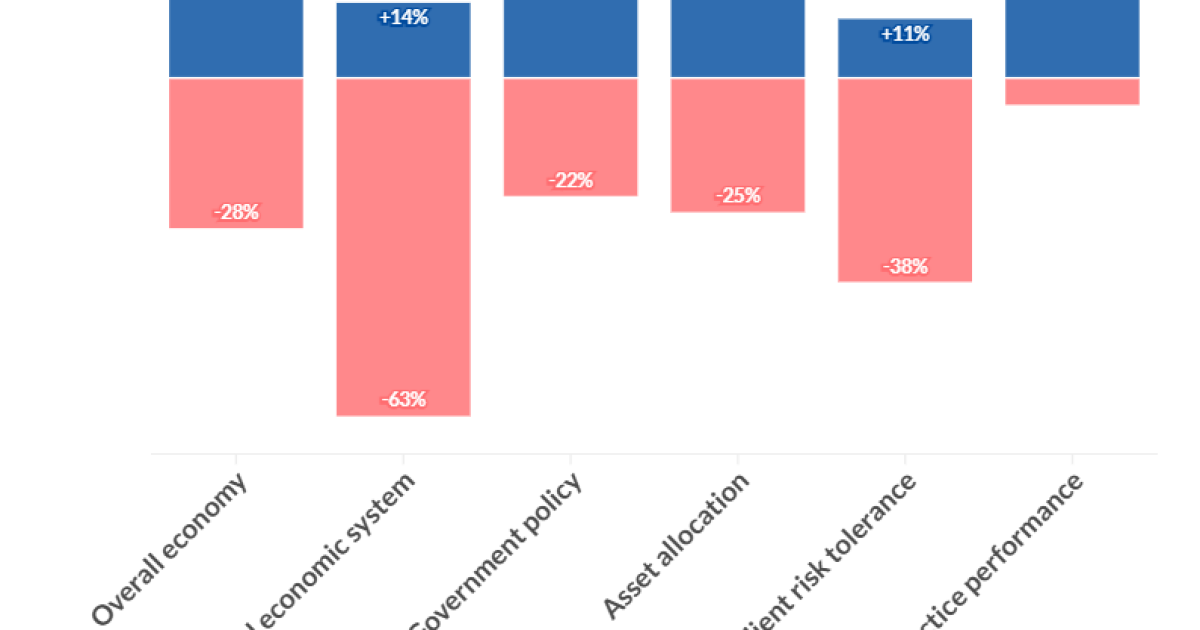
This was especially evident in views on the overall economy, where sentiment fell from 22 in March to 8 in April.
“The volatile markets are making clients wary of the market so I am spending too much time encouraging them to stay the course and not enough time prospecting for new assets,” wrote one advisor.
Sentiment on government policy also took a decidedly negative turn this month. After holding steady at a score of 14 in both February and March, it fell to 0 — the lowest level since June 2024, when it stood at minus-4.
Client risk tolerance also followed a similar trajectory, declining from minus-21 in March to minus-28 in April.
“Anxiety among clients about life and lifestyle in the future,” wrote one advisor. “Rising costs are very concerning for clients. Rising rates have increased the costs of what were standard expenses for cars and credit cards.”
Sentiment on the global economic system remained the most negative factor for advisors this month, improving from minus-68 in March to minus-49 in April but still firmly in the red.
Despite the weak headline figures, not all indicators dropped sharply in April.
Advisors remained relatively positive about their own firm’s outlook. Practice performance remained relatively steady, dipping just two points from a score of 27 in March to 25 in April.
“Client expectations, economic uncertainty and evolving technology are all influencing my approach, pushing me to be more responsive, adaptable and efficient in how I deliver value,” wrote one advisor.
Advisors’ sentiment on asset allocations, while still generally pessimistic, rose slightly from a score of minus-10 in March to minus-6 in April.
In recent months, advisors have reported increasing allocations to foreign equities amid broader market turmoil. That trend was reflected in April’s FACO data, with 36% of advisors saying they plan to increase exposure to foreign equities over the next three months, while 48% expect to keep those allocations unchanged. Meanwhile, 25% of advisors said they expected to move client assets away from cash.
“The current drop in the equity markets have created an opportunity to put new money to work at more attractive levels,” wrote one advisor.