Updated on April 1st, 2026 by Nathan Parsh
Horizon Technology Finance (HRZN) has a current dividend yield of more than 17%, which makes it extremely attractive at first glance. The S&P 500 Index, on average, offers just a 1.2% dividend yield.
Horizon has a very high dividend yield and makes its payments monthly. It is one of only 117 monthly dividend stocks.
You can download our full Excel spreadsheet of all monthly dividend stocks (along with metrics that matter, like dividend yield and payout ratio) by clicking on the link below:

Horizon’s yield is near the top of the list of monthly dividend stocks, a group that includes many other high-yield securities, such as REITs and other Business Development Companies.
This article will discuss Horizon’s business model and whether it is an appealing stock for income investors.
Business Overview
Horizon Technology Finance is a Business Development Company, or BDC. These are companies that make investments in privately held companies.
Horizon makes its returns via investments in companies through directly originated senior secured loans and, to a smaller extent, capital appreciation potential through warrants.
It provides debt financing to early-stage companies across three industry groups:
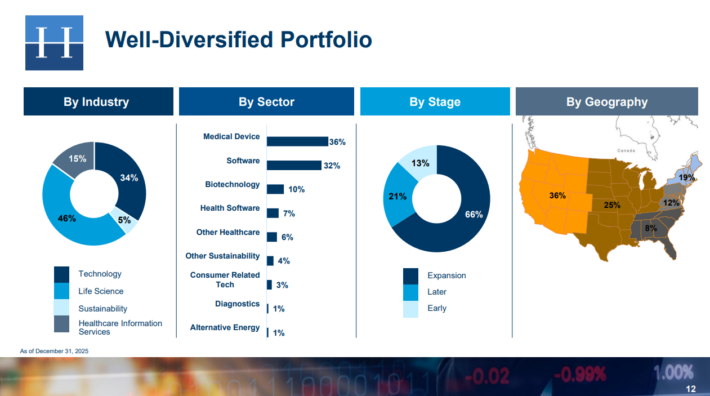
Life Science (45.5% of portfolio)
Technology (34% of portfolio)
Healthcare Information & Services (14.7% of portfolio)
Sustainability (5.8% of portfolio)
Life science companies primarily include biotechnology, medical devices, and specialty pharmaceuticals.
Technology investments are typically made in cloud computing, wireless communications, cyber security, data analytics and storage, internet, software, and more.
Healthcare information includes diagnostics, medical records, and patient management software providers.
A breakdown of Horizon’s portfolio is as follows:
Source: Investor Presentation
The portfolio is heavily weighted in the life science and technology groups, but even within those groups, industries are highly diversified.
In addition, the company’s portfolio includes a favorable mix of stable and growing companies, respectively, to provide a balance of growth and safety in its lending.
Horizon views prospective investments through a long-term lens. It invests in companies that have growth potential, strong management teams, superior technology, and/or valuable intellectual property.
Growth Prospects
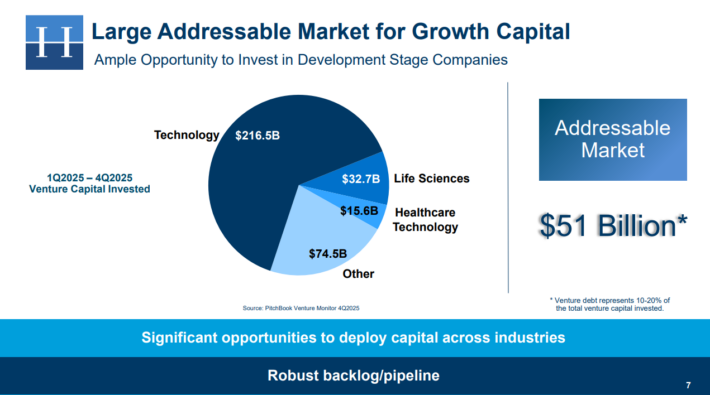
Horizon also has a growing and enormous addressable market.
Source: Investor Presentation
Horizon sees a $51 billion addressable market against its current portfolio. This should provide a wealth of opportunities for Horizon, and it can select the best opportunities in the coming years.
However, based on Horizon’s current portfolio composition, we forecast net investment income for 2026 at $0.73 per share, which would be down from $1.05 in 2025. We do not expect investment income per share to grow over the next five years.
Dividend & Valuation Analysis
Horizon currently pays a monthly dividend of $0.06 per share. The annualized dividend payout of $0.72 represents a yield of 17.3%, based on Horizon’s current price. This doesn’t include special dividends, of which the company has distributed $0.05 per share each year for the 2020 to 2024 period. No special dividend was distributed last year.
This high yield demonstrates why BDCs are a popular investment for income investors, particularly one that is as elevated as Horizon’s.
Investors should note that abnormally high dividend payouts can be reduced if the issuing company encounters financial difficulty. In the case of Horizon, its share price has dropped by more than a third following the recent dividend cut.
Net investment income for 2026 is expected to be $0.73 per share, which equates to a payout ratio of nearly 100%.
If investment income declines in the future, the dividend would be in danger of a reduction. On the other hand, if the U.S. economy avoids a recession and Horizon continues to see satisfactory investment spreads, the dividend could be maintained and even grow. The last increase occurred for the first payment of 2023.
Related: 3 Reasons Why Companies Cut Their Dividends (With Examples)
The company’s competitive advantage lies in its expertise in identifying the most promising companies in risky sectors, which requires professional knowledge and experience beyond finance. So far, this perk has stood solid, as the company’s results have outperformed the rest of its peers, many of which were forced to cut their distribution due to increased market pressure.
In an optimal scenario, Horizon could continue to pay its distribution of $0.72 annually for the foreseeable future. However, any BDC has an increased risk of cutting its distribution, given that it is required to distribute essentially all of its income. Should Horizon’s financial results deteriorate, another dividend cut is possible.
Shares of Horizon trade at ~$4.16 today, leading to a P/IIS of 5.7, which is below our target of 7.0. Reaching our target P/IIS would add 4.2% to annual returns over the next five years.
Combined with the dividend yield, we project total returns of 15.9% per year through 2031.
Final Thoughts
High dividend yields are often a sign of elevated risk. In this case, there is a considerable risk that Horizon’s dividend could be further reduced in the future if its investment income deteriorated, which would likely occur in a recession.
Horizon’s outlook is generally positive. It invests in technology and healthcare, two stable industries with growth potential. The company’s underwriting principles offer high yields and generally safe lending conditions, which support net investment income and, therefore, the dividend.
Horizon could be an attractive high-dividend stock for income investors thanks to its 17% dividend yield, but we rate the stock as a sell following the dividend cut.
Don’t miss the resources below for more monthly dividend stock investing research.
And see the resources below for more compelling investment ideas for dividend growth stocks and/or high-yield investment securities.
Thanks for reading this article. Please send any feedback, corrections, or questions to [email protected].