Yves here. This article has a very important finding even though it is bizarrely loath to depict the “shock and awe” sanctions as the cause of depositor concerns and actions that in turn increased funding costs in many European banks. It shows that the increase was meaningful, about 60 basis points, and not surprisingly also led the “exposed” banks to tighten up on lending.
By Falko Fecht, Head of Research Deutsche Bundesbank; Professor of Financial Economics Frankfurt School Of Finance & Management; Stefan Greppmair, Research Economist Deutsche Bundesbank; and Björn Imbierowicz, Economist Deutsche Bundesbank. Originally published at VoxEU
The debate about the economic consequences of Russia’s invasion of Ukraine has focused on supply-side concerns such as soaring energy prices and severed supply chains. However, this overlooks the role of the financial sector. Using granular transaction data, this column shows that the outbreak of war acted as a ‘silent monetary tightening’. Exposed banks faced immediate higher funding costs and reduced credit supply, an effect equivalent to a policy rate hike of nearly 60 basis points, well before the ECB acted. Geopolitical tensions appear to influence both the stance and the effectiveness of monetary policy more directly and powerfully than previously assumed.
Geopolitical tensions have once again seized the centre stage of macroeconomic policy debates. From Russia’s ongoing war in Ukraine to instability in the Middle East, Red Sea transport disruptions, the US involvement in Venezuela, and renewed trade conflicts, the global economy faces a new era of fragmentation. Since the Russian invasion in February 2022, the dominant economic narrative has focused almost exclusively on supply-side pressures; soaring energy prices, severed supply chains, and the resulting cost-push inflation.
These physical disruptions are well documented, ranging from the fundamental rewiring of European import structures (Felbermayr et al. 2025, Borin et al. 2023) to the complex supply chain adjustments in neutral countries (Li et al. 2024). Yet, while these studies capture the staggering real economic costs (Gorodnichenko and Vasudevan 2025), they largely abstract from a parallel shock: the tightening in bank funding conditions. Premised on this purely supply-side diagnosis, the early debate among central bankers focused on how much to ‘look through’ these price spikes while guarding against second-round effects.
This perspective, however, overlooks a critical transmission channel: the financial sector. As the IMF and others warn of ‘geoeconomic fragmentation’ (Gopinath et al. 2025), it is crucial to understand how these ruptures affect not just trade flows but also bank balance sheets and, by extension, aggregate demand. In a recent paper (Fecht et al. 2026), we argue that geopolitical shocks reshape the macroeconomy well before central banks decide to act.
Using granular European data from corporate deposit and loan transactions, we show that Russia’s invasion generated a direct balance-sheet shock for exposed banks. This shock did not just create localised stress; it raised funding costs, reduced credit supply, and compressed aggregate demand. In effect, the invasion acted as a ‘silent tightening’ of monetary conditions, amplifying the effects of the ECB’s subsequent hiking cycle. In short, geopolitics acted as a monetary shock.
Depositors as the First Line of Monitoring
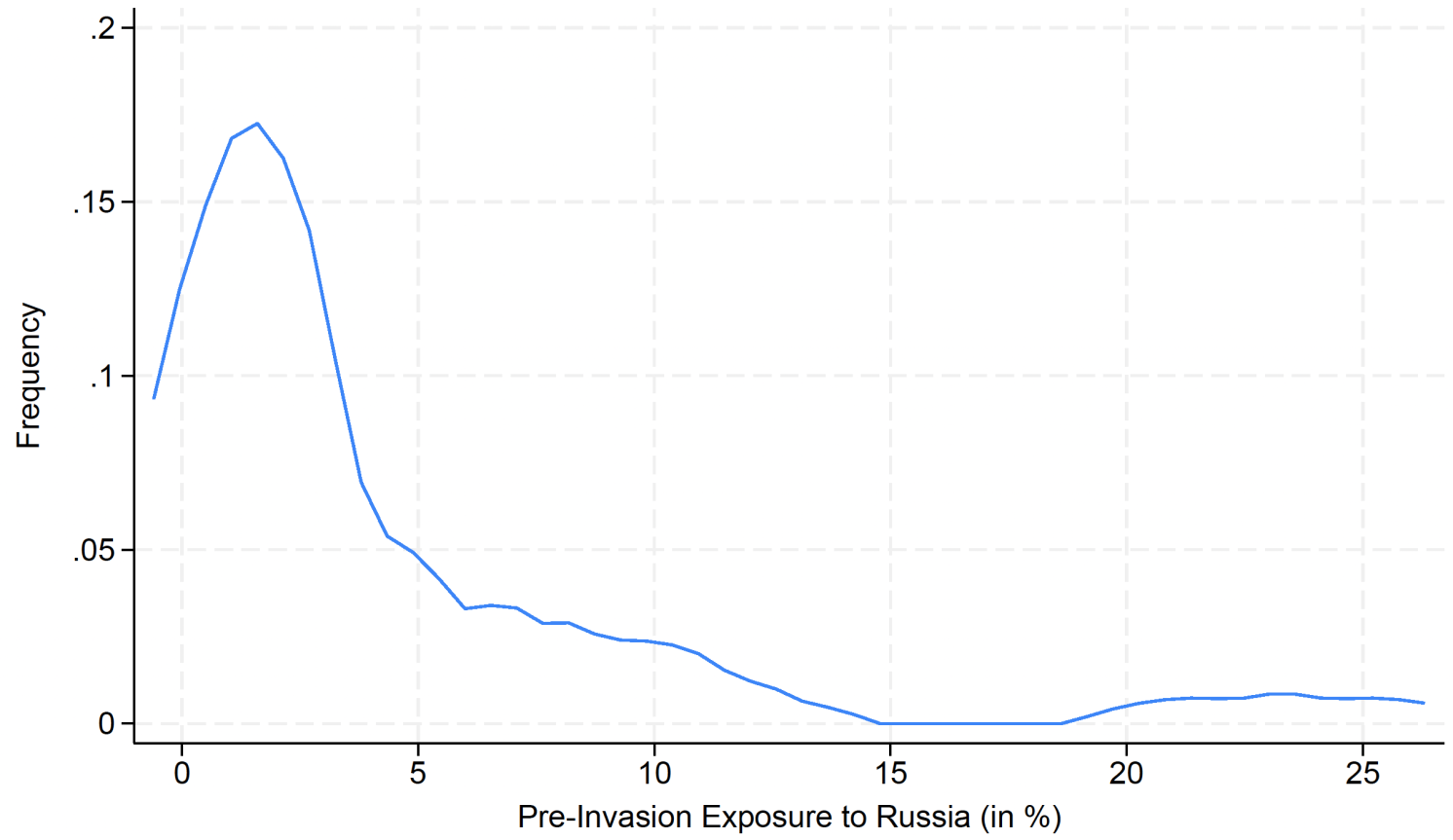
The significantly expanded sanctions in February 2022 effectively led to stranded assets at European banks with borrowers in Russia and Belarus. 1 While the median exposure for affected banks was manageable, amounting to roughly 1.5% of equity, the shock immediately increased perceived bank risk. Figure 1 illustrates the distribution of banks’ exposure to Russian and Belarusian borrowers prior to the invasion. The data reveal significant heterogeneity: while many institutions had limited direct contact, a relevant tail of the distribution held substantial exposures relative to their equity. These pre-existing financial linkages served as the conduit through which the geopolitical flare-up turned into an immediate funding squeeze.
Figure 1 Banks’ average exposure to Russian and Belarusian borrowers prior to the Russian invasion of Ukraine in February 2022
Notes: This figure displays the kernel density estimate of banks’ pre-invasion exposure to Russian and Belarusian borrowers. Exposure is defined as the sum of outstanding loans and debt securities vis-à-vis Russian and Belarusian firms, scaled by the bank’s book equity (2021 averages). The sample is restricted to banks with positive exposure that report to both the AnaCredit and SHS databases. Data Sources: AnaCredit, SHS-G, SHS-Base Plus.
Unlike insured retail depositors, large corporate depositors are sophisticated, uninsured, and highly mobile. They are vigilant monitors and respond swiftly when risks materialise and question banks’ financial health. Our analysis reveals that immediately following the invasion, exposed banks faced a distinct funding penalty.
We find that exposed banks had to offer around five basis points higher rates to retain their non-financial corporate deposits compared to their non-exposed peers. In an environment where rates were still negative, this was economically significant, representing a 15% increase relative to the market spread at the time. By employing a precise identification strategy, comparing identical firms’ depositing across different banks on the same day, we can isolate the bank-specific component of this funding stress. Beyond pricing, quantity constraints also kicked in: deposit flows weakened, and the probability of an exposed bank receiving new corporate funds declined significantly.
When aggregated across the banking sector, this was not a trivial friction. We estimate that the shock increased aggregate deposit funding costs for exposed banks by between €80 million and €110 million. To put this in perspective of monetary conditions: this ‘silent tightening’ effectively acted like an additional 57 basis points policy rate hike for exposed banks. Crucially, this tightening occurred months before the ECB formally lifted rates from -0.5%.
A Liability-Driven Credit Contraction
Basic financial theory suggests that when banks face higher funding costs and lower net worth, they retrench. Our findings confirm that this funding squeeze translated directly into a contraction in loan supply.
We find that exposed banks reduced credit volumes by roughly 3% relative to non-exposed peers. Using loan-level data from AnaCredit, we again compare the same borrower across different lenders to control for loan demand.
Importantly, we establish a direct causal link between the two sides of the balance sheet. The banks that saw the sharpest increase in deposit costs immediately after the invasion were exactly those that cut lending the most in the following months. This confirms a classic ‘liability-driven credit contraction’. It was not merely that banks held bad assets; the geopolitical shock rather impaired their refinancing conditions, and this constraint was passed on to the real economy.
For the wider economy, this matters because borrowers could not fully substitute this reduction in loan supply with credit from other banks, leading to a decline in total borrowing and muted investment activity. This represents a clear demand-side contraction. While energy markets were driving up inflation (a supply shock), the banking channel was quietly depressing investment and consumption (a demand shock), complicating the picture for monetary policymakers.
The Amplification of Monetary Policy
Perhaps the most critical implication for current policy concerns what happened next. When the ECB began raising interest rates in July 2022, the banking sector was already ‘bruised’.
We find that this pre-existing weakness significantly altered the transmission of the monetary policy tightening. Banks that had been hit by the geopolitical shock transmitted the subsequent policy rate hikes much more forcefully than their peers.
Our local projection results show a stark divergence:
A one percentage point increase in the policy rate led exposed banks to raise deposit rates by about 40 basis points more than unexposed banks.
Loan rates increased 25-30 basis points more for the same policy shock.
This amplification is consistent with theories of state-dependent external finance premia (e.g. He and Krishnamurthy 2013). Financially constrained banks have less capacity to smooth interest rate shocks; they must pass costs on to protect margins and retain funding. Consequently, the ‘geopolitical wedge’ in bank balance sheets acted as an amplifier for ECB policy. The effective stance of monetary policy became tighter for a large segment of firms and households than the headline rate implied.
Implications for a Fragmented World
Our findings challenge the view that central banks can simply ‘look through’ geopolitical events as temporary supply distortions.
First, geopolitical shocks are not purely supply shocks. While energy prices dominate headline inflation, the banking channel generates a countervailing contraction in demand. Ignoring this mechanism risks misjudging the underlying stance of monetary policy.
Second, policymakers must account for the ‘shadow tightening’ produced by geopolitical events. In the case of the Ukraine invasion, exposed banks faced an extra funding-cost burden equivalent to a 57-basis-point rate hike before the first official increase. Central banks operating in a fragmented global economy need to monitor these endogenous tightening effects to avoid overtightening into a weakening economy.
Our findings thus extend the understanding of the economic costs of war. While Cecchetti and Schoenholtz (2023) warned early on that the invasion could threaten global financial stability through a loss of trust, we quantify this mechanism specifically for European bank balance sheets. The war affects the economy not only through physical destruction and collateral damage, as documented by Shpak et al. (2023) for Ukrainian firms, but also through a transnational transmission channel that curbs lending in Europe, even in the absence of direct physical damage.
Third, monetary transmission becomes stronger when banks are financially constrained. Rate hikes implemented in the shadow of a geopolitical crisis may bite harder and faster than standard models predict.
Finally, this underscores the intersection of macroprudential and monetary policy. Supervisors should integrate geopolitical concentration risk into stress tests and capital planning. As our results show, banks with large exposures to geopolitically sensitive borrowers act as conduits, transmitting foreign policy shocks directly into domestic credit conditions.
In an era of rising geopolitical fragmentation, the border between foreign policy and monetary policy is eroding. Geopolitical shocks affect not only the supply side of the economy but also the strength of monetary transmission through the banking system. Understanding this bank lending channel is no longer just a matter of financial stability; it is essential for calibrating monetary policy in a world where geopolitical risks increasingly shape macroeconomic outcomes.
____________
https://www.consilium.europa.eu/en/press/press-releases/2025/12/22/russia-s-war-of-aggression-against-ukraine-council-extends-economic-sanctions-for-a-further-6-months/
See original post for references