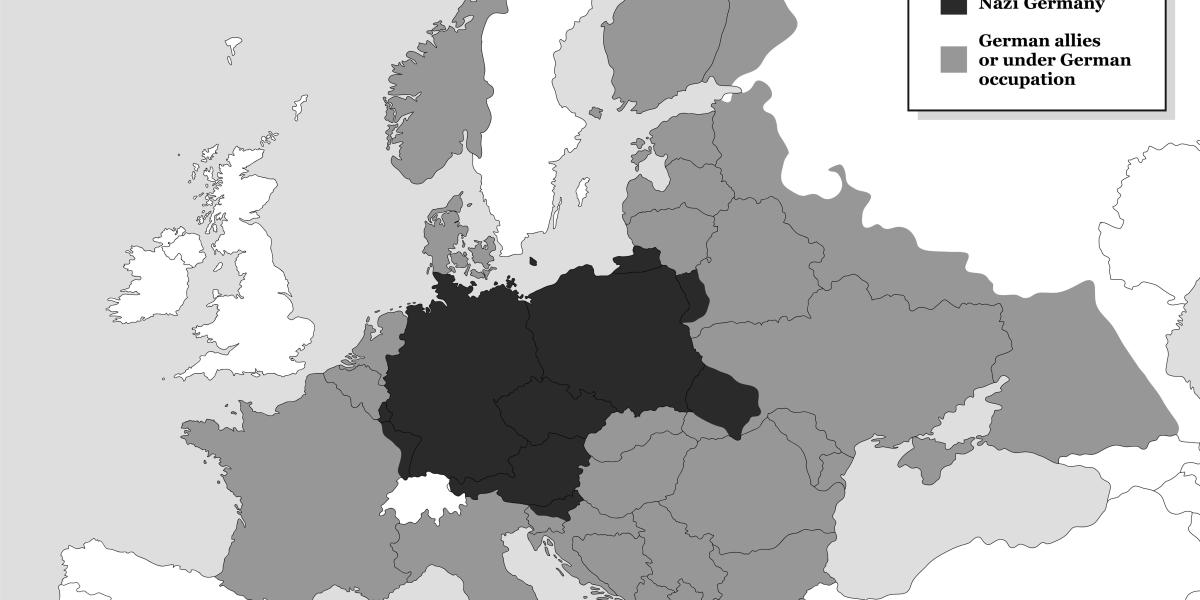
In his 1944 book Omnipotent Government, Ludwig von Mises provided a detailed analysis about how the protectionism and welfarism instituted by German Chancellor Otto von Bismarck, together with the anti-capitalist teachings of the Historicist School that dominated German universities, ultimately drove Germany towards an economic autarky which, in a country unable to obtain enough food and many other essential natural resources from within its own borders, would compel it to wage a war to conquer more Lebensraum (“living space”). In an autarkic world, “have not” countries must of necessity go to war with the “have” countries to survive. Mises’s basic conclusion about German aggression was that, “Germany does not aim at autarky because it is eager to wage war. It aims at war because it wants autarky—because it wants to live in economic self-sufficiency.”
Mises’s thesis that Nazi aggression was fundamentally motivated by an ideological continuity with earlier forms of German nationalism and with other statist ideologies is bound to raise doubts among scholars who prefer to emphasize the racist and especially the virulently anti-Semitic aspects of Nazi doctrines. So what is the relationship between Nazi racism and the older German nationalist tradition of economic autarky?
Mises didn’t deny that anti-Semitism was important, but he argued that it was significant to the rise of the Nazi movement mainly in terms of promoting a “stab-in-the-back” myth (the Dolchstoßlegende), enabling Nazis to shift blame for Germany’s defeat in the First World War away from pro-war nationalists onto Social Democrats and Communists; the “November criminals” who supposedly betrayed Germany’s war effort as pawns of a secret Jewish conspiracy. For Mises, autarky was still the more fundamental issue though.
Nazi dictator Adolf Hitler himself publicly embraced the “haves” versus “have-nots” theme in a major January 30, 1942 speech justifying Germany’s role in the Second World War. But were such economic considerations really foundational to the quest for Lebensraum, or were they merely peripheral to a racist ideology? Did Mises miss something?
The only detailed exposition of Hitler’s thinking that would have been publicly available in 1944 was Hitler’s 1924 book Mein Kampf (“My Struggle”). In the chapter dealing with Eastern Europe, Hitler argued his case for expansion at the expense Russia starting with this premise:
The foreign policy of a People’s State must first of all bear in mind the duty of securing the existence of the race which is incorporated in this State. And this must be done by establishing a healthy and natural proportion between the number and growth of the population on the one hand and the extent and resources of the territory they inhabit, on the other. That balance must be such that it accords with the vital necessities of the people.
What I call a healthy proportion is that in which the support of a people is guaranteed by the resources of its own soil and sub-soil. Any situation which falls short of this condition is none the less unhealthy even though it may endure for centuries or even a thousand years. Sooner or later, this lack of proportion must of necessity lead to the decline or even annihilation of the people concerned.
Only a sufficiently large space on this earth can assure the independent existence of a people.
While Hitler failed to offer a clear justification for this principle, it clearly ties his quest for Lebensraum to the notion that a “People’s State” serving the interests of a particular race ought to strive for self-sufficiency in natural resources, thus supporting Mises’s thesis.
There is another source about Hitler’s economic doctrines that surfaced long after Mises wrote Omnipotent Government. In 1928, Hitler wrote a sequel to Mein Kampf that wasn’t published until 1961. Hitler’s second book provides the detailed case for economic autarky that Mein Kampf lacked, clearly indicating how Hitler’s flawed understanding of economics intersected with his racial ideas.
Two economic blunders that Hitler made at the outset of his second book were to assume that nations struggle for self-preservation and continuance just like individuals do (an erroneous methodological collectivism exhibiting a fallacy of composition), and that politics, not production, is the leader of the struggle for existence. Hitler’s theory of political struggles among nations sharply contrasts with Mises’s treatment of nationality in his 1919 book Nation, State, and Economy, where a “nation” is understood to be a community of discourse defined primarily by individuals composing it voluntarily choosing to learn and speak a common language.
Hitler conceded (in accord with Mises’s conception of nationality) that German emigrants would cease being German if they moved to America and became English-speakers, but contrary to Mises, he denied that non-Germans like Slavs could be Germanized through a process of peaceful assimilation. For Hitler, authentic Germanness requires one being born with the right genes as well as choosing to participate in a community of German-speakers.
Hitler then proceeded to argue for waging wars for Lebensraum by offering a naive Malthusian analysis of the relationship of a population to its resources, exactly in line with Mises’s characterization of earlier German nationalists:
Since the population grows incessantly, and the soil as such remains stationary, tensions perforce must gradually arise which at first find expression in distress, and which for a certain time can be balanced through greater industry, more ingenious production methods or special austerity.
But there comes a day when these tensions can no longer be eliminated by such means. Then the task of the leaders of a nation’s struggle for existence consists in eliminating the unbearable conditions in a fundamental way, that is in restoring a tolerable relation between population and territory.
Hitler was aware of several liberal objections to this argument. People could emigrate from a relatively overpopulated country. They could practice birth control. Countries practicing free trade can intensify their industrialization and rely on their exports to obtain whatever resources they lack from their relatively resource-rich trading partners. Given all these possibilities, why did Hitler think that a war would be necessary to conquer foreign resources?
Regarding emigration and birth control, Hitler’s counter-argument was derived from his racial theories—a nation will supposedly devalue its remaining “human material” when limiting its population by such voluntary methods. Regarding the possibilities of spurring exports through greater industrialization, free trade, and dismantling of welfarism to pay for imports of needed resources, Hitler failed to comprehend how the law of association works; instead embracing the fallacy that, as industrialization spreads across the world, there would be fewer opportunities for Germany to trade for the resources it needs.
Hitler also invoked a racist counter-argument against too great a reliance of a nation upon greater industrialization and urbanization:
This over filling of an inadequate living space with people not seldom also leads to the concentration of people in work centers which look less like cultural centers, and rather more like abscesses in the national body in which all evil, vices and diseases seem to unite.
Above all they are breeding grounds of blood mixing and bastardization, and of race lowering, thus resulting in those purulent infection centers in which the international Jewish [expletive metaphor deleted] thrive and finally effect further destruction.
Here we see Hitler’s desire for economic autarky and thus for conquest of Lebensraum was by no means disconnected from some of his most vile expressions of racism and anti-Semitism. Rather, his racism provided an important, though not sole rationale for rejecting peaceful, voluntary alternatives for keeping Germans fed.
Whatever Hitler was thinking, the vast majority of Germans didn’t take such racial grievances very seriously in mid-1928 when the Nazis finished in 9th place in federal elections, receiving less than 3 percent of the vote. As I mentioned in my previous article discussing the nature of fascism, illiberal policies that caused the First World War and the Great Depression and the economic chaos following from those events were necessary antecedents to the rise of the Nazis.
The 1929 outbreak of the Great Depression and the near simultaneous imposition of the Young Plan to extort tribute from Germany (which a coalition of Nazis and other nationalists waged a referendum campaign against, arguing that Germans would be enslaved by it for three generations), followed by the 1931 collapse of several major Austrian and German banks (which prompted Britain to leave the gold standard and further crippled international trade and finance), proved to be the two key drivers of spectacular Nazi electoral gains as the German economy spiraled downwards. By July of 1932, Nazis were in first place, winning over 37 percent of the vote.
Chancellor Heinrich Brüning’s disastrously interventionist response to the 1931 crisis (increasing taxes, imposing currency controls, launching make-work programs, taking equity stakes to bail out busted industrial and banking firms, not curbing trade union powers) played right into Hitler’s hands. Hitler promised work and bread to the voters while raising campaign funds from industrialists who had formerly supported other parties. Most of these industrialists were associated with firms partly-nationalized by Brüning and often also having deep Wall Street connections, as the German industrial boom of the late 1920s was largely financed by the same Wall Street-led bank credit bubble that had caused the Great Depression in America.
Mises was correct in his assessment, most Germans—whether they shared Hitler’s racial views or not—erroneously believed that interventionism and autarky was the solution to their increasingly dire economic circumstances, and it was Hitler who profited politically from such beliefs. Ultimately, that meant a war for Lebensraum.