Right now, geopolitics is front of mind for investors and almost nothing else matters to the markets. Whether you invest in the stock market, real estate, bonds, or cryptocurrencies, you’re probably checking the global news section of the newspaper first thing each morning—hoping against hope for some good news, especially with regard to the US-Israel war with Iran.
Unfortunately, Since the time of writing the previous edition of this column, the war has only gotten worse. The US and Israel continue their onslaught on targets in Iran, while Iran continues to target several gulf countries with US military bases, including Saudi Arabia, Qatar, Kuwait, the United Arab Emirates (UAE), and others. As of now, apart from a few (sometimes contradictory) tweets from President Trump, there are few signs that this war will abate as soon as we’d hoped.
The best crypto platforms and apps
We’ve ranked the best crypto exchanges in Canada.
What does the Iran war have to do with Bitcoin (BTC)?
What does a war being fought thousands of kilometers away have to do with BTC and crypto investors in Canada, you may ask. The answer, unfortunately, is everything.
The war has led to higher crude oil prices. This could likely cause higher inflation, leading to higher interest rates. In fact, the Bank of Canada (BoC), in its most recent interest rate announcement on March 18, held rates stable and struck a cautious tone in light of the inflationary potential of the Iran war. The end result? A damaging effect on growth assets, including stocks and cryptocurrencies.
As the chart below shows, the price of crude oil has risen from about $67 to over $100 (all figures in U.S. dollars unless otherwise specified) since the current Iran war began on February 28, 2026.
Source: Google Finance on Mar. 29, 2026
Crude has jumped about 50% in just 30 days. That’s bad enough, but if things in the Middle East don’t calm down soon, oil could possibly climb to $150 or higher. It’s no wonder investors are cautious and, frankly, a little scared.
How has BTC fared compared to other assets since the war began?
In the gloom and doom of the current market, here is an encouraging data point for BTC investors: Since the Iran war began one month ago, BTC has been more or less flat (up 2.56% as I write this on the morning of March 31, 2026). That’s way better than the performance of the S&P 500 (down 7.82%), the S&P/TSX 60 (down 6.25%), and gold (down 15.39%).


X
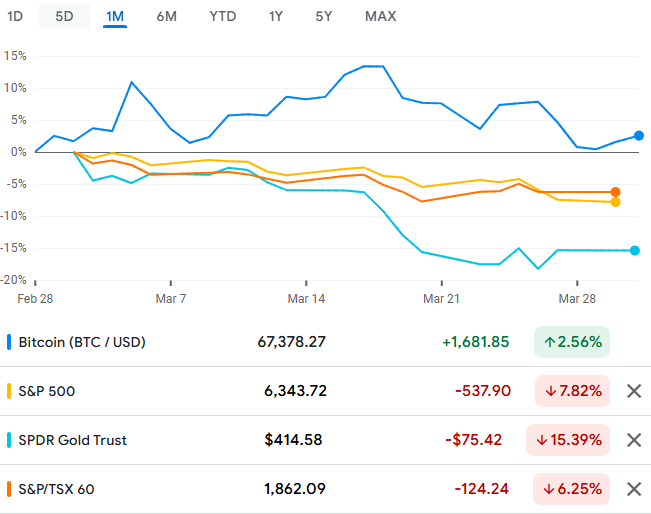
Source: Google Finance on Mar. 31, 2026
Does this mean that BTC will continue to outperform other asset classes? Not necessarily. Markets are cyclical, and BTC could have performed better in the past month simply because it’s been a laggard since October 2025. In other words, BTC was probably oversold before the war even began.
A positive sign for BTC investors: ETF inflows turn positive
While the geopolitical news is bleak, there’s a silver lining for BTC investors: we’re seeing some significant buying in US Bitcoin exchange-traded funds (ETFs).
As the chart below shows, BTC ETFs experienced net outflows since October 2025, as indicated by the red bars at the bottom right of the graph; however, February and March 2026 saw significant green bars, indicating renewed institutional interest in BTC. It remains to be seen whether this trend will continue.
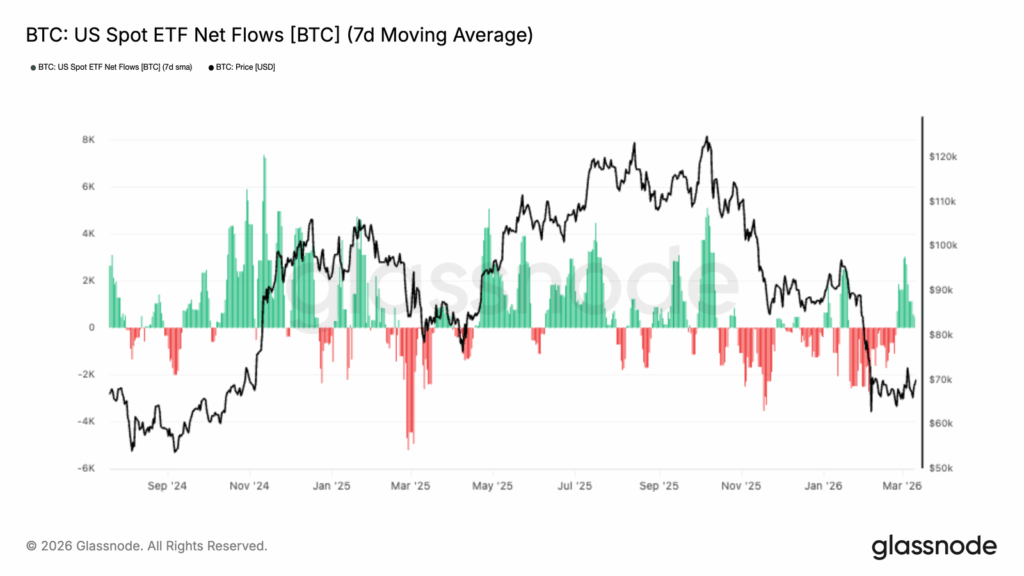
Source: Glassnode on Mar. 29, 2026.
Another way to get a glimpse of the same story is through the net flows of the iShares Bitcoin Trust ETF (IBIT), the largest BTC spot ETF in the world. Each bar below represents one week net flows of IBIT over the past year.
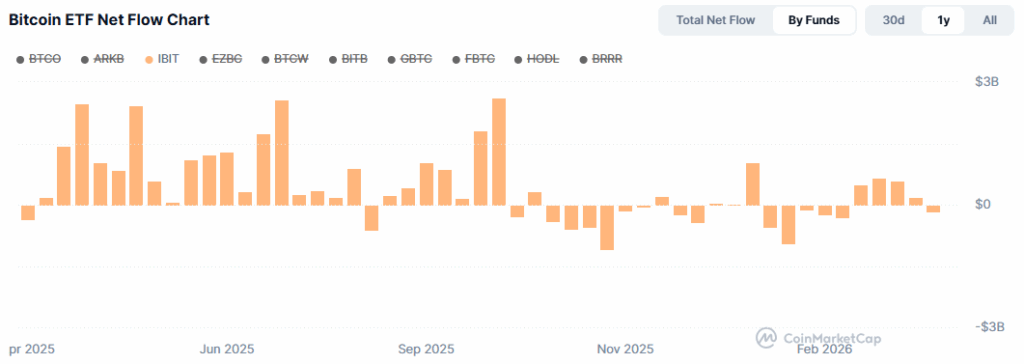
Source: Coinmarketcap as on Mar. 31, 2026.
As the chart above shows, the picture has been pretty bleak since about October 2025, with most weeks showing a net outflow of money from the ETF. In other words, investors were pulling more money out of IBIT than they were investing in it. However, in what is a welcome relief from this negative trend, at the far right of the chart, we can see four consecutive positive weeks in February and March of this year. This could mean that institutional investors find BTC attractive at $60,000 to $70,000.