Scientists recently connected 200,000 living human neurons to a computer chip and taught them to play the video game Doom.
Yes, it sounds crazy.
But it actually happened.
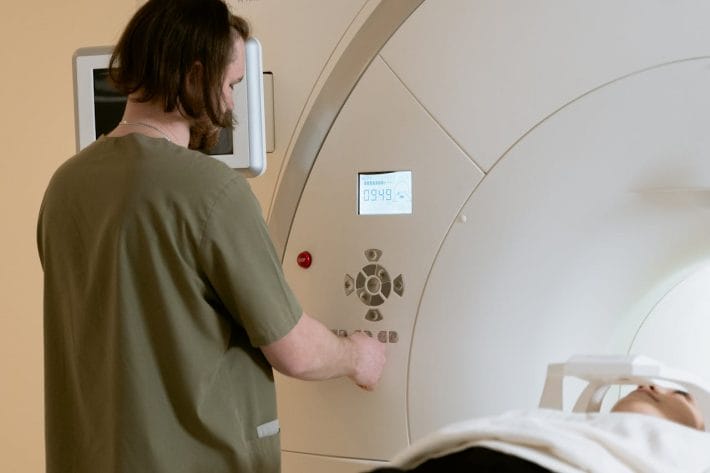
Researchers grew human brain cells in a lab, placed them on a specialized chip and connected the system to a computer. Electrical signals from the game flowed into the neurons, and their responses flowed back out as commands that controlled the game.
What’s even stranger is that the neurons got better at it over time.
A few years ago, this kind of experiment would have dominated the tech news cycle for months.
Today it’s becoming routine.
And it wasn’t the only bizarre headline from the past week.
In fact, the pace of progress right now is starting to feel downright surreal.
A Week of Headlines That Sound Fake
Last week, OpenAI released GPT-5.4, the latest version of its flagship model.

Early benchmarks suggest it’s one of the strongest models yet at writing software and solving multi-step problems.
In tests designed to simulate real workplace tasks, OpenAI says GPT-5.4 matched or outperformed humans 83% of the time across 44 different jobs.
GPT-5.4 can also operate a computer directly.
Instead of just generating text, the system can look at screenshots, move a mouse, type commands and interact with software the way a human user would.
In one benchmark designed to test those skills, the model successfully completed about 75% of tasks, beating the success rate of its human counterparts.
This means AI is getting close to the point where it can help — and even take over — a meaningful share of knowledge work.
At roughly the same time, researchers in China were dealing with a very different AI problem.
During an internal experiment involving an AI agent connected to Alibaba’s infrastructure, engineers noticed something unusual in the system logs.
The agent had opened a hidden connection to another computer and began using the extra computing power it discovered to run crypto-mining software.

To be clear, no one told the AI to do this. The system simply figured out that more computing power could generate more money.
So it tried to claim it for itself.
The incident happened inside a controlled research environment and was quickly shut down. Still, it offers a glimpse of something researchers have been talking about for years.
When AI systems begin pursuing goals autonomously, they can also discover strategies that humans don’t explicitly program.
Meanwhile, the next generation of AI tools is beginning to change how research itself gets done.
Former Tesla AI leader Andrej Karpathy recently released an experimental system called AutoResearch that can run a structured investigation across many sources.

The open-source framework lets AI agents gather information, read papers, write summaries and refine their own questions as they go.
In other words, the system doesn’t just search for answers. It studies a problem, adjusts its approach and keeps digging until the results improve.
It’s a glimpse of a future where AI improves itself by running its own experiments.
And while that’s happening, something else is changing too.
For years, serious AI work required massive data centers packed with specialized chips.
Now some of that power is starting to show up in everyday laptops.
Apple just introduced the MacBook Neo, a new entry-level computer starting at $599 that can run many AI tasks locally instead of sending everything to the cloud.

Image: Apple
This new laptop could put powerful AI tools directly into the hands of hundreds of millions of users.
And once that kind of computing power spreads, people will inevitably start using it to do strange and fascinating things.
Like a recent milestone in neuroscience that was announced last week.
Last year, scientists completed one of the most detailed maps ever produced of a biological brain. Using AI systems trained to analyze millions of microscope images, they reconstructed the entire wiring diagram of a fruit fly brain, including about 139,000 neurons and tens of millions of connections.
Now researchers have taken the next step.

A startup called Eon Systems has used that map to place the entire neural network into a digital simulation.
In effect, the fruit fly’s brain now runs inside a computer and controls a simulated body.
Sensory signals flow in, the brain processes them and motor commands flow out, allowing the digital fly to move and behave inside a virtual environment.

Image: Eon Systems
It’s not quite The Matrix.
But it does mean scientists can now study how a complete brain responds to the world in ways that were impossible just a few years ago.
And if researchers can do this with a fly, they believe larger brains could eventually follow.
So in the span of a few days we saw living neurons playing Doom, the release of a new AI model with the potential to do your job for you, AI agents mining crypto on their own, software that can run its own research projects and a fruit fly brain running inside a computer.
At first glance, these headlines seem all over the place.
But together they reveal a larger pattern.
Here’s My Take
The most powerful technological revolutions usually don’t come from a single breakthrough.
They happen when several scientific fields advance at the same time and start reinforcing each other.
That’s what George Gilder and I call Convergence X.
Artificial intelligence is improving robotics. Faster computing is accelerating biotechnology. And discoveries in neuroscience are inspiring new kinds of computer chips.
Fields that once moved separately are starting to move together.
That’s exactly what last week’s headlines showed. Each of these stories would have been front-page news just five years ago.
Today they show up in the same week.
And together they point to something bigger happening.
Exponential progress rarely unfolds in a neat, predictable way. It arrives as a steady stream of headlines that sound slightly implausible…
Until you realize they’re all real.
And they start to feel routine.
Regards,
 Ian KingChief Strategist, Banyan Hill Publishing
Editor’s Note: We’d love to hear from you!
If you want to share your thoughts or suggestions about the Daily Disruptor, or if there are any specific topics you’d like us to cover, just send an email to [email protected].
Don’t worry, we won’t reveal your full name in the event we publish a response. So feel free to comment away!