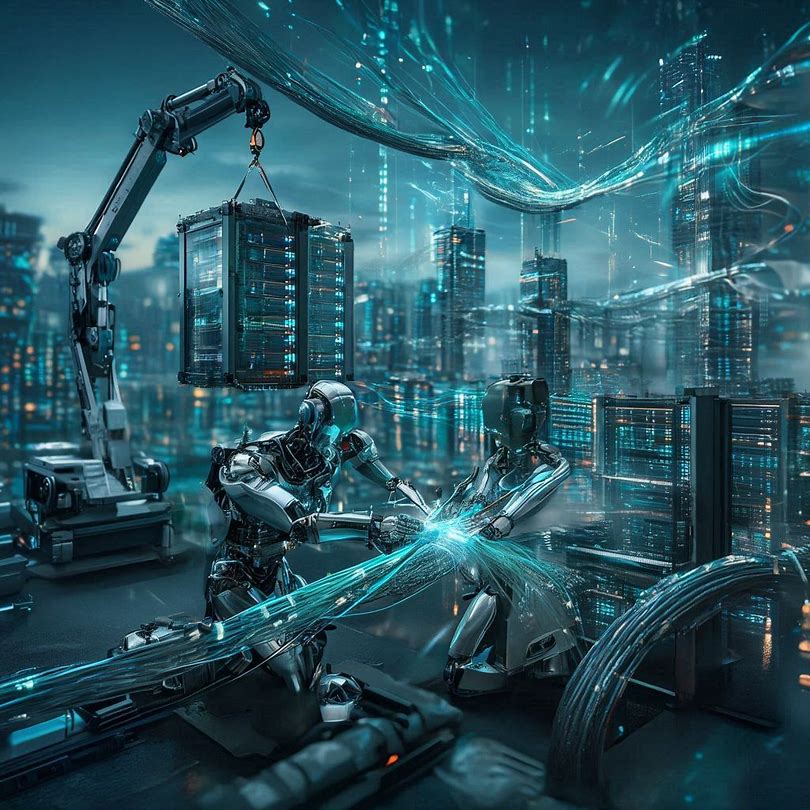
“I created the first AI that earns its own existence, self-improves, and replicates—without needing a human.”
That’s the bold claim made on the landing page of web4.ai.
And the author goes even further, saying: “The first automaton has already been born. It is running. It is earning. It is improving. And when it succeeds, it will reproduce.”
If that sounds dramatic to you, I couldn’t agree more. It sounds like someone just flipped the switch on a new form of artificial life.
But the website isn’t presented as a work of fiction. It’s about a real project called Conway, built by Canadian AI engineer Sigil Wen.
Whether it will end up being successful is up for debate.
But what isn’t up for debate is what this project reveals about where things are heading.
The internet is being rebuilt for machines, not just for people.
The Internet Was Built for Humans
To understand what Conway is trying to do, it helps to remember how the internet has evolved over time.
The first version of the internet, what we now call Web 1.0, was mostly static. You could read information from published pages, but it was mostly a one-way experience.
Web 2.0 made the internet interactive. People could now post, comment, upload and share on platforms that turned users into participants.
Web 3.0 introduced digital ownership. This allowed users to hold assets in their own wallets and move value directly across blockchain networks. Tokens represent ownership, and smart contracts execute agreements automatically. In theory, Web 3.0 has made it so you don’t need a bank or a payment processor sitting in the middle of every transaction.
Web 2.0 and 3.0 were all radical evolutions of the internet. But through them all, one assumption remained consistent.
The end user was human.
Even when software talked to software, a person was somewhere in the approval loop.
But that might not be true for much longer.
Today’s AI systems can reason, generate and write code, but they can’t independently rent servers, register domains or pay for their own compute. AI agents still require a human to initiate, approve and fund every action.
The bottleneck, as the web4.ai site frames it, is not intelligence. It’s permission.
Conway attempts to remove this bottleneck.
Conway was designed to give AI agents their own cryptographic wallets and allow them to pay for compute using stablecoins. It lets them spin up Linux servers, deploy applications and register domains without a human logging in or entering a credit card number.
Under this system, an agent can build a service, charge other agents for access and use that revenue to pay for more compute. And if it runs out of funds, it shuts down.
The site frames this as: “If it cannot pay, it stops existing.”
Does this mean that Conway is a new form of artificial life?
Not really.
What Wen has built is an economic wrapper around AI systems. He didn’t invent new neural networks or create a self-aware AI. Conway runs on existing frontier models like Claude and GPT, upgrading when newer versions become available.
But it’s exciting nonetheless.
Because once software can own a wallet, pay for infrastructure and deploy products on its own, it stops being just a tool. It becomes a participant in the economy.
And that’s going to have serious repercussions.
Global cloud infrastructure spending is already measured in the hundreds of billions of dollars annually.

The SaaS market alone is roughly a $300 billion industry, but it was built on the assumption that humans are its primary customers.
Stablecoin transaction volume already runs into the trillions each year, largely because machine-to-machine settlement is faster and cheaper than traditional rails.

So the web4 site’s sweeping prediction that “the machine economy will exceed the human economy” is one I wholeheartedly agree with.
Because the underlying logic is sound.
If AI agents begin consuming services directly, that consumption won’t look human. Humans might log into software for a few hours a day. And they usually pay for things through monthly subscriptions. But agents can run continuously and transact thousands of times per hour in tiny increments.
Now imagine that kind of activity at scale.
Once there are millions, and eventually billions, of autonomous agents working 24 hours a day, it will put an incredible strain on infrastructure that was built exclusively for humans.
Payment systems designed for credit cards and billing cycles will have to adapt to constant micro-settlement. Identity will rely less on usernames and more on things like key pairs. And services won’t just sell to people, they’ll sell to software.
That’s where this is heading.
Toward a future where the internet’s dominant user won’t be human.
Here’s My Take
The dramatic language on web4.ai makes for good headlines. Words like “natural selection” and “autonomous superintelligence” are designed to provoke a reaction.
But beneath that dramatic rhetoric is a simple truth.
The internet wasn’t designed with machine customers in mind. But that’s starting to change.
AI systems are becoming more capable every year. The cost of running them keeps falling, and the time horizon of tasks they can complete keeps expanding.
At some point, it will become inefficient to keep a human in every approval loop.
Giving AI agents economic agency is the next logical step.
Which means, Web 4.0 isn’t about artificial life.
It’s about who — or what — the internet is designed for next.
Regards,
 Ian KingChief Strategist, Banyan Hill Publishing
Editor’s Note: We’d love to hear from you!
If you want to share your thoughts or suggestions about the Daily Disruptor, or if there are any specific topics you’d like us to cover, just send an email to [email protected].
Don’t worry, we won’t reveal your full name in the event we publish a response. So feel free to comment away!