Sometimes there’s a pattern SO beautiful that it would be crazy not to trade it.
Other times, I’m so focused on one of my favorite patterns that I trade a pattern within a pattern.
It’s counterintuitive, but I know what works best for me.
Still, this was one of the most beautiful intraday cup and handle charts I’ve seen in a while.
Even more wild, it was also a multiday cup and handle (but not as clean).
If you’ve ever wondered about the cup and handle pattern, you’ll love this.
Even if I did drop it in the cup…
What’s the Cup & Handle Pattern?
It’s a continuation pattern. It’s pretty simple: the pattern looks like a cup with a handle from the side. Here’s an example…
Source: StocksToTrade
Cup and Handle Chart Example: Rare Element Resources Ltd. (REEMF).
The cup with handle signal is another way of saying the pattern is a bullish chart pattern. The pattern signals technical traders about a potential breakout.
Technical traders often buy right when the stock climbs back to the pivot price. (The pivot is the top of the handle.)
In the case of an inverse cup and handle, it’s bearish. It signals a potential breakdown.
William O’Neil also wrote about it in his classic book “How to Make Money in Stocks.”
It’s definitely a book you should add to your collection (and READ).
He said:
“Cup patterns can last from 7 weeks to as long as 65 weeks, but most of them last for three to six months. The usual correction from the absolute peak (the top of the cup) to the low point (the bottom of the cup) of this price pattern varies from around the 12% to 15% range to upwards of 33%. A strong price pattern of any type should always have a clear and definite price uptrend prior to the beginning of its base pattern.”
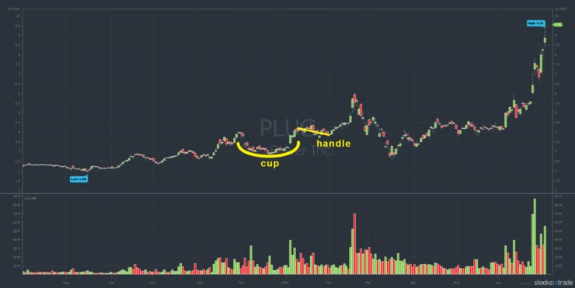
Here’s another example. It’s not textbook cup and handle, but the pattern is still obvious.
Source: StocksToTrade
Cup and Handle Chart Example: Plug Power (PLUG).
Now, I have my favorite patterns to trade. So I don’t go on the hunt for the cup and handle pattern.
But — and this is super important — a lot of traders do. And that means it can be a self-fulfilling prophecy.
In other words, if enough traders see the cup shape, they can get interested.
Then they see the pullback handle. And then it can turn into a breakout just because so many people believe it will happen.
They all buy together and drive up the price.
It’s not an exact science. Patterns fail all the time and for a variety of reasons.
That’s why it’s essential to plan your trades and follow rule #1: cut losses quickly.
The Cup & Handle That I Played As a Dip Buy
The funny thing is that I didn’t even trade this one as a cup and handle.
I took the dip buy off of the afternoon squeeze.
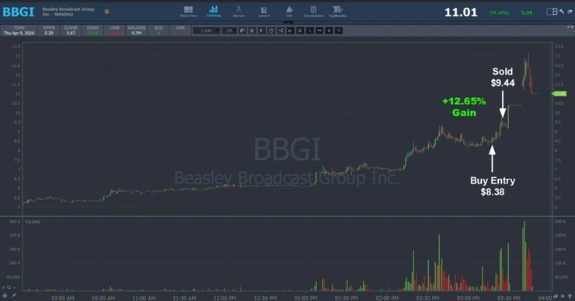
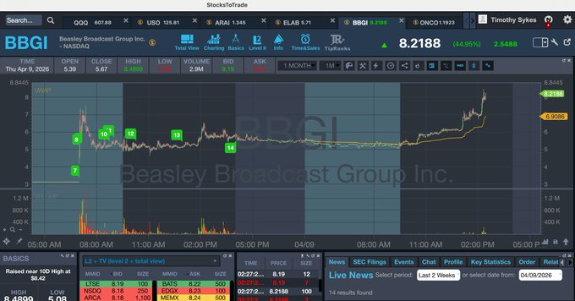
But if you look at the two-day chart below, it forms a multiday cup and handle.
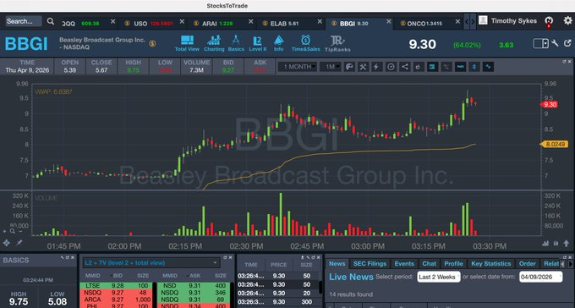
Beasley Broadcast Group Inc. (BBGI) was an earnings winner on April 8.
It chopped sideways before ramping into one of the best plays of the day the next day.
Source: StocksToTrade
BBGI 04/09/10, dip buy, cup & handle.
As you can see, BBGI formed a cleaner cup and handle on the intraday chart.
Source: StocksToTrade
Source: StocksToTrade
My buy entry was inside the cup (much better than when I play golf). And I sold right at the start of the handle.
Let’s look at the structure of the pattern with this example…
Source: StocksToTrade
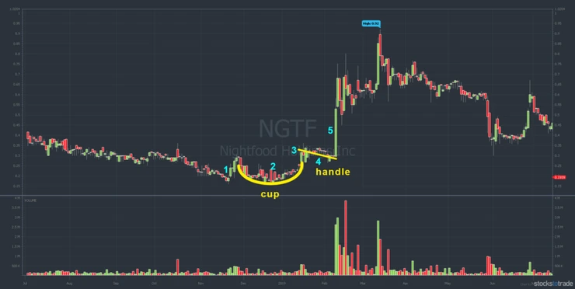
Cup and Handle Structure Example: Night Food Holdings (NGTF).
Here’s how to spot the cup & handle pattern using NGTF as an example:
1. Upward momentum. O’Neil said to look for a 30% upward move to the rim of the cup.
2. A pullback forming an arc or U shape. The base length can vary — and does. Pure long-term technical traders tend to follow the “seven weeks or more” rule. You won’t always have that luxury with penny stocks.
3. Ramping up to the rim on the right. The great Jesse Livermore called this the high pivot.
4. A pullback to form the handle. O’Neil liked a downward handle as opposed to an uptrending handle. His backtesting showed uptrending handles often lead to cup and handle pattern failure.
5. Strong upward momentum to breakout above the high-pivot (i.e., the breakout).
If you have any questions, email me at [email protected].
Cheers,
 Tim SykesEditor, Tim Sykes Daily