The strategy behind Global Water’s asset base makes sense; areas with population growth and relatively scarce water supplies should see ever-rising demand for water. Global Water is well-positioned to grow in such areas.
The utility has many tailwinds, including considerable growth in its recycled water deliveries, massive rate increases, and solid population growth in Phoenix.
Its regulated annual revenues have been growing consistently over the years. During the last decade, the company has grown its revenues at a 7.6% average annual rate. Water is an essential commodity, so its consumption is resilient even under the most adverse economic conditions. As a result, Global Water’s revenues should remain resilient during a potential recession, as was the case during the Great Recession.
Source: Investor relations
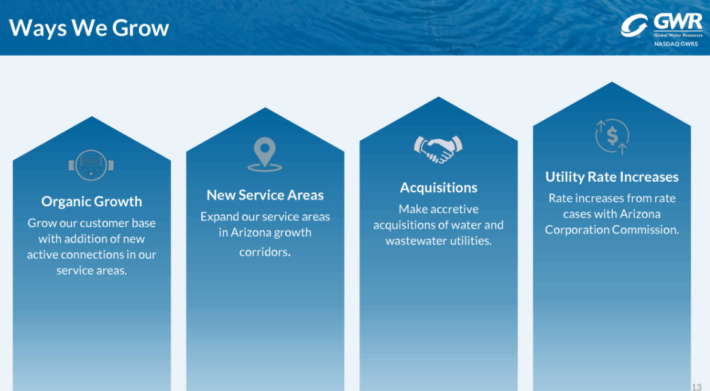
We expect organic growth contributions from rate increases, which amounts to another low single-digit gain annually, on average. Like other utilities, Global Water is able to pass through approved pricing increases to its customers, which is a steady, long-term tailwind to revenue.
Overall, thanks to material rate hikes and Global Water’s sustained expansion, we expect the utility to grow its earnings per share at an average annual rate of 6.0% over the next five years.
Dividend & Valuation Analysis
Water stocks are prized for their stable dividends and consistent dividend growth. Global Water has paid a monthly dividend since May of 2016, with a handful of monthly raises from the initial two cents per share. These small increases over time have led to a dividend growth streak of 10 years.
The current payout is $0.0253 per share monthly or $0.30 per share annually, and it was not affected by the worst of the coronavirus crisis.
This results in a current yield of 3.9%, which is on the lower side for a utility stock. In addition, we are concerned about the dividend’s safety, as Global Water’s earnings haven’t covered the dividend in recent years.
Earnings per share for 2021, 2022, 2023, 2024, and 2025 came in at just $0.16, $0.24, $0.33, $0.24, and $0.11, respectively, whereas the annual dividends were $0.29, $0.30, $0.30, $0.30, and $0.30 in those years. In other words, Global Water paid out much higher dividends than its earnings during that period. This means the company has a significant shortfall and must fund the payout through other means, including debt and share issuances.
Another feature of Global Water is its dividend growth rate. The company has grown its dividend at a rate of just 1.7% over the last 10 years, which is much lower than the utility sector’s five-year median dividend growth rate of 5.43%.
We expect Global Water’s earnings power to be $0.33 in 2026. In such a case, the payout ratio would be below 100%. Thanks to its regulated business and the reliable cash flows resulting from its business model, Global Water can easily borrow funds to support its future dividend. Nevertheless, given the recent years of maintaining a payout ratio well above 100%, the dividend should not be considered entirely safe in the long run.
Shares of Global Water are trading at 23.3x our earnings power estimate for the year, which is above our target price-to-earnings ratio of 18.0. Reaching our valuation target by 2031 could reduce annual returns by 5% over this period.
This headwind will be offset by the 3.9% dividend yield and our expected growth rate of 6%. We predict total returns of 4.5% through 2031.
Final Thoughts
We think Global Water has a positive road ahead regarding earnings growth. Given the multiple sources of organic growth, the company is on a reliable revenue growth trajectory.
The dividend yield is solid at 3.9% and the company has increased its distributions at a steady, if unspectacular, rate over the last decade. But with shares trading above our fair value target, we maintain our hold rating on Global Water.
Don’t miss the resources below for more monthly dividend stock investing research.
And see the resources below for more compelling investment ideas for dividend growth stocks and/or high-yield investment securities.