Updated on April 1st, 2026 by Felix Martinez
Investors are often attracted to dividend-paying stocks for the income they generate. Dividend stocks provide income even as the stock price fluctuates.
Some companies pay monthly dividends, which provide more consistent cash flow for investors. Nearly 117 stocks pay a monthly dividend.
You can download our full list of monthly dividend-paying stocks (along with price-to-earnings ratios, dividend yields, and payout ratios) by clicking on the link below:

Ellington Financial Inc (EFC) is a Real Estate Investment Trust (REIT) that pays a monthly dividend. The stock has a very high dividend yield of 13.2%.
However, such high-yielding stocks can be flashing a warning sign that the underlying business is facing challenges. Stocks with extremely high yields above 10% might disappoint investors if they cut dividends later on. Those “yield traps” should be avoided.
This article will examine Ellington Financial’s business model, growth prospects, and its dividend safety.
Business Overview
Ellington Financial only transitioned into a REIT at the beginning of 2019. Before this, the trust was taxed as a partnership. It is now classified as a mortgage REIT.
Ellington Financial is a hybrid REIT, meaning that the trust is a combination of an equity REIT, which owns properties, and a mortgage REITs, which invest in mortgage loans and mortgage-backed securities.
The company manages mortgage-backed securities backed by prime jumbo loans, Alt-A loans, manufactured housing loans, and subprime residential mortgage loans.
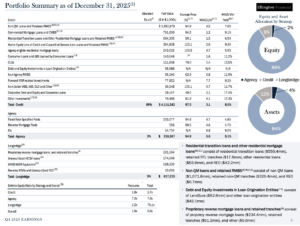
Ellington Financial has a market capitalization of about $1.2 billion. You can see a snapshot of Ellington’s investment portfolio in the image below:
Source: Investor Presentation
On February 25th, 2026, Ellington Financial reported Q4 2025 net income of $14.7 million ($0.14 per share) and adjusted distributable earnings of $51.4 million ($0.47 per share), comfortably covering its $0.39 dividend.
Performance was driven primarily by the investment portfolio, which generated $42.2 million—largely from credit strategies—and the Longbridge segment, which contributed $16.4 million. Overall, earnings remained solid, supported by strong loan origination and securitization activity.
The company continued to expand its portfolio, with the credit portfolio growing 15% quarter-over-quarter to $4.11 billion and total investments increasing about 9%. Growth was concentrated in non-QM loans, Agency-eligible loans, reverse mortgages, and commercial mortgage assets.
However, profitability showed some pressure, as net interest margins declined in both the credit (3.37%) and Agency (2.18%) portfolios due to lower asset yields.
From a balance sheet perspective, Ellington strengthened its capital structure by issuing $400 million in unsecured notes and increasing long-term, non-mark-to-market financing through securitizations.
Book value declined slightly to $13.16 per share, while leverage remained elevated at approximately 9.0x debt-to-equity. Liquidity remained solid, with $201.9 million in cash and $1.57 billion in unencumbered assets. Overall, the company improved financial flexibility, though margin compression and high leverage remain key risks.
Growth Prospects
Ellington’s EPS generation has been quite inconsistent over the past decade, as rates have generally declined. As a result, its per-share dividend has also mostly been falling since 2015.
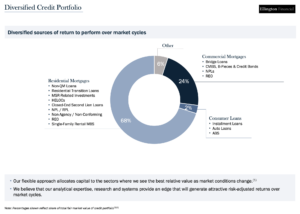
However, the company has done its best to diversify its portfolio and reduce its performance variance.
Additionally, its residential mortgage investments are diversified among many different security types (Non-QM, Reverse mortgages, REOs, etc.).
Ellington has taken steps not to concentrate its risk in its portfolio, which improves economic return volatility.
Source: Investor Presentation
Ellington has structured its portfolio so that movements in rates over time won’t have a major impact on its overall performance.
The Federal Reserve has stated it is likely to decrease interest rates in the future if inflation reaches its target, which would benefit the company.
We expect 1% annual EPS growth for EFC over the next five years.
Competitive Advantage & Recession Performance
We don’t consider Ellington’s dividend safe at this point, with a rollercoaster of cuts and hikes in recent years hampering the stock’s investment case.
Still, the most recent cut should allow Ellington to build some equity value on the balance sheet and potentially improve the overall margin of safety for investors.
The days of mortgage REITs employing 8x or 9x leverage have come and gone, but risks attached to over-leveraged balance sheets have not evaporated.
In this case, it’s worth noting that the recourse debt-to-equity ratio decreased to 1.9:1 in Q4, remaining stable compared to the previous quarter.
Dividend Analysis
Ellington Financial has a volatile dividend history with multiple reductions followed by increases. The company cut its monthly dividend from $0.15 to $0.08 in Q1 2020 due to the pandemic, but management has since increased it several times.
In Q4 2023, EFC cut the monthly dividend from $0.15 to $0.13, a move the board approved to build equity value. The dividend has remained at the same rate since. Currently, EFC has an annual dividend payout of $1.56 per share.
This is a concerning sign for the dividend’s safety; therefore, the company’s DPS should not be considered safe for the time being.
With a yield approaching 14%, the stock is undoubtedly attractive for income investors, although a high level of volatility is to be expected.
Ellington’s payout ratio has averaged 85% over the last five years, though it has often exceeded 100% in the past. Investors should be aware that the expected payout ratio for 2026 is 98%.
Since its IPO, the company has paid cumulative dividends exceeding $34/share, nearly three times its current share price. Therefore, it has delivered a solid income stream to its shareholders over the years.
Final Thoughts
High-yield dividend stocks must always be considered carefully, as their elevated yield is often a warning sign of fundamental deterioration.
This seems to be the case with Ellington Financial, as the company has exhibited great volatility in its dividend payments.
The trust has a diversified loan portfolio and has successfully increased its profitability over time. Ellington Financial’s dividend yield also looks safe for now, though another cut could be possible if the trust saw a slowdown in its business.
EFC has an attractive yield of 13.2%, but the stock carries elevated risk.
Additional Reading
Don’t miss the resources below for more monthly dividend stock investing research.
And see the resources below for more compelling investment ideas for dividend growth stocks and/or high-yield investment securities.
Thanks for reading this article. Please send any feedback, corrections, or questions to [email protected].