Updated on March 18th, 2026 by Felix Martinez
Regarding dividend growth stocks, the Dividend Aristocrats are the “cream of the crop.” These are stocks in the S&P 500 Index with 25+ consecutive years of dividend increases.
We recommend that long-term investors looking for the best stocks first consider the Dividend Aristocrats.
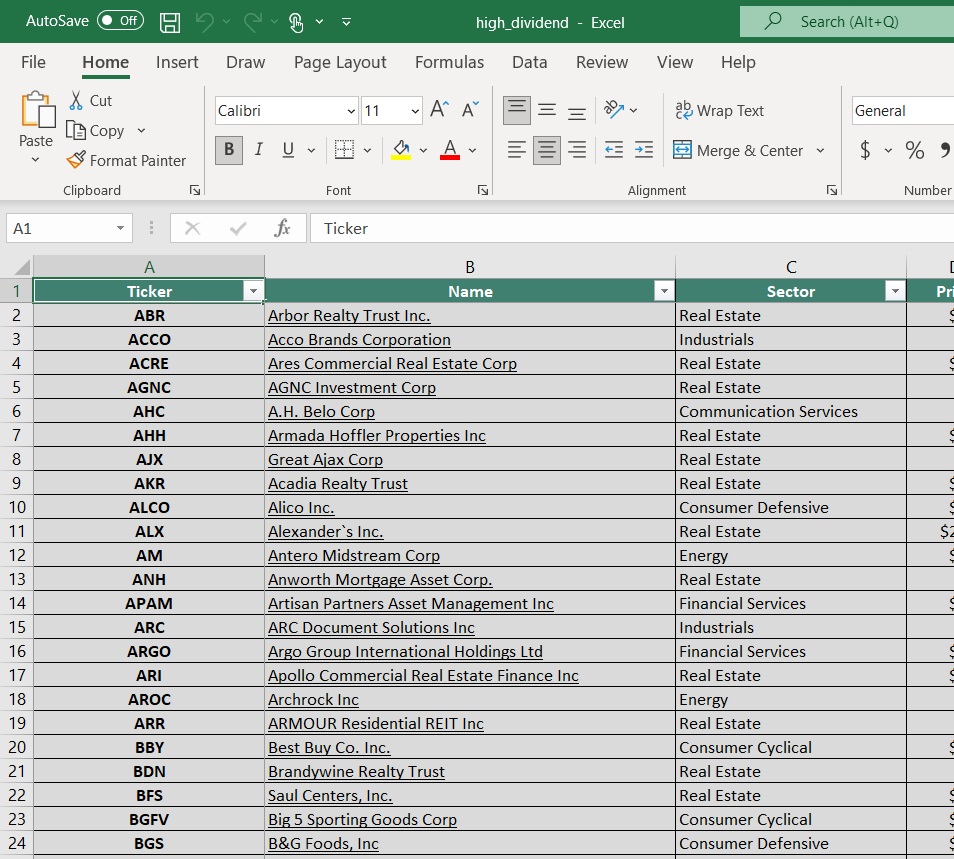
We have compiled a list of all 69 Dividend Aristocrats, along with relevant financial metrics like dividend yield and P/E ratios. You can download the full list of Dividend Aristocrats by clicking on the link below:

Disclaimer: Sure Dividend is not affiliated with S&P Global in any way. S&P Global owns and maintains The Dividend Aristocrats Index. The information in this article and downloadable spreadsheet is based on Sure Dividend’s own review, summary, and analysis of the S&P 500 Dividend Aristocrats ETF (NOBL) and other sources, and is meant to help individual investors better understand this ETF and the index upon which it is based. None of the information in this article or spreadsheet is official data from S&P Global. Consult S&P Global for official information.
At the same time, Real Estate Investment Trusts (REITs) seem like natural fits for the Dividend Aristocrats. REITs are required to distribute at least 90% of their earnings to shareholders, which leads to steady dividend growth for the asset class, provided earnings continue to grow.
And yet, there are only three REITs on the Dividend Aristocrats list: Federal Realty Investment Trust (FRT), Essex Property Trust (ESS), and Realty Income (O).
Realty Income has a very impressive dividend history, particularly for a REIT. Realty Income is a Dividend Aristocrat. It is also a monthly dividend stock, meaning it pays shareholders 12 dividends each year instead of the more typical quarterly payment schedule.
This article will discuss this Dividend Aristocrat in more detail.
Business Overview
Realty Income was founded in 1969. It is a retail-focused REIT that has become famous for its successful dividend growth history and monthly dividend payments, even labeling itself “The Monthly Dividend Company.”
The trust employs a highly scalable business model that has enabled it to become a massive landlord with more than 15,500 properties.
It owns retail properties that are not part of a wider retail development (such as a mall) but instead are standalone properties. This means the properties are viable for many tenants, including government, healthcare, and entertainment services.
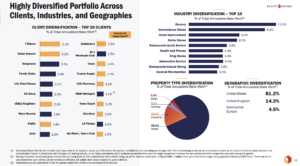
Source: Investor Presentation
Realty Income owns a highly diversified portfolio across industries, tenants, and geographies. The vast majority of its rent comes from e-commerce and recession-resistant tenants, making it a good bond substitute.
The company also has exposure to industrial, office, and agricultural tenants, though retail still makes up the bulk of its rental income.
The REIT’s business model is quite simple and has delivered spectacular long-term results.
Realty Income acquires well-located commercial properties, remains disciplined in acquisition underwriting, executes long-term net lease agreements, and actively manages the portfolio to maximize value.
The results of this model speak for themselves: 13.6% compound average annual total return since the 1994 listing on the New York Stock Exchange, a lower beta value (a measure of stock volatility) than the S&P 500 in the same time period, and positive earnings-per-share growth in 27 out of the past 28 years.
Growth Prospects
Realty Income’s future growth will be fueled by its proven and highly scalable business model. Acquisitions have been a major component of Realty Income’s growth for many years.
Annual rent increases provide for built-in revenue growth over time. The company has a long history of generating solid growth, both organically and through acquisitions.
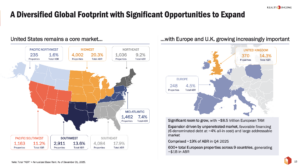
Source: Investor Presentation
On February 24th, 2026, Realty Income Corp reported Q4 2025 revenue of $1.49 billion, up 9.4% year over year, while EPS was $0.32, missing estimates. Net income totaled $296.1 million, compared with $199.6 million in the prior year.
AFFO per share was $1.08, up from $1.05, reflecting continued portfolio growth and higher rental income.
For full-year 2025, revenue increased to $5.75 billion (+9.1%), while net income reached $1.06 billion ($1.17 per share). AFFO per share rose to $4.28 from $4.19, and FFO per share increased to $4.25.
The company invested $6.3 billion in 2025 at an average cash yield of 7.3%, ending the year with 15,511 properties, 98.9% occupancy, and a weighted-average lease term of 8.8 years.
Looking ahead, management expects 2026 AFFO per share of $4.38–$4.42, implying ~2.8% growth at the midpoint, with investment volume projected at ~$8.0 billion. Same-store rent growth is expected at 1.0%–1.3%, and occupancy near 98.5%.
The company also extended its track record of dividend growth, delivering its 113th consecutive quarterly increase, with an annualized dividend of $3.24 per share.
Competitive Advantages & Recession Performance
REITs establish a competitive advantage by investing in the highest-quality portfolios. Realty Income has built a broadly diversified portfolio of well-located real estate with many high-quality tenants.
Realty Income also benefits from a favorable economic backdrop, with high occupancy rates and the ability to raise rents over time.
Another – and perhaps the most prominent – competitive advantage for Realty Income is its extremely strong balance sheet. With a credit rating of A- from Standard & Poor’s – solidly investment-grade and a high rating for a REIT – it can unlock value in significant acquisitions simply by refinancing the existing debt on the properties it acquires at considerably lower interest rates.
As a result, it can profitably invest in high-quality assets that many of its competitors cannot. This allows it to build a more robust portfolio and access more growth levers, generating superior risk-adjusted returns for shareholders.
History shows that these competitive strengths allow Realty Income to outperform well during the worst of economic recessions. For example, its FFO per share during the Great Recession (2007-2009) grew at an annualized rate of 2.1%, and its occupancy remained highly resilient throughout the period.
This was a remarkable achievement and speaks to the strength of the business model. We expect Realty Income to hold up similarly well during the next downturn and, in fact, present the trust with an opportunity to refuel its growth pipeline, as it will likely use its strong balance sheet to snatch up discounted properties.
Valuation & Expected Returns
Based on our expected 2026 adjusted FFO per share of $4.47, Realty Income’s stock trades at a price-to-FFO ratio of 14.4x. Investors can think of this as similar to a price-to-earnings ratio.
Our fair value estimate is based on a P/FFO ratio of 14, indicating the stock is slightly overvalued.
A decreasing P/FFO ratio could lower annual returns by 0.5% over the next five years. Also, future returns will comprise a mix of FFO growth (estimated at 3.3% annually) and dividends (current yield of 5.1%), resulting in expected annual returns of 7.9%.
The current dividend yield is well above the S&P 500 average, and the company has done an excellent job growing the dividend payout over time.
Final Thoughts
Investors flock to REITs for dividends, and with high yields across the asset class, it is easy to see why they are so popular for income investors.
We have compiled a list of 150+ REITs worth further consideration based on their dividend yields and growth potential. You can see our entire REIT list here.
Realty Income stock is expected to return 7.9% per year at its current price, making it a Hold.
If you are interested in finding more high-quality dividend growth stocks suitable for long-term investment, the following Sure Dividend databases will be useful:
The major domestic stock market indices are another solid resource for finding investment ideas. Sure Dividend compiles the following stock market databases and updates them monthly:
Thanks for reading this article. Please send any feedback, corrections, or questions to [email protected].