Updated on February 20th, 2026 by Bob Ciura
The Dividend Aristocrats are widely known as the best dividend growth stocks to buy and hold for the long term.
These companies have generated strong profits year after year, even during recessions, and have proven the ability to grow their earnings steadily over many years.
The Dividend Aristocrats are a group of companies in the S&P 500 Index, with 25+ consecutive years of dividend increases. Of the stocks that comprise the S&P 500 Index, just 69 currently qualify as Dividend Aristocrats.
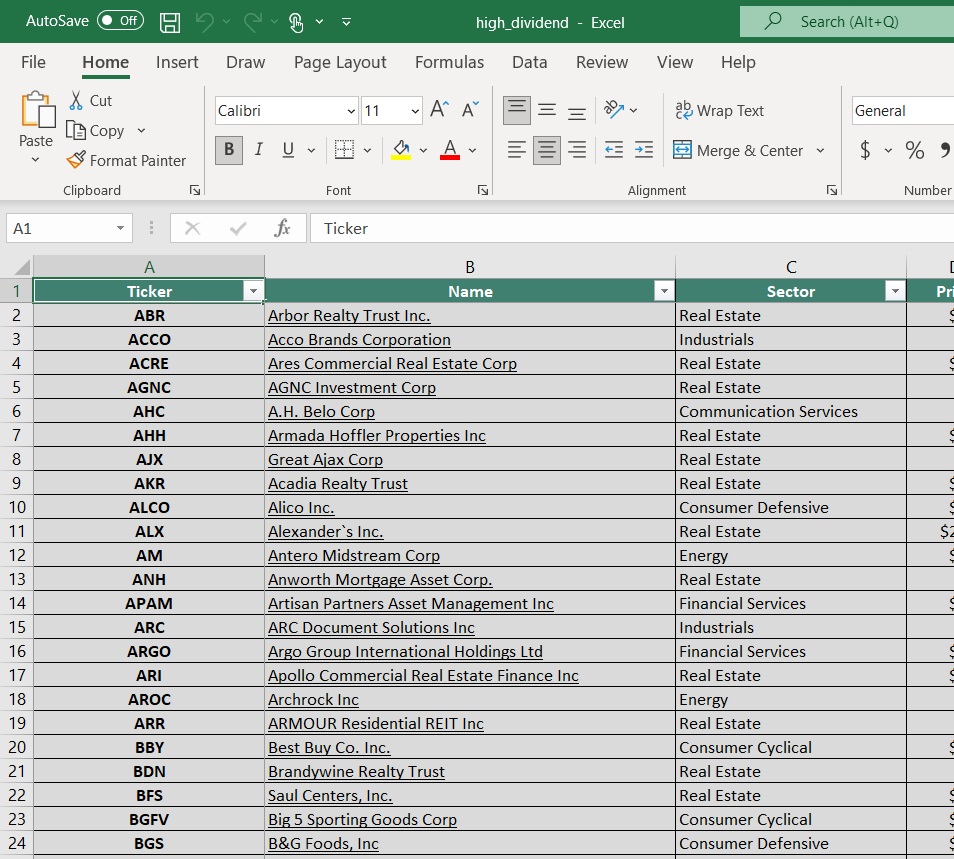
You can download an Excel spreadsheet with the full list of Dividend Aristocrats by clicking on the link below:
Disclaimer: Sure Dividend is not affiliated with S&P Global in any way. S&P Global owns and maintains The Dividend Aristocrats Index. The information in this article and downloadable spreadsheet is based on Sure Dividend’s own review, summary, and analysis of the S&P 500 Dividend Aristocrats ETF (NOBL) and other sources, and is meant to help individual investors better understand this ETF and the index upon which it is based. None of the information in this article or spreadsheet is official data from S&P Global. Consult S&P Global for official information.
Once per year, we review each of the Dividend Aristocrats. Up next in the series is the consumer products behemoth Procter & Gamble (PG).
P&G has paid dividends for 134 years and has increased its dividend for 69 consecutive years.
Not only is the company a Dividend Aristocrat, but it is also a Dividend King as well. The Dividend Kings have increased their dividends for 50+ consecutive years.
Procter & Gamble is one of the most well-known dividend stocks, largely due to its extremely long dividend history and its widely recognizable brands.
This article will discuss P&G’s recent portfolio transformation, future growth prospects, and stock valuation.
Business Overview
Procter & Gamble is a consumer products giant that sells its products in more than 180 countries and generates over $85 billion in annual sales.
Some of its core brands include Gillette, Tide, Charmin, Crest, Pampers, Febreze, Head & Shoulders, Bounty, Oral-B, and many more.
During P&G’s massive portfolio restructuring over the past few years, the company sold off dozens of its consumer brands. Today, P&G has slimmed down to just ~65 brands, down from 170 previously.
The benefit of the restructuring is that P&G held on to its core consumer brands while shedding low-margin businesses with limited growth potential.
This transformation has weighed on the top line, but it should allow Procter & Gamble to focus on its strongest, most profitable brands moving forward. Indeed, the company has returned to solid growth mode in the last seven years.
Growth Prospects
Procter & Gamble has grown its earnings-per-share by 7.1% per year on average over the last decade. Sales have grown 2% per year on average over this period, and net profit margin has increased.
P&G has continued to generate steady results in recent quarters. In late January, Procter & Gamble reported (1/22/26) results for the second quarter of fiscal 2026 (its fiscal year ends June 30th).
Its sales edged up 1% while organic sales remained flat over the prior year’s quarter, as modest price hikes were offset by slightly lower volumes. Core earnings-per-share remained flat at $1.88, beating the analysts’ consensus by $0.02.
The firm sales amid sustained price hikes are a testament to the strength of the brands of Procter & Gamble. However, we note a remarkable deceleration in price hikes in the last seven quarters.
This indicates that the company cannot keep raising its prices aggressively anymore. Due to soft consumer spending amid increased economic uncertainty, Procter & Gamble reiterated its modest guidance for fiscal 2026.
It expects 0%-4% growth of organic sales and 0%-4% growth of core earnings-per-share.
Overall, we expect 5% average annual growth of earnings-per-share.
Competitive Advantages & Recession Performance
P&G has several competitive advantages. The first is its strong brand portfolio. P&G has several brands that generate $1 billion or more in annual sales.
The ~65 remaining core brands hold leadership positions in their respective categories. These products are associated with high quality, and consumers will pay a premium for them.
The company invests heavily in advertising to retain its competitive position, which it can do thanks to its financial strength.
The company invests billions more each year in research and development. This investment is a competitive advantage for P&G; R&D fuels product innovation, while advertising helps market new products and gain share.
P&G’s competitive advantages allow the company to remain profitable, even during periods of recession. Earnings held up very well during the Great Recession:
2007 earnings-per-share of $3.04
2008 earnings-per-share of $3.64 (19.7% increase)
2009 earnings-per-share of $3.58 (-1.6% decline)
2010 earnings-per-share of $3.53 (-1.4% decline)
P&G had a very strong year in 2008, with nearly 20% earnings growth. Earnings dipped only mildly in the following two years.
This was a very strong performance in one of the worst economic downturns in the past several decades. The company continued to perform well during 2020-2021 when the coronavirus pandemic sent the U.S. economy into recession. Once again, P&G generated stable profits and raised its dividend.
P&G has a recession-resistant business model. Put simply, everyone needs paper towels, toothpaste, razors, and other P&G products, regardless of the economic climate.
Valuation & Expected Returns
Based on the expected earnings-per-share of $6.98 for fiscal 2026, P&G is trading at a price-to-earnings ratio of 22.7.
Over the past decade, shares traded with an average valuation of around 20 times earnings. As such, shares appear to be more than fully valued. The improved growth prospects of the company appear to be priced in, and then some.
If P&G’s valuation were to revert back to 20 times earnings, which is our estimate of fair value, future shareholder returns would face a -2.5% annual reduction over the next five years.
Earnings growth and dividends will help offset the impact of a contracting price-to-earnings multiple. For example, we expect P&G to generate 5% annual earnings growth, and the stock has a current dividend yield of 2.7%.
Total returns are expected at 5.0% per year, as the impact of a declining valuation multiple effectively offsets the company’s expected EPS growth.
The current dividend payout is well-covered by earnings. Based on expected fiscal 2026 earnings, P&G has a payout ratio of 61%. This leaves enough cushion for future dividend increases each year in the low-to-mid single-digit range.
Investors should expect P&G to continue increasing its dividend each year for many years to come. It has the brand strength, competitive advantages, and profitability to maintain its steady annual dividend increases over the long term.
Final Thoughts
P&G has many strong qualities that make it a time-tested dividend growth company. It has paid a dividend for 134 years. It has also earned a place on both the Dividend Aristocrats and Dividend Kings lists.
However, the current valuation – notably above its historical average despite a rising-rates environment – leaves something to be desired from a value perspective.
As a result, we have assigned shares a hold recommendation, given that valuation concerns overshadow the company’s dividend yield and dividend growth prospects.
Additionally, the following Sure Dividend databases contain the most reliable dividend growers in our investment universe:
The Dividend Champions: Dividend stocks with 25+ years of dividend increases, including those that may not qualify as Dividend Aristocrats.
The Dividend Kings: considered to be the ultimate dividend growth stocks, the Dividend Kings list is comprised of stocks with 50+ years of consecutive dividend increases
If you’re looking for stocks with unique dividend characteristics, consider the following Sure Dividend databases:
The major domestic stock market indices are another solid resource for finding investment ideas. Sure Dividend compiles the following stock market databases and updates them monthly:
Thanks for reading this article. Please send any feedback, corrections, or questions to [email protected].