Updated on February 6th, 2026 by Nathan Parsh
We believe the Dividend Aristocrats are the “cream of the crop” of the U.S. stock market. The Dividend Aristocrats are a group of S&P 500 stocks that have increased their dividends for at least 25 years, among other requirements.
With this in mind, we created a list of all 69 Dividend Aristocrats, along with important financial metrics such as dividend yields and price-to-earnings ratios.
You can download your free list of all 69 Dividend Aristocrats by clicking on the link below:
Disclaimer: Sure Dividend is not affiliated with S&P Global in any way. S&P Global owns and maintains The Dividend Aristocrats Index. The information in this article and downloadable spreadsheet is based on Sure Dividend’s own review, summary, and analysis of the S&P 500 Dividend Aristocrats ETF (NOBL) and other sources, and is meant to help individual investors better understand this ETF and the index upon which it is based. None of the information in this article or spreadsheet is official data from S&P Global. Consult S&P Global for official information.
We review all the Dividend Aristocrats each year. Next up, we will review the food and beverage giant PepsiCo (PEP).
The stock offers a solid 3.5% dividend yield and has increased its dividend for over 50 years in a row. The company’s dividend is very safe, and the stock is suitable for risk-averse income investors.
PepsiCo’s valuation is well below its historical average, and it continues to post solid results.
Business Overview
Pepsi-Cola was created in the late 1890s by Caleb Bradham, a North Carolina pharmacist. Meanwhile, Frito-Lay, Inc. was formed in 1961 from the merger of Frito Company and the H. W. Lay Company. In its current form, PepsiCo came together as a result of the 1965 merger of Pepsi-Cola and Frito-Lay.
Today, PepsiCo is a global food and beverage giant with a market capitalization nearing $230 billion and approximately $94 billion in annual revenue.
Its business is split roughly 60-40 in terms of food and beverage revenue. It is also balanced geographically between the U.S. and the rest of the world.
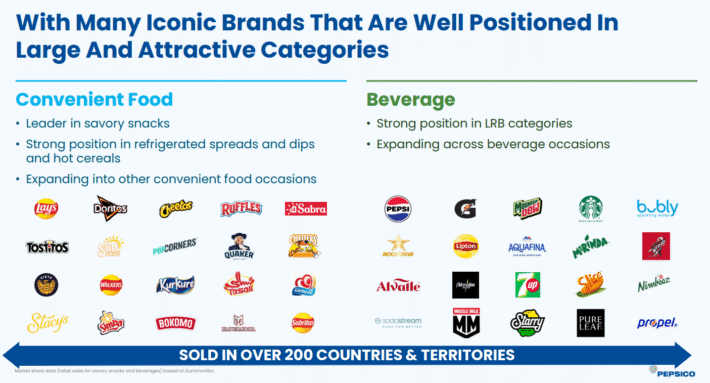
PepsiCo has a large portfolio and owns many popular brands.
Source: Investor Presentation
Some of the company’s major brands include Pepsi and Mountain Dew sodas and non-sparkling beverages like Pure Leaf, Tropicana, Gatorade, and bottled water.
In addition to PepsiCo’s core beverage brands, it also has a large snacks business under the Frito-Lay brand. The company has also built a portfolio of healthier foods, including Quaker, Naked, and Sabra.
On February 3rd, 2026, PepsiCo reported fourth-quarter and full-year results for the period ending December 31st, 2025. For the quarter, revenue increased 5.6% to $29.3 billion, which was $370 million above estimates. Adjusted earnings-per-share of $2.26 compared favorably to $1.96 in the prior year and was $0.02 better than expected.
For the year, revenue grew 2.3% to $93.9 billion while adjusted earnings-per-share of $8.14 was down from $8.16 in 2024.
Organic sales were up 2.1% for the quarter and 1.7% for the year. For the quarter, food volume fell 2% while beverages increased 1%. PepsiCo Beverages North America’s revenue improved 2% for the period even as volume decreased by 4%. PepsiCo Foods North America was down 1%, primarily due to divestitures. Food volume was lower by 1%.
PepsiCo provided an outlook for 2026 as well, with the company expecting organic growth of 2% to 4%. Adjusted earnings-per-share are projected to be 4% to 6% for the year.
Growth Prospects
PepsiCo has a long history of steady growth. Even in a challenging environment due to declining soda consumption, PepsiCo has continued its consistent growth.
We believe PepsiCo will generate 6% adjusted earnings-per-share growth per year over the next five years, which compares to the company’s five- and 10-year growth rates of 6.4% and 5.9%, respectively. Going forward, two of PepsiCo’s most promising catalysts are growth in healthier foods and beverages and emerging markets.
Large soda companies like PepsiCo have had to adapt to a more health-conscious consumer. To do this, PepsiCo has shifted its portfolio toward healthier foods that are resonating more strongly with changing consumer preferences.
In addition, PepsiCo has a huge growth opportunity in emerging markets like China, Africa, India, and Latin America.

Source: Investor Presentation
These are under-developed regions of the world with large consumer populations and high economic growth rates.
International markets (particularly emerging ones) have been a growth driver over the past few years.
Last quarter, revenue in Europe/Middle East/Africa was up 5%, Latin America Foods increased 5%, and Asia Pacific Foods was higher by 4%.
Competitive Advantages & Recession Performance
PepsiCo has numerous competitive advantages, including strong brands and a global scale. In all, PepsiCo has more than 20 brands that each collect at least $1 billion in annual revenue. Strong brands give PepsiCo optimal shelf space at retailers and pricing power.
PepsiCo’s financial strength also allows the company to invest in research and development and advertising to retain its competitive advantages.
For example, PepsiCo invests billions each year in research and development to innovate new products and packaging designs. In addition, PepsiCo regularly spends more than $2 billion each year on advertising to maintain market share and build brand equity with consumers.
PepsiCo’s competitive advantages and strong brands make the company highly profitable, even during recessions. Food and beverages always retain a certain level of demand, which is why the company held up so well during the Great Recession.
PepsiCo’s earnings-per-share throughout the Great Recession of 2007-2009 are listed below:
2007 earnings-per-share of $3.34
2008 earnings-per-share of $3.21 (3.9% decline)
2009 earnings-per-share of $3.77 (17% increase)
2010 earnings-per-share of $3.91 (3.7% increase)
As you can see, PepsiCo’s earnings-per-share declined only modestly in 2008. The company then increased earnings by nearly 20% in 2009, which is very impressive. Earnings continued to grow once the recession ended.
The company reported strong growth in 2020 and 2021 when the coronavirus pandemic sent the U.S. economy into a recession. Therefore, PepsiCo is a recession-resistant business.
Valuation & Expected Returns
We expect PepsiCo to generate earnings per share of $8.55 for 2026. Based on this, the stock trades for a price-to-earnings ratio of 19.6. Our fair value estimate is a price-to-earnings ratio of 24.0. Therefore, PEP stock appears undervalued. Multiple expansion could add 4.1% to yearly annual returns over the next five years.
Earnings-per-share growth and the stock’s dividend yield will also drive total returns. We expect PepsiCo to grow earnings-per-share each year by 6%. In addition, PepsiCo also has a 3.5% current dividend yield.
The combination of valuation changes, earnings growth, and dividends results in total expected returns of 13.0% per year over the next five years.
PepsiCo’s dividend is secure, with a projected payout ratio of about 69% for 2026. This gives PepsiCo enough room to continue increasing the dividend at a rate in line with the growth rate of its adjusted EPS.
Given the total return potential and the company’s overall quality, we rate shares of PepsiCo as a buy.
Final Thoughts
PepsiCo is a very strong business with several category-leading brands. Investing heavily in new products and acquisitions will likely continue growing sales and earnings for many years.
Shareholders should continue to benefit from PepsiCo’s strong business through annual dividend increases. Few other companies in the consumer staples sector can match its dividend growth history. PepsiCo recently achieved Dividend King status in February 2022.
We believe that PepsiCo remains a valuable holding for a dividend growth portfolio.
Additionally, the following Sure Dividend databases contain the most reliable dividend growers in our investment universe:
If you’re looking for stocks with unique dividend characteristics, consider the following Sure Dividend databases:
The major domestic stock market indices are another solid resource for finding investment ideas. Sure Dividend compiles the following stock market databases and updates them monthly:
Thanks for reading this article. Please send any feedback, corrections, or questions to [email protected].