Advisory firm teams are composed of individuals from a variety of backgrounds who each bring their unique personality, preferences, and work style to the client base. When a team is well-supported, and individuals can contribute their best work, satisfaction, productivity, and retention are typically high across the entire team. Yet the tool most commonly used to evaluate these issues – personality and aptitude assessments – is often deployed in superficial or inconsistent ways, rather than to fuel real business and work decisions.
In this article, Senior Financial Planning Nerd Sydney Squires discusses how to select an assessment that surfaces the team’s needs… and how to use results to inform strategic decisions that actually make a difference for team satisfaction, productivity, and retention. Kitces Research on Advisor Wellbeing underscores that high job satisfaction is not just about the firm culture and vision… but also how the day-to-day feels. Team members who feel effective and engaged in their work are far more likely to avoid burnout and remain in their roles in the long term!
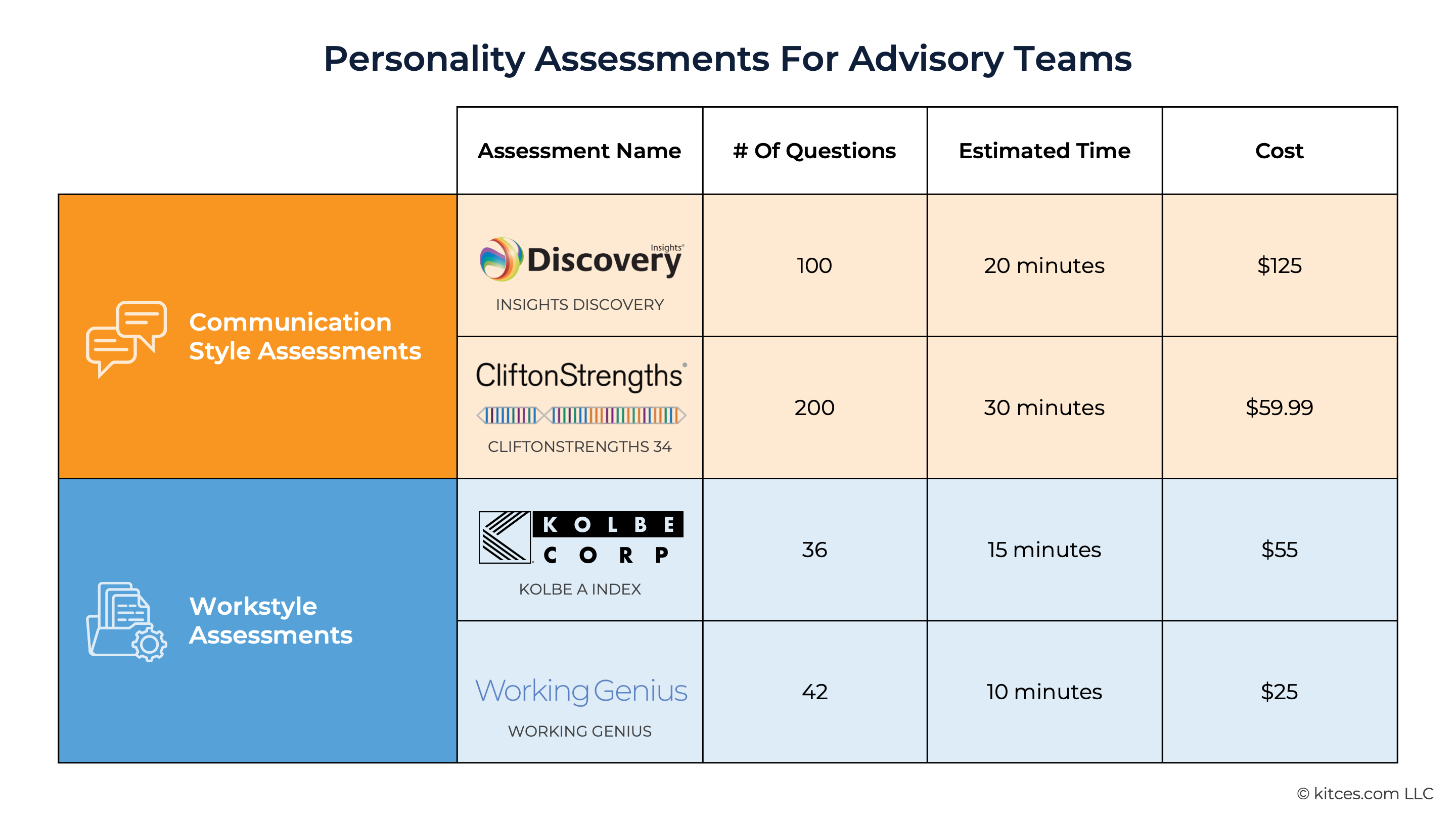
Not all assessments, however, are equally useful in practice. The most effective tools are psychometrically sound (i.e., producing consistent results), contrastable (able to show clear differences between individuals), and focused (avoiding overcomplication). They offer nuanced insights – avoiding false dichotomies like introvert versus extrovert – and resonate with the individuals being assessed. The most valuable assessments fall into two categories: communication style tools, which help teams navigate interpersonal dynamics; and aptitude tools, which clarify how individuals approach work tasks. Assessments like Insights Discovery, CliftonStrengths, Kolbe A Index, and Working Genius are especially well-suited for advisory teams, offering practical frameworks for workload allocation, role fit, and collaboration strategies.
Advisory firms benefit most when assessments are tied to a specific goal – such as improving communication or refining role fit – and followed by structured team conversations. These debriefs create opportunities for reflection and honest dialogue, helping team members understand their results, identify potential conflicts or synergies, and begin to articulate how their roles might better reflect their strengths. The most fruitful discussions happen not when assessments are used to box people in, but when they spark curiosity and collaborative problem-solving about how work gets done. In the long term, assessments can also be used in one-on-one conversations to evaluate seat fit. Sometimes, it can be difficult to ‘admit to’ or talk about friction in a role, but using assessments as a starting point can provide a helpful point of entry to highlight (potential) gaps between an employee’s ideal and current role.
Ultimately, the real power of personality assessments lies not in the test results themselves, but in how those insights are applied. Used strategically, assessments can help managers diagnose sources of team friction, support more satisfying role design, and even inform smarter hiring decisions by identifying where gaps exist within the current team’s mix of strengths. Most importantly, they create a common vocabulary for discussing the otherwise intangible elements of work – like communication, energy, and motivation – that drive both individual and firm-wide success. When woven into the rhythm of firm operations, assessments become not just a tool for understanding people, but a lever for unlocking better performance, stronger engagement, and more durable advisory teams.
Read More…