Financial advisors call it “leakage,” a dangerous habit that drains retirement accounts to pay for today’s wants. But new research suggests that 401(k) loans are rarely used for frivolous spending, serving instead as a critical safety net for households hitting a wall on medical bills and housing costs.
Processing Content
The research, conducted by the Employee Benefit Research Institute and J.P. Morgan Asset Management, analyzed the spending behavior of private-sector 401(k) participants to determine where loan proceeds were actually spent. The researchers found that health care and housing were the most significant drivers of borrowing.
Medical costs were the main culprit. Nearly half (47.6%) of households that took a loan faced a jump in health care spending of more than 10% that year. In fact, when comparing borrowers to nonborrowers, health care was the only spending category that rose significantly more for those who dipped into their 401(k)s.
Housing was also a major factor, with the data showing a clear link between plan loans and new mortgages.
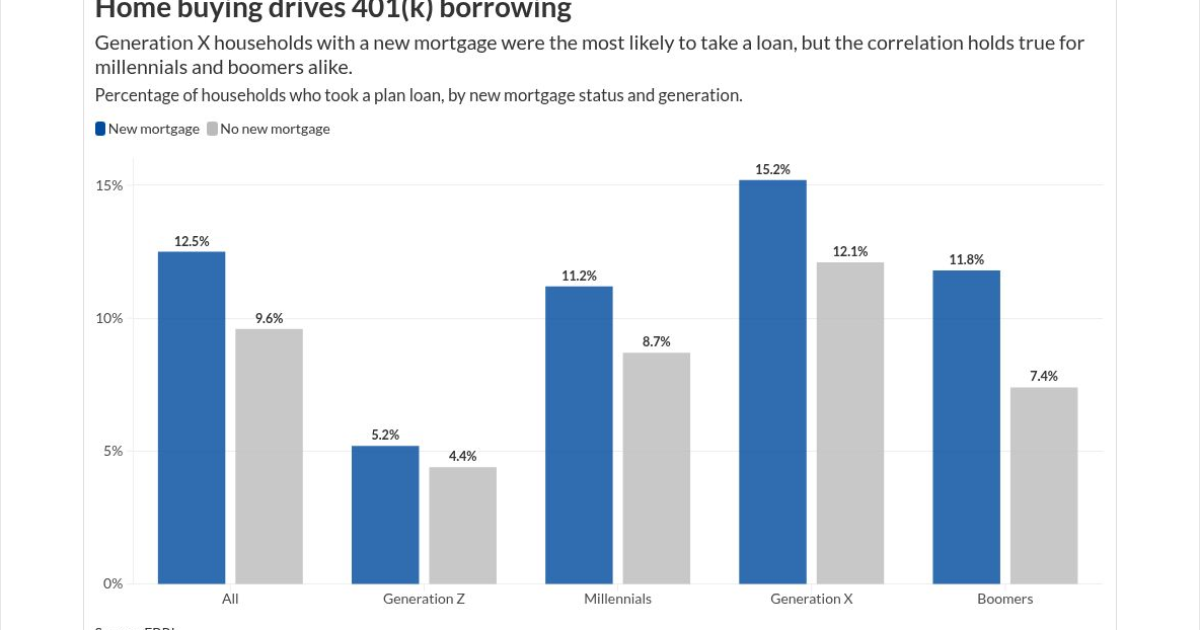
Households that started making mortgage payments were more likely to have taken a plan loan (12.5%) compared to those who did not start a mortgage (9.6%). This correlation held true across all age groups, suggesting that participants are frequently using retirement funds to cover down payments or closing costs.
Because these loans primarily fund essential needs like health and housing, researchers say restricting access to them wouldn’t necessarily improve retirement security. In fact, the report warns that without the option of a plan loan, participants would likely fill the gap with outside loans that carry less favorable terms, potentially causing more long-term financial harm.
Advisors warn of ‘tax bombs’ and performance drag
Despite the research suggesting these loans are often necessary for financial survival, financial advisors remain wary of treating a 401(k) as a multipurpose bank account.
Vince Clanton, a principal and investment advisor representative at Atlanta-based Chancellor Wealth Management, said he generally encourages employers not to allow for hardship loans at all. Clanton said that employees often view their 401(k) balance as their only liquid form of savings, failing to account for the risks of job separation.
“If an employee leaves the firm with a debt, they must satisfy the debt, or it is deemed a distribution, subject to ordinary income tax and [potentially] a 10% penalty if the employee is under 59 1/2,” he said.
Beyond the tax implications, Clanton said that loans generally cause the portfolio to underperform due to the opportunity cost of the assets being out of the market.
“The better answer is to encourage a balance between the 401(k) contribution and an emergency fund held with a bank,” he said.
Can 401(k) loans work for home down payments?
While the EBRI data highlights the popularity of using plan loans for housing, advisors like Michael Espinosa, president of TrueNorth Retire in Salt Lake City, warn against such an approach.
A client’s need to raid retirement funds to afford a home often signals that the buyer is overextending themselves, Espinosa said.
“I see it as an issue if they need to take a loan from their retirement account in order to have the down payment for a home because it encourages them to stretch beyond their means,” Espinosa said.
Dean Tsantes, a financial advisor at VLP Financial Advisors in Vienna, Virginia, agreed, particularly for younger clients who need compound interest to work in their favor.
“I would encourage them to do early planning for the long term and look at the 401(k) for only retirement and not a bucket of money they should have access to in case there is an emergency,” Tsantes said.
He advocates for a “bucket” strategy where clients build three to six months of liquid savings before aggressively funding other goals.
A viable option for the right client?
For all of their drawbacks, some advisors say defined contribution plan loans have their place for certain clients, especially when the alternative is a higher-interest loan.
Cody Ward, the founder of Leeway Planning in Walpole, Massachusetts, said that while the conversation must be prefaced with the explicit risks — taxes, penalties and sequence of returns — there is a time and place for 401(k) loans.
“Under the right circumstances, it can make a lot of sense when pitted against high-interest debt that is working against financial goals,” Ward said.
If the client understands the risks and has remedied the financial habits that created the situation in which they need a DC plan loan, Ward said it’s sometimes “better for the client to be their own bank” than to rely on predatory lenders.
“It’s ultimately a decision that belongs to the client,” Ward said.