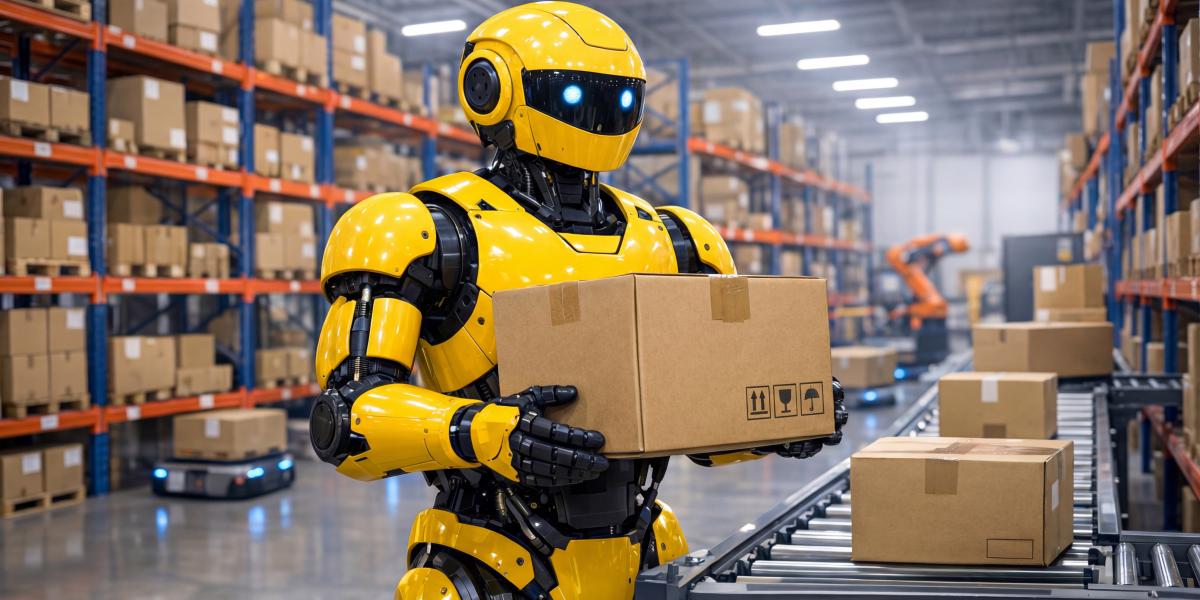
The advance of automation has accelerated the development of machines capable of performing repetitive and physically-demanding tasks, transforming processes that once took hours into actions that are now completed in minutes. For example, the robotic arm developed by Pickle Robot Company was specifically designed to handle packages in logistics environments. Its main function is to load and unload boxes from trucks with precision, a task that demands significant physical effort and poses risks to workers.
In other words, technology increases productivity and quality of life by eliminating physical exertion, and workers can invest that saved time in other tasks, expanding and developing human knowledge.
It goes without saying that politicians don’t like robots since they don’t pay personal taxes or contribute to state “social security” funds that enrich bureaucrats and their cronies. But they don’t just hate robotics; they hate productivity in general. Imagine what would happen if the cumbersome procedures that companies are forced to undertake to satisfy the bureaucracy—taxes, environmental regulations, etc.—didn’t exist? Bureaucracy would disappear.
According to the International Labor Organization (ILO), a Latin American is three times less productive than a European. As we will see, there is clearly a relationship between overwork and poverty, and the key lies in low productivity due to the same old thing: the useless interference of bureaucrats.
“From home to work and from work to home,” Perón used to repeat, revealing the true purpose of statism: for people to work for the state, that is, to be almost slaves at the service of bureaucrats and politicians who use the government monopoly of violence for all kinds of regulations. The result of this policy of coercive impositions is not only the enormous waste of time dealing with bureaucracy, but it also hinders the natural development of society by stifling its productivity. For example, under the false pretext of “defending national industry,” the entry of better technology at better prices into the country is made more difficult.
For a long time, and even today, it was a popular belief that the problems of Latin America were largely due to the laziness of its inhabitants. And the explanations ranged from the hot climate to racism: Latinos were supposedly lazy due to cultural or, rather, genetic factors.
But surprisingly, Latin America is where people work the most. For example, according to the ILO, in Colombia each person works an average of 2,298 hours per year, in El Salvador 2,246, in Mexico 2,226, in Costa Rica 2,210, in the Dominican Republic 2,122, in Chile 2,101, in Brazil 2,028, and in Argentina 1,924, while in developed countries such as France 1,867, Switzerland 1,856, Ireland 1,851, the USA 1,792, and Germany 1,778.
In other words, it’s not about working long hours; on the contrary, technological development and rationality—which bureaucrats lack—allow us to dedicate fewer hours to work and more to leisure.
For example, the “flexible hours” campaign in Houston, Texas, encourages employees to freely start their workday around noon to avoid traffic jams, achieving a 58 percent reduction in stress levels, and time. There, companies like Chevron include options such as staggered work schedules and alternating 9/80 days off work schemes.
Incidentally, robotics has reignited the old debate of man versus machine. According to the OECD, more than 60 million workers are at risk of being replaced by robots in the coming years. At least 14 percent of jobs in developed countries today are highly automatable. Manufacturing and agriculture are the sectors that would be most impacted by Industry 4.0, as this technological revolution has been called, which—according to the International Federation of Robotics—is growing at a rate of 15 percent annually.
Conversely, robotics professor Marko Munih, from the University of Ljubljana, asserts that this revolution will bring benefits to the consumer, who will obtain cheaper products, and to the worker, who will be able to develop more skilled and better-paying jobs.
History shows how technology opens new opportunities. In 1830, around 60 percent of the English population worked the land. Then, for two years, rural workers staged uprisings, burning farms, killing livestock, and destroying agricultural machinery in protest against the adoption of a technological innovation: the threshing machine, which replaced backbreaking labor that had previously employed many people.
Today, only 3 percent work the land, unemployment has fallen, and agricultural production has increased dramatically. Most people now work in industries developed by technological advancements: automobile factories, electronics factories, telephone companies, airlines, etc. If technology brought more unemployment, the most advanced countries, such as the US and Germany, would have a high unemployment rate, and yet they have low unemployment. The countries with the highest density of robots—South Korea, Germany, and Japan—have a low unemployment rate.
So, contrary to what many say, technological development enhances human creativity, enriching us, making life easier, and opening up opportunities for new jobs and challenges. Two hundred years ago, pilots and air traffic controllers were unthinkable, as were the vast numbers of people working in robot factories, the masses employed by dot-com companies, and so on.
And there’s plenty of work to be done. Just think of the housing shortage, the lack of hospitals, schools, and so forth. It’s the politicians who create unemployment with coercive laws that prevent voluntary work. For example, the minimum wage law effectively prohibits those who earn the least from working—precisely those who need it most. Wages aren’t increased by laws mandating a minimum level, but rather by capital investment that creates more productivity, efficiency, and jobs. Ironically, this requires facilitating the labor market by promoting, not prohibiting, hiring.
To top it all off, the government collects taxes that impoverish everyone involved. Impoverished—almost driven to crime—by the very politicians who then promise welfare using the tax revenue they collect (only after pocketing a portion for themselves), workers are discouraged from production.