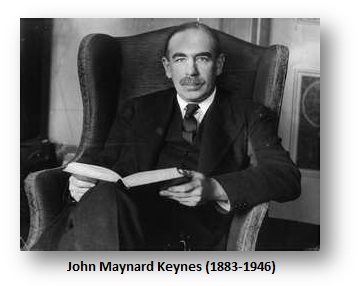
In his 1936 book, ‘The General Theory of Employment, Interest and Money,’ John Maynard Keynes argued that aggregate demand was too volatile to be stable and would lead to inflation or recession. His theory honed in on spending as a means of price control. Low aggregate demand, Keynes argues, would lead to high unemployment and stagflation. Government could intervene through fiscal policies to increase aggregate demand, as an example, increased government spending could tame inflation. According to Keynes, interest rates could also be adjusted to encourage spending and stimulate demand. So why are these theories failing miserably today?
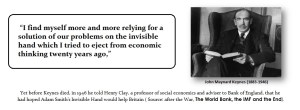
To begin, the United States had a balanced budget when Keynes presented his theory. The government is now the biggest borrower, acting in its own self-interest under Adam Smith’s theory of the invisible hand that Keynes spent his career attempting to deny. According to Keynes, “there is no self-correcting mechanism in a free market economy that automatically restores full employment.” He believed that the government could change the business cycle but arguably regretted this notion on his deathbed.
Keynesian economics gave the government the green light to manipulate the economy, or at least make numerous failed attempts to do so. There is that old joke about communism that you can vote your way in, but must shoot your way out, seemingly fitting to the utter disaster governments have created regarding our economic situation.
The government is by far the biggest borrower. Raising interest rates can have no impact on demand, as the government will simply borrow more, and the central banks have no control over government spending. In a historic act of defiance, Powell came out during the Biden administration and warned that government spending was completely unsustainable. It is extremely rare to see the Fed criticize Washington, but the situation has become too dire for anyone with integrity to remain quiet. Powell plainly stated that the government was borrowing against future generations of Americans. Now, Powell must continually defend the pivot away from failed QE programs due to Trump’s insistence on lowering rates to the negatives.
The central bank seeks to align with Washington to maintain public confidence. During the Great Depression, Washington forced the Federal Reserve to implement QE policies to artificially lower rates to increase demand. Yet, when Washington ordered the Federal Reserve to do the same during the Korean War in 1951, the central bank first broke with Washington and refused to comply, as it knew it would hurt the economy, as America’s budget was no longer balanced.
Quantitative Easing has destroyed the Keynesian model, leaving central banks with no alternative means of controlling the economy. If they raise rates, the budget explodes. Keynesians advocate manipulating aggregate demand and fiscal spending that the central bank cannot control. However, the other component of Keynesianism is the use of taxation. Keynes argued that to stimulate demand, you lower taxes. He saw this correctly, but again, it does not fit with government agendas. The government is desperate for funding and believes citizens must pay. Taxes alone could never make a dent in government spending, but some politicians genuinely do not understand that reality.
There is no limit to what the government will spend with “money” that does not exist. Governments continue to borrow perpetually with no real intention of paying back their debts. This is one piece of the Sovereign Debt Crisis that will implode like a nuclear bomb, the likes of which we have never witnessed. The business cycle cannot be manipulated, and, moreover, the Keynesian model cannot account for declining confidence in both government and the economy.