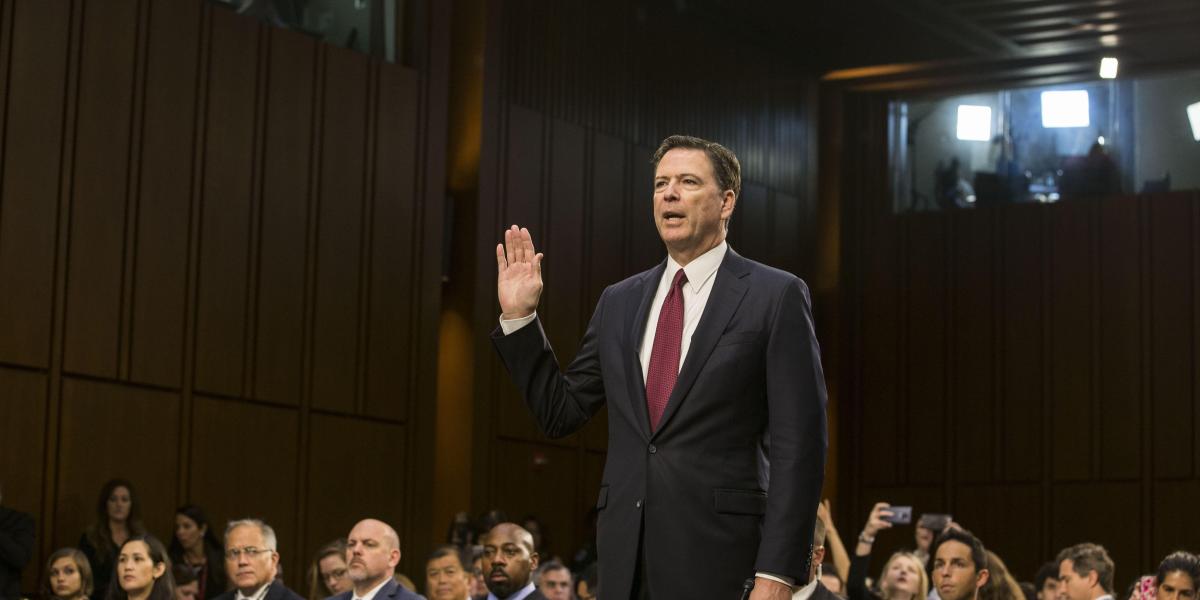
Last week, former FBI director James Comey was charged with making false statements to Congress. The specific comment in question occurred in September 2020, when Comey testified to a Senate committee that he had not authorized a leak of classified information to the media. The Department of Justice claims that it was untrue. A second count alleges that Comey was “obstructing” and/or “impeding” the Senate panel with his lie.
The two-page indictment is vague about the specific claims Comey made, but the hearing at which he was testifying was examining two investigations that Comey had, at least partially, overseen. The first—named Crossfire Hurricane—was looking into whether the Russian government had intervened to help elect Donald Trump in 2016.
Comey was leading the investigation when he met with then-President-elect Trump in January of 2017. After “briefing” Trump on what the Bureau had learned so far about Russian activity, the FBI director requested a few minutes alone with the president-elect, where he presented Trump with highly embarrassing, obscene, and almost definitely fake rumors that had been compiled by an opposition research firm hired by the Clinton campaign.
Comey knew where the rumors had come from and that they were, in his own words, “salacious and unverified.” And yet, in what looks a lot like a blackmail attempt, he was evidently motivated to show the president-elect some embarrassing records the Bureau had on him. He also reassured Trump that the FBI was not investigating him, even though they were investigating his campaign, and therefore were looking closely at Trump.
After the meeting, Comey rushed out to a Bureau car, where a laptop was waiting for him to write a detailed account of the meeting, which he quickly emailed to “senior FBI leadership.” Details from Comey’s account found their way to the press a few days later.
However, that does not appear to be the leak this indictment is focused on. The charges seem to concern a leak that came from Comey’s deputy director, Andrew McCabe, relating to the second FBI investigation discussed at the 2020 hearing into Hillary Clinton’s email server.
McCabe’s lawyers claim that, when McCabe leaked classified information to a Wall Street Journal reporter related to that investigation, it was done with Comey’s knowledge. So the central questions in this case are whether McCabe is telling the truth and, if so, whether Comey’s allowing a subordinate to carry out leaks is legally equivalent to authorizing them.
Trump’s critics are trying to paper over those details and instead depict this indictment as simply a norm-shattering case of a president weaponizing the Justice Department to go after innocent people just because he doesn’t personally like them. That characterization would have more teeth if we hadn’t just lived through years of establishment officials attempting to weaponize the justice system to disqualify Trump from ever holding office again. Within that context, the Comey indictment is—at most—a minor attempt to push back at a key figure in that effort.
However, it’s better to understand this indictment as the latest chapter in a long struggle within the American federal government between elected and unelected officials.
This struggle has been a persistent feature of American politics since the beginning, and is well-documented in Murray Rothbard’s lengthy essay, “Bureaucracy and the Civil Service in the United States.”
As the first president, George Washington had the power to staff the tiny “civil service” authorized by the Constitution. Washington mostly appointed fellow Federalists who were ideologically aligned with his vision for the young country. John Adams—another Federalist—was even more aggressive in filling federal offices with loyal partisans.
In contrast, when the Federalists lost power in 1800, Jefferson, Madison, Monroe, and John Quincy Adams were not nearly as focused on removing Federalist bureaucrats, which hampered their party’s ability to make meaningful changes from the early Federalist years. But that changed with Andrew Jackson.
The Jacksonians understood that, if they wanted to implement the changes they had promised to the voters who put them in office, they needed to ensure that the people making up the federal government were, at the very least, not vigorously opposed to that agenda. Jackson and his successors were very active in trying to build an executive branch that was aligned with the president.
Party politics in the mid-nineteenth century were very ideological, and both parties worked hard to ensure the federal bureaucracy was aligned with their agendas when they were in power. But it came to a head under President Lincoln, who fired and replaced an astounding 96 percent of civil service employees upon taking office.
As the country moved on from the Lincoln years, a civil service reform movement emerged that sought to make it harder for presidents to fire federal employees.
The reform movement tried and failed to enact legislation to that end under Presidents Johnson, Grant, and Hayes. When President James Garfield took office, he was less committed to civil service reform than his predecessors had been.
But then, in 1881, Garfield was killed by a deranged man who shot him in a train station. The killer, Charles Guiteau, was severely mentally ill. He had become convinced that God wanted him to kill Garfield and that, as a result, he would be celebrated as a hero by the entire country. He was a sick man motivated by the delusions of a diseased mind.
However, when reformers discovered that one of Giteau’s earlier delusions had been that Garfield was getting ready to appoint him as the ambassador to either Austria or France, they seized on this detail to recast the assassin as a “disappointed office-seeker”—a characterization that remains popular to this day.
They then worked to exploit Garfield’s assassination. The only way to prevent future murders by office-seekers, they reasoned, was for Congress to eliminate the offices to be sought.
The campaign was successful. It culminated in the 1883 signing of the Pendleton Act, which put heavy limits on the changes elected executive officials could make to the unelected parts of the government.
With this new law, the permanent federal bureaucracy that we know today was born. And, in the following century, the federal bureaucracy’s interest shifted from advancing the ideologies of politicians and voters to protecting its own interests and those of their well-connected friends—all while it expanded in size from a couple of thousand permanent employees to well over three million.
That is the context in which the FBI was created and developed into its current form. It is—and has always been—a domestic intelligence agency that, above all, works to protect the permanent power structure in DC.
And James Comey himself is an excellent embodiment of the self-serving, permanent federal bureaucratic class. In his media tours and self-aggrandizing book, Comey frames himself as a stereotypical civil servant who’s above politics and committed only to higher principles, such as morality, the Constitution, and the rule of law.
But when you look back at his career climbing the federal judiciary, it’s clear his main motivation has been protecting the status quo that his bureaucratic class is benefiting so much from.
For example, as James Bovard detailed, Comey has sought to brand himself as a young prosecutor who stood up against the use of torture in the years after 9/11 when, in fact, he signed off on the legality of virtually every method the CIA was using and only wrote up a few concerns in internal memos about the possibility that the torture he had approved could create bad optics for the national security state.
Comey then left the government to work as a senior vice president at Lockheed Martin but returned in 2013 to lead the FBI. Meaning, as Trump surged and eventually won the election in 2016 on a platform that the vast majority of the federal bureaucracy enthusiastically opposed, Comey was in a key position to protect his unelected peers from the new administration voters had just sent to the White House.
If Comey and his allies’ aim was—as it seemed—to remove Trump from power, they failed. And they certainly deserve to face consequences for breaking rules to protect the status quo. But if MAGA Republicans, or any political movement, wants to prevent the “deep state” from sabotaging any attempt at actual reform, they must recognize the true nature of the federal bureaucracy and then roll back the laws and regulations that the permanent government’s absurd level of power relies on. Until that happens, there will be many more James Comeys.