Economists have two favorite expressions: First, the phrase “Sunk costs are sunk costs” means that costs expended thus far are water over the dam and should not themselves constitute a rationale to proceed with an effort that may have had persistent cost overruns or delays with no clear end in sight. Second, “There ain’t no such thing as a free lunch,” is self-explanatory and known by its acronym TANSTAAFL. This means that every action incurs some opportunity cost and someone will pay for it even as it may appear to be “free” to others.
Both of these principles apply to the California bullet train—originally authorized by voters in 2008—struggling for several years with its first 171-mile segment between Merced and Bakersfield in the state’s Central Valley, ultimately destined to become one segment of a longer bullet train route from San Francisco to Los Angeles.
About $14 billion has been spent on this phase of the bullet train project—82 percent of that from the state and the remaining 18 percent from federal grants. Reports reveal a $7 billion funding gap for completion of the Merced-Bakersfield segment by 2033. The US Transportation Department is investigating and a bill in Congress could entirely end further federal funding for the project.
William Anderson—Mises Senior Editor—has recently written about this California bullet-train fiasco here and here. He has also spoken about this with Ryan McMaken on the Radio Rothbard podcast.
How One US City Managed to Avoid Such a Sunk-Cost Disaster
Seattle, Washington is a city of half a million residents in a metropolitan area of over three million, with some of the nation’s worst gridlock traffic. Before some unexpected hiccups occurred along the way, Seattle nearly became another victim of an elevated rail project.
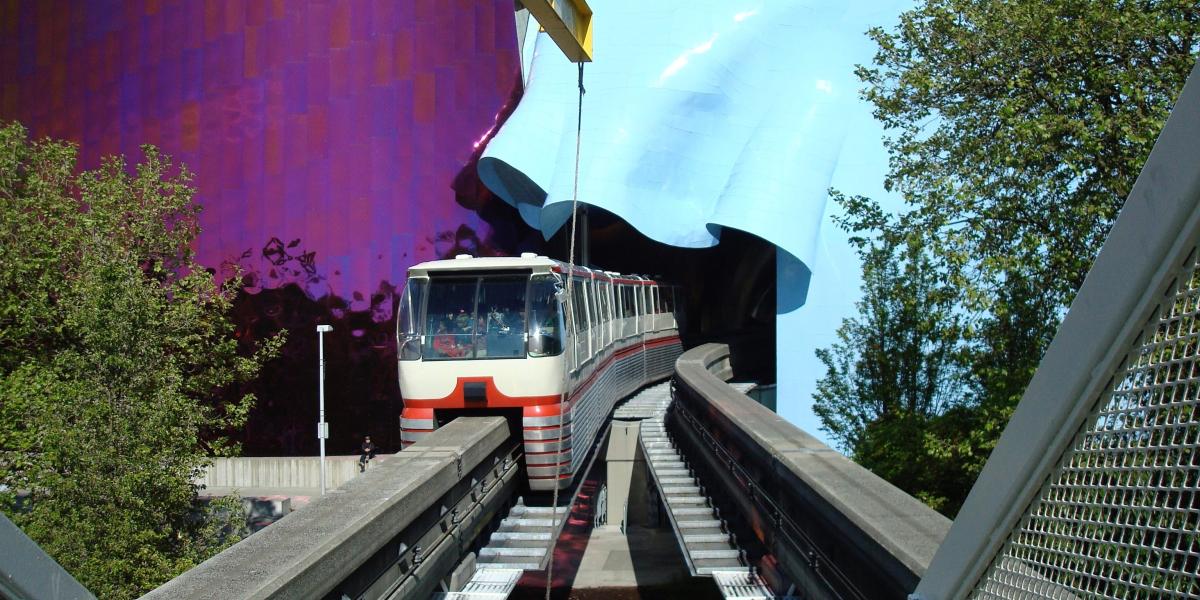
Note that this derailed Seattle monorail project is not the original 1962 world’s fair monorail, which still runs successfully under private management, charging above-market fares to ride the short distance from downtown to Seattle Center, about a 15-minute walk. This original monorail is a novel tourist attraction that cannot be considered serious urban rail transit, nor was it ever intended to be.
I lived in Seattle during the period of the ill-fated newer monorail project—1997-2008—as well as some years both before and afterward. After its original voter passage, I circulated petitions asking the city for ballot opportunities to cancel the project, spoke at city council meetings, wrote letters to local newspaper editors, and discussed it regularly with other Seattleites.
It was difficult to dissuade Seattleites from their romantic image of urban trains running above street level. The new monorail project, moreover, had competition in the form of a more ambitious light rail project, to be called Sound Transit. This project had been proposed at the same time in the mid-1990s, competing for voter support and funding sources.
This Sound Transit light rail project was better-funded than the monorail project and more politically viable because its routes would cover the entire Seattle metropolitan region rather than only the city itself. Its tracks would run both above traffic and underground. While city officials publicly supported both the monorail and light rail projects, their enthusiasm for light rail appeared greater. Its service began in 2009 between downtown and SeaTax airport.
Seattle’s Sound Transit light rail system is today deemed a success, adequately funded by car license fees, property tax, sales tax, rental car sales tax—and several handsome federal construction grants over the years.
The Story of the Ill-Fated Seattle Monorail Project
Here is the backstory of the Seattle monorail project based on my notes and memory of those days. Additional detail is available on Wikipedia, and the History Link.
What is now called the “Seattle monorail project”—to distinguish it from the 1962 world’s fair monorail—was a contentious political issue in Seattle from 1997 to 2005. After sufficient petition signatures qualified the project for the ballot in 1997, voters passed it 53 percent to 47 percent. The initiative proposed a 54-mile X-shaped monorail system connected to and extending the original 1962 monorail. The voter initiative created a new agency—the Elevated Transportation Corporation (ETC) using private funding.
When the ETC determined that private money could not build a monorail system without public funds, a second monorail referendum went on the ballot in 2000. It passed 56 percent to 44 percent, allowing $6 million for additional studies to design an improved plan with full cost estimates and funding for construction.
The ETC developed a plan that was now officially named the Seattle Monorail Project (the Project), which would dissolve the ETC, create a new monorail agency, and enact an annual 1.4 percent excise tax on motor vehicles registered in Seattle. This referendum passed in 2002 by 877 votes—50.2 percent to 49.7 percent. Construction was scheduled to begin in fall 2005 and be completed in 2009.
The annual vehicle excise tax began in June 2003. The average annual monorail tax per vehicle was $130. Yet the actual revenue from the tax came in 30 percent under projections while projected costs rose by 10 percent.
Just a year later, in 2004, a recall initiative went on the ballot seeking to halt the entire project by forcing the city to deny the Project the right to use the air space above public city streets. This fourth voter initiative in seven years lost 64 percent to 36 percent, prolonging the Project.
But the situation became worse following these four trips to the ballot box. The Project next proposed extending the tax and bond repayments over a 50-year time frame, which would result in about $9 billion in interest paid on the $2 billion construction cost. At the same time, the Washington state Treasurer announced that the state’s investment-grade bond rating could not be considered an endorsement of the Project’s bond issuance, leaving those bonds rated junk-grade.
The Seattle Monorail Project’s Denouement
At the news of a junk rating for the Project bonds, Seattle mayor Greg Nichols issued an ultimatum to create a new financial plan or lose city support. He had supported the four previous ballot issues, but now called for a measure on the November 2005 ballot to determine whether to continue the Project, the fifth time voters were asked to opine. When this fifth vote failed—65 percent to 35 percent—the Project reduced staff, terminated the annual motor vehicle excise tax, and began to sell properties already purchased for the proposed system construction.
The Seattle Monorail Authority was formally dissolved in January 2008 after liquidating all its assets, repaying its debt, and transferring its remaining cash balance to the county-run bus system. The failed monorail project ultimately cost Seattle taxpayers $124.7 million in taxes, costs of five ballot efforts, and miscellaneous expenses.
Thus was Seattle saved from becoming the victim of an ill-fated urban rail project because of a few individuals who stepped forward: a state Treasurer who refused to lend the state’s investment-grade rating to bonds issued by the teetering monorail project, a city mayor who finally determined that he could no longer support the project, and savvy voters who took their cues from these elected officials and nixed the project after four previous sustaining votes.
What about the Fate of the California Bullet Train?
One can only wonder how the Seattle Monorail Project managed to remain alive as long as it did—1997 through 2008. Are there sufficient similarities between this Project and California’s bullet train to provide clues to handle the struggling bullet train?
There comes a time when allocating resources to a failing project incurs significant opportunity costs, since those resources could be allocated to some of California’s other major problems—homelessness, crime rates, budget deficits, high taxes and cost of living. This should remind Californians of the important economic principle that there’s no free lunch, that everyone pays for the misallocated resources.
Though most Californians are presumably aware of the bullet train boondoggle, one senses that California’s deep-blue residents who vote as a monolithic block would have neither the will nor energy to endure the lengthy process of petitioning for an initiative on the ballot that could halt the project. Seattle voters, on the other hand, were a less monolithic deep-blue wall during the Monorail Project’s failure, though they have helplessly shifted further leftward recently.
To halt a large, failing, sunk-cost project like a monorail or bullet train requires strong leaders who can convince voters when it is time to cancel a project despite claims that doing so wastes the sunk costs. Both Seattle and California voters today share a tendency to continue voting for the same politicians who have previously mismanaged their respective states.
One can foresee a future time when the California bullet train’s concrete pylons—once intended to support train tracks in the Central Valley—may someday be unearthed by archeologists who will wonder what the project was intended for and what happened to it.
Editor’s Note: Jane L. Johnson, who had become popular with many of our readers, recently passed away. We will miss her intelligent copy and the many lively emails she sent to the editors. Rest in peace.