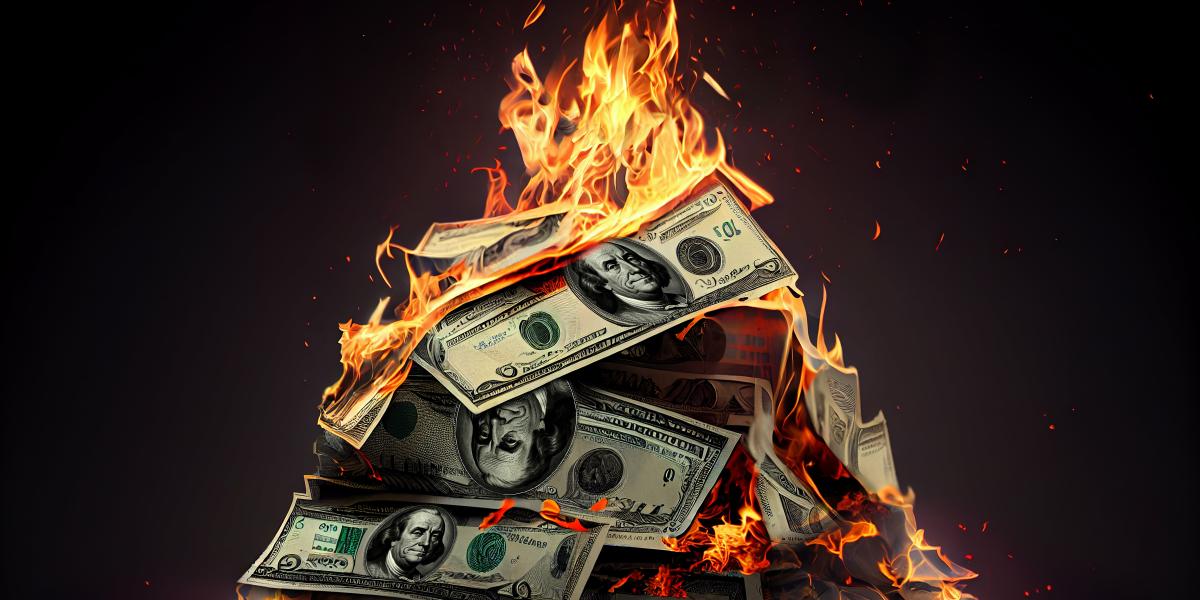
The title of this article may sound like a jab at MMT’s confidence in monetarily sovereign governments’ lack of fiscal constraint—and it is—but the real focus is on a cherished historical claim of MMT: that governments burned paper money collected through taxation.
MMT, History, and Burning Money
The MMTers are correct that, historically, several governments did burn paper money collected in taxes. In fact, there are several cases where governments have burned either paper money or tally sticks, and much modern currency is routinely shredded, pulped, or incinerated. Colonial American paper currencies were deliberately burned in several colonies prior to the Revolution, and similar destruction of depreciated paper money continued at the state and national levels after the Revolution, particularly during the withdrawal of Continental currency; medieval tally sticks were destroyed as obsolete financial instruments by the British government, causing a fire (1834, see image below); the Greenbacks were both eventually redeemed in gold and some were destroyed post-Civil War.
The Palace of Westminster on fire, October 1834, with Old Palace Yard in the foreground (public domain)
MMTers love to point out that governments have historically burned money. Randall Wray, in his “Modern Money Theory for Beginners” discusses governments burning money. Writing in the context of American colonial currency, he said,
What did the Treasury do with the notes it received in tax payment? Grubb reports that the “notes were removed and burned.” Yep. Burned:
“Most redemption taxes were collected in the fall, and so notes reported in the Journals of the House of Burgesses as burned were likely removed via tax payments in the prior year [Grubb].”…
The government recognized that it spent the paper currency into existence. It recognized that the purpose of the taxes imposed (by the same Acts that authorized issuing paper notes) was to redeem as many notes as possible. The taxes were not to “raise revenue”, indeed, when the paper notes were received in tax payments, they were burnt, not spent.
Elsewhere, he writes,
Farley Grubb—the foremost authority on Colonial currency—proved that the American colonists understood perfectly well that taxes drive money. Every Act that authorized the issue of paper money imposed a Redemption Tax. The colonies burned all their tax revenue. Again, history shows that this has always been true. All money must be redeemed—that is, accepted by its issuer in payment. As Innes said, that is the fundamental nature of credit. It is written right there in the early acts by the American colonies. Even a gold coin is the issuer’s IOU, redeemed in payment of taxes. Once you understand that, you understand the nature of money. (emphasis added)
Again, Wray argues,
The government imposed taxes payable in its own paper notes (its liabilities) or “specie” coin (liabilities of the crown of England). It issued its paper notes in payments by the treasury. When it received its tax revenue in the form of its own paper notes, it burned them. When it received coin in tax payments, it held them until an announced redemption day, to exchange for paper notes. (emphasis added)
Farley Grubb—referenced by Wray—cites a passage from The Statutes at Large; being a Collection of all the Laws of Virginia from the First Session of the Legislature, in the Year 1619, regarding Virginia’s 1760 paper money act, which reads:
And whereas it is of the greatest importance to preserve the credit of the paper currency of this colony, and nothing can contribute more to that end than a due care to satisfy the publick that the paper bills of credit, or treasury-notes, are properly sunk, according to the true intent and meaning of the several acts of assembly passed for emitting the same; and the establishing a regular method for this purpose may prevent difficulties and confusion in settling the publick accounts,… Be it therefore enacted, by the authority aforesaid, That…all such bills of credit, or treasury-notes, redeemable on the first day of March, one thousand seven hundred and sixty five, as have been or shall be paid into the treasury, in discharge of the duties and taxes imposed by any former act of assembly; and upon receipt of the said bills or notes, the said committee shall give to the treasurer for the time being a certificate of the amount thereof, which shall avail the said treasurer in the settlements of his accounts…: And the said committee are hereby required and directed, so soon as they have given such certificate, to cause all such bills or notes to be burnt and destroyed. (emphasis added)
What MMT Gets Partially Right
Governments certainly did rearrange real resources by issuing paper money; government revenue did not always need to be collected first through taxes before it was spent; tax acceptability, legal tender laws, and compulsory par laws did support and sustain some demand for a depreciating paper currency (i.e., Gresham’s law); legal structures and redemption schedules did help paper circulate, even when people might not have otherwise accepted it voluntarily; governments did accept back its paper money in settlement of tax obligations and did sometimes burn the money.
All these things can be affirmed without embarrassment, however, they do not confirm MMT. Where MMT goes wrong in this argumentation is in misplaced chartalist assumptions, historical inversion, disanalogies between theory and history, equivocation of definitions (e.g., chartalism, redemption), and reinterpreting destruction as ontology. Space only permits touching on a few of these elements here.
What MMT Gets Wrong: Chartalist Assumptions
Why governments burning or shredding money excites MMTers is because of misguided chartalist presuppositions, namely, that taxation imparts value to fiat-tokens and that tax collection is not about revenue but about removing excess currency from circulation. But this is a category error: it reinterprets the end of an inflationary-taxation process as demonstrative of the essence of money’s nature.
Chartalism proper, as I call it, argues that a government originates money by creating an otherwise-worthless fiat-foken—requiring citizens to exchange real resources for the fiat-tokens, then accepting the token alone in payment of taxes, while legally privileging the token (e.g., legal tender, etc.). Following this, the token becomes a generally-accepted medium of exchange because of these state actions. Thus, because of the state, money becomes money. In summary:
Money originates from the state, not the market;The state determines what money is by creating and/or naming an otherwise worthless fiat-token as a unit of account;As an unbacked fiat-token (i.e., like points on a scoreboard) becomes a medium of exchange and receives its value (demand) because it is required to pay taxes (and other legal requirements, e.g., legal tender laws)
Presupposing chartalism would lead us to accept that the government can originate money to rearrange resources, tax it to ensure value, then finally destroy the money to manage price inflation. The burning of money supposedly evidences money’s true nature (i.e., a state-created fiat-token) and its inherent worthlessness outside of the government spend-and-tax system, thus confirming MMT. The internal logic of MMT makes sense, but only if you already accept chartalism.
That said, Wray’s selected historical examples do not even match the definition. Market-chosen monies already existed, the fiat-token was not required exclusively for tax payment (other forms of payment were accepted), and the paper money was accepted because of its supposed link to real money (i.e., specie). At every point, the example fails to meet the definition.
Also, keep in mind that MMT proponents toggle between definitions of chartalism and whether chartalism is essential and foundational and unnecessary for Modern Monetary Theory. Such a position enables them to make bold historical claims only to retreat from inconvenient, disanalogous history when it suits them. Why this equivocation is necessary is because chartalism proper—strictly meeting each requirement of the theory—has never happened historically.
What MMT Gets Wrong: Inverted Historical Sequence
The sequence (described above) matters in chartalism. However, hopefully the informed reader can see that—at least in the case of the US—not only is chartalism theoretically and historically incorrect on every point, but the sequence is almost entirely backwards.
Multiple market-chosen monies already circulated;Governments accepted taxes in multiple forms, including the market-chosen monies;Depending on the previous two points, governments recognized the opportunity to expropriate purchasing power to themselves by inflating paper money;Governments promised convertibility and/or future redemption in true money (i.e., specie, gold, silver), as well as tax settlement, which facilitated conditional and temporary acceptance of government’s paper money;Governments later imposed coercive interventions to compel continued acceptance of the money in payment of public and private debts (e.g., legal tender laws, compulsory par laws, etc.) as inflation increased and the public’s trust faltered;Governments accepted both paper and specie in taxes;Sometimes governments destroyed (burned) the paper received in tax payments rather than redeem it for specie or spend it again
In all cases in American monetary history, market-chosen monies preceded the state and the public’s fragile, conditional acceptance of inflated paper money from the government depended on the (often misplaced) trust in the (usually false) promises of convertibility and/or future redemption, not in taxes, but in money proper (i.e., real money, specie, etc.). Statist intervention came after the fact and depended on such a process to enable artificial money expansion. The chartalist sequence is not just incorrect, it is nearly the inverse of history.
Ironically, the government depended on the preexistence of (imperfectly) sound money in order to have a chance to inflate instead of taxing. Without this feature, it would be doubtful that anyone would accept and continue to use what they knew to be pure government fiat paper money, except by legal force. This can only happen in a context where there are already media of exchange circulating. Governments—short on revenue and wanting to avoid unpopular taxation—print paper money and lead people to believe that the money will be redeemable in real money later. Money has not been created for the first time by this spend-and-tax process.
Why Burning?
Why did governments burn the notes they received back in taxes instead of using them for revenue?
There are several answers to this question, but the first and primary one seems to be that the real taxative purpose of the paper money had already served the government—expropriating purchasing power costlessly and without the appearance of direct taxation. Governments often choose the easy-money path of the hidden tax of inflation. This brings the printer-spenders and early users many benefits at the expense of others, however, there is a trade-off: by choosing this method of taxation people must be convinced that the money will be redeemable and will not be printed endlessly, the currency’s value will be gradually reduced, price inflation will occur, economic calculation is distorted, and there are even the risks hyperinflation and monetary collapse. While some may say that the political elites would not care about these consequences, even they recognize that such unchecked inflation undermines their ability to maintain power and continue taxing.
The governments who burned money had so destroyed the conditional usefulness of the paper money by inflation, as well as the public’s trust, to the point that it was no longer useful, even to them. In fact, it was a liability. The massively depreciated and discredited paper money was near-worthless. Further, burning the tax revenue saved the governments from having to redeem in real money (with specie they did not have), tax the people again in order to redeem the paper notes (risking popular unrest), and/or a monetary collapse.