No Result
View All Result
  • Login
Saturday, March 21, 2026
FeeOnlyNews.com
  • Home
  • Business
  • Financial Planning
  • Personal Finance
  • Investing
  • Money
  • Economy
  • Markets
  • Stocks
  • Trading
  • Home
  • Business
  • Financial Planning
  • Personal Finance
  • Investing
  • Money
  • Economy
  • Markets
  • Stocks
  • Trading
No Result
View All Result
FeeOnlyNews.com
No Result
View All Result
Home Economy

Marginal Returns of Regulation – Econlib

by FeeOnlyNews.com
2 months ago
in Economy
Reading Time: 5 mins read
A A
0
Marginal Returns of Regulation – Econlib
Share on FacebookShare on TwitterShare on LInkedIn


On this post by Kevin Corcoran, frequent commentator Steve writes:

“Is there a health care system in the world that would be regarded as first world quality that does not have health care heavily regulated? Is it just a coincidence that in the countries where health care is not heavily regulated that health care is generally poor?”

One might be willing to dismiss Steve’s comment for falling prey to the Bandwagon Fallacy. Such a dismissal, however, would be inappropriate for two reasons:

First, just because an argument contains a logical fallacy does not imply the argument is incorrect. Indeed, such a dismissal would in and of itself be fallacious. It’s called the Fallacy Fallacy.

Second, Steve’s comment mirrors one frequently made by economists, namely that if there were a better way to do something, people would be doing it. It’s the oft-told “$20 bill on the sidewalk” joke. In this joke, two economists are walking down the street. One spots a $20 bill on the sidewalk. As he bends over to pick it up, his friend stops him. “There can’t really be a $20 bill on the sidewalk,” the friend says. “If there were, someone would have already picked it up.” The economist nods sagely, and the two continue along their way. 

This is, of course, a joke. It highlights the absurdity of taking models literally, but there is truth in it. If there are profit opportunities and they are obvious, then they will be snatched up quickly. A genuine profit opportunity is difficult to find. That’s one of the reasons why so many businesses fail. The argument is important but subtle (in a different post, Kevin does an excellent job discussing the subtleties of the argument), and it is a rule of thumb—it is not always and literally true. Profit opportunities do exist and some of them are quite large. Furthermore, failures do exist, preventing those mutually beneficial trades from being consummated (more on this point below). But it’s a useful starting point.

As I read Steve’s comment, he is making a similar argument. If heavy health care regulation were so bad, why do the wealthiest countries regulate so heavily? If governments want to improve health care, wouldn’t they choose the mix of regulations that is optimal? These are good questions. 

Whenever I think about things from an economic perspective, I start with the assumption that the present state of affairs is efficient (my null hypothesis, if you will). That is to say, I start with the assumption that all profit opportunities have been eaten up and, at least at the present time, there are no failures in the market. Then I consider how likely it is that such an assumption is an approximate representation of reality. That is where methodological individualism and the economic way of thinking come in. 

One of David Henderson’s 10 Pillars of Economic Wisdom is that incentives matter. Incentives are not mind control, of course, but they do shape people’s behavior. One of the key assumptions behind the $20 bill story is that the market provides the incentive for people to find those bills. In a market system, where the benefits are (largely) kept by those who create value, it incentivizes people to seek out those benefits. In other words, being allowed to keep profits incentivizes profit-seeking behavior.

Legislators and regulators do not face the same economic incentives. No matter how well-intentioned their actions are, they do not enjoy all (or even most) of the increased value produced by a well-regulated health care system. Cost-savings do not increase their bottom line. Efficiencies only help them insofar as their personal care improves. Even ignoring knowledge problems, there is no economic incentive for regulators to choose a mix of regulations that optimizes health care outcomes. Thus, it is not necessarily the case that the current mix of regulations is optimal, even if everyone is doing it. 

Indeed, there are often incentives for regulators and legislators to keep poor regulations in place, even if they acknowledge the regulation has failed in its goal. The regulations created jobs to fix the problem, which means that if a regulation has failed to solve a problem, there are benefits to responding with more regulation. Rarely do we get repeal-and-replace, but rather new regulation tacked on over the old, often creating contradictions (that are then fixed with more regulation). Eventually, the regulatory system lacks any sort of coherence. This is especially true of the health care industry in the United States, where there are so many rules and regulations that contradict each other. It’s less a body of regulation and more like a chimera.

There is another issue, which we might call diminishing marginal returns from regulation. The law of diminishing marginal returns is a scientific law in economics that states: all else held equal, each additional unit of input (or consumption) brings less output (or benefit) on the margin than the previous unit. 

The late, great Ronald Coase pointed out a similar pattern with regard to regulation. In a 1997 interview with Reason Magazine, Coase stated:

“When I was editor of The Journal of Law and Economics, we published a whole series of studies of regulation and its effects. Almost all the studies–perhaps all the studies–suggested that the results of regulation had been bad, that the prices were higher, that the product was worse adapted to the needs of consumers, than it otherwise would have been. I was not willing to accept the view that all regulation was bound to produce these results. Therefore, what was my explanation for the results we had? I argued that the most probable explanation was that the government now operates on such a massive scale that it had reached the stage of what economists call negative marginal returns. Anything additional it does, it messes up. But that doesn’t mean that if we reduce the size of government considerably, we wouldn’t find then that there were some activities it did well. Until we reduce the size of government, we won’t know what they are (emphasis added).”

It’s probable we are past the point of diminishing marginal returns in health care regulations. The optimal level of regulation in health care is likely not 0, but it is also not likely to be the approximately 50,000 federal regulations we have (as of 2018). Initially, health care regulations likely had a significant positive effect on outcomes (that is, the benefits of the regulation outweighed costs). But, given the discussion of incentives above, one can reasonably argue that we (and indeed all major countries, since they also face the same incentives) are overregulated. Since the regulators do not face the costs of the regulations but enjoy benefits, they face the incentive to keep adding more, even if the net cost is negative. There are likely regulations we could remove that would improve health care outcomes.



Source link

Tags: EconlibMarginalregulationReturns
ShareTweetShare
Previous Post

Michael Burry, Cathie Wood Are Betting Big on These Undervalued Names

Next Post

Best money market account rates today, January 22, 2026 (earn up to 4.1% APY)

Related Posts

Who Owns the Bus? | Mises Institute

Who Owns the Bus? | Mises Institute

by FeeOnlyNews.com
March 21, 2026
0

In nearly every city, the same bitter argument repeats itself: riders complain about disorder on trains and buses—open drug use,...

The Global Energy Crisis & The Market Impact Into 2028

The Global Energy Crisis & The Market Impact Into 2028

by FeeOnlyNews.com
March 21, 2026
0

  The advantage of having offices around the world is that this also provides us with boots on the ground...

Trump Backs Down – Will Declare Victory

Trump Backs Down – Will Declare Victory

by FeeOnlyNews.com
March 20, 2026
0

QUESTION: Marty, the word is you have been screaming on Capitol Hill and some are listening to your computer. You...

Market Talk – March 20, 2026

Market Talk – March 20, 2026

by FeeOnlyNews.com
March 20, 2026
0

ASIA: The major Asian stock markets had a mixed day today: • NIKKEI 225 closed • Shanghai decreased 49.50 points...

Elizabeth Warren demands answers on costs, economic impact of ‘illegal and reckless war’

Elizabeth Warren demands answers on costs, economic impact of ‘illegal and reckless war’

by FeeOnlyNews.com
March 20, 2026
0

Senator Elizabeth Warren, a Democrat from Massachusetts and ranking member of Senate Banking, Housing, and Urban Affairs Committee, speaks during...

Natural Capitalism and its Degeneration

Natural Capitalism and its Degeneration

by FeeOnlyNews.com
March 20, 2026
0

Today’s capitalism reflects a tragic reality: artificially oversized corporations; monetary systems designed for credit expansion; recurrent financial bailouts; state-financed armed...

Next Post
Nasdaq Files with US SEC to Remove Bitcoin and Ethereum ETFs Restrictions

Nasdaq Files with US SEC to Remove Bitcoin and Ethereum ETFs Restrictions

Ken Griffin says bond market has sent ‘explicit warning’ on national debt

Ken Griffin says bond market has sent 'explicit warning' on national debt

  • Trending
  • Comments
  • Latest
York IE Appoints Chuck Saia to its Strategic Advisory Board

York IE Appoints Chuck Saia to its Strategic Advisory Board

February 18, 2026
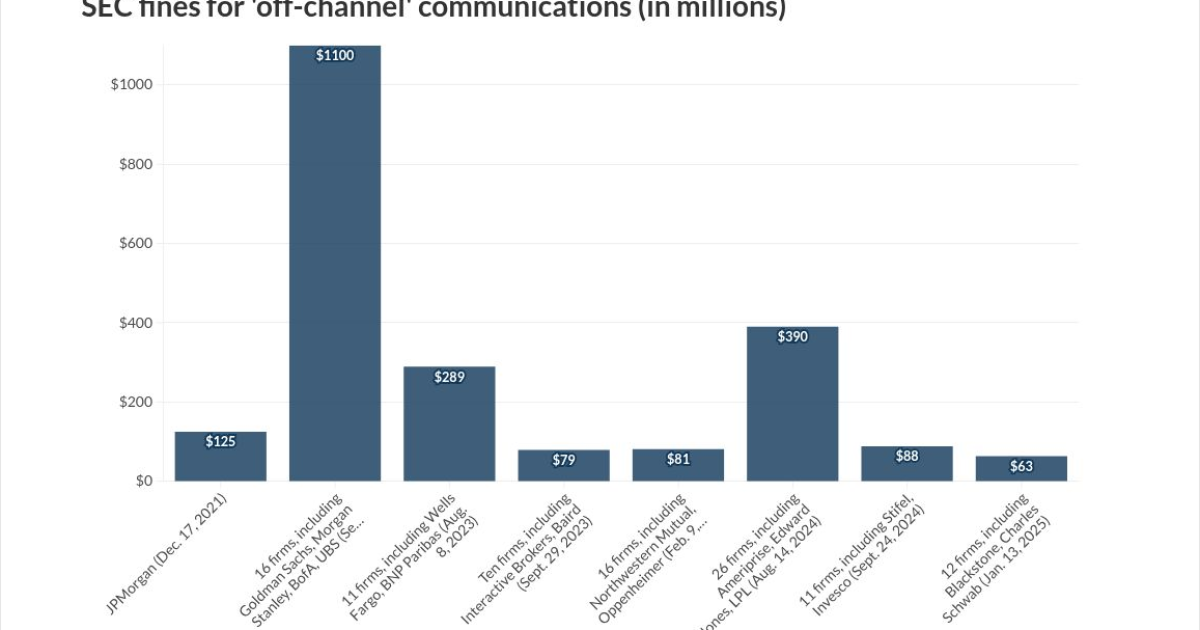
Judge orders SEC to release data behind B in WhatsApp fines

Judge orders SEC to release data behind $2B in WhatsApp fines

March 10, 2026
8 Cost-Cutting Moves Retirees Are Sharing Online in February

8 Cost-Cutting Moves Retirees Are Sharing Online in February

February 14, 2026
3 Grocery Chains That Give Seniors a “Gas Bonus” for Every  Spent

3 Grocery Chains That Give Seniors a “Gas Bonus” for Every $50 Spent

March 15, 2026
8 Procedures That Can Be Cheaper Without Insurance

8 Procedures That Can Be Cheaper Without Insurance

February 14, 2026
FPA partners with Snappy Kraken to update PlannerSearch

FPA partners with Snappy Kraken to update PlannerSearch

February 25, 2026
Costco’s .50 hot dog will never change, CEO Ron Vachris promises

Costco’s $1.50 hot dog will never change, CEO Ron Vachris promises

0
Who Owns the Bus? | Mises Institute

Who Owns the Bus? | Mises Institute

0
These Hidden Mastercard Perks Could Upgrade Your Next Trip

These Hidden Mastercard Perks Could Upgrade Your Next Trip

0
Views for next Fed rate cut pushed back after hot inflation report

Views for next Fed rate cut pushed back after hot inflation report

0
Israeli AI cybersecurity co Surf AI raises m

Israeli AI cybersecurity co Surf AI raises $57m

0
Kalshi Defies U.S. Legal Tussle and Nevada Temporary Ban as Valuation Doubles to B

Kalshi Defies U.S. Legal Tussle and Nevada Temporary Ban as Valuation Doubles to $22B

0
Who Owns the Bus? | Mises Institute

Who Owns the Bus? | Mises Institute

March 21, 2026
Costco’s .50 hot dog will never change, CEO Ron Vachris promises

Costco’s $1.50 hot dog will never change, CEO Ron Vachris promises

March 21, 2026
I’m 37 and I realized last month that I have two hundred contacts in my phone and not a single person I could call at 2 AM without feeling like I was being a burden — and that math broke something in me

I’m 37 and I realized last month that I have two hundred contacts in my phone and not a single person I could call at 2 AM without feeling like I was being a burden — and that math broke something in me

March 21, 2026
Rupee on shaky ground, touches fresh low of 93.73

Rupee on shaky ground, touches fresh low of 93.73

March 21, 2026
Three weeks into the Iran war that’s seeking 0 billion, here’s what success for Trump looks like

Three weeks into the Iran war that’s seeking $200 billion, here’s what success for Trump looks like

March 21, 2026
Grayscale Files For HYPE ETF – Here’s What To Know

Grayscale Files For HYPE ETF – Here’s What To Know

March 21, 2026
FeeOnlyNews.com

Get the latest news and follow the coverage of Business & Financial News, Stock Market Updates, Analysis, and more from the trusted sources.

CATEGORIES

  • Business
  • Cryptocurrency
  • Economy
  • Financial Planning
  • Investing
  • Market Analysis
  • Markets
  • Money
  • Personal Finance
  • Startups
  • Stock Market
  • Trading

LATEST UPDATES

  • Who Owns the Bus? | Mises Institute
  • Costco’s $1.50 hot dog will never change, CEO Ron Vachris promises
  • I’m 37 and I realized last month that I have two hundred contacts in my phone and not a single person I could call at 2 AM without feeling like I was being a burden — and that math broke something in me
  • Our Great Privacy Policy
  • Terms of Use, Legal Notices & Disclaimers
  • About Us
  • Contact Us

Copyright © 2022-2024 All Rights Reserved
See articles for original source and related links to external sites.

Welcome Back!

Sign In with Facebook
Sign In with Google
Sign In with Linked In
OR

Login to your account below

Forgotten Password?

Retrieve your password

Please enter your username or email address to reset your password.

Log In
No Result
View All Result
  • Home
  • Business
  • Financial Planning
  • Personal Finance
  • Investing
  • Money
  • Economy
  • Markets
  • Stocks
  • Trading

Copyright © 2022-2024 All Rights Reserved
See articles for original source and related links to external sites.