The Falklands War saved Margaret Thatcher’s career. Donald Trump appears to believe it could save his. This article explores the historical parallels between the political motivations surrounding the 1982 Falklands war and Trump’s current menacing conduct toward Venezuela. Securing a swift military victory in the Falklands to reverse declining political fortunes was a goal achieved by Margaret Thatcher in 1982, but this feat is unlikely to be repeated by Trump in Venezuela.
Thatcher’s Triumph
In the spring of 1982, Margaret Thatcher was a dead Prime Minister walking. Her approval rating had sunk toward 25 percent, lower than any modern prime minister had ever survived. Britain was mired in recession; unemployment had crossed three million; and even her own party whispered about removing her before she led them to annihilation. The “Iron Lady” was rapidly turning into an electoral liability. Many Conservatives believed she would be a one-term footnote, remembered only for austerity, riots, and industrial collapse.
Then Argentina invaded the Falkland Islands. The effect on British politics was instantaneous. A failing leader suddenly received a great political gift: an external crisis that appears both morally clear and militarily winnable. Within a week, the British public rallied around Thatcher. Within two months she had transformed from the most unpopular prime minister in living memory into a war leader with heroic approval numbers. And within a year she would win one of the largest electoral landslides in British history. This is the “Falklands Effect,” the political miracle of a short, victorious, foreign conflict. It is also the political fantasy Donald Trump has never quite abandoned.
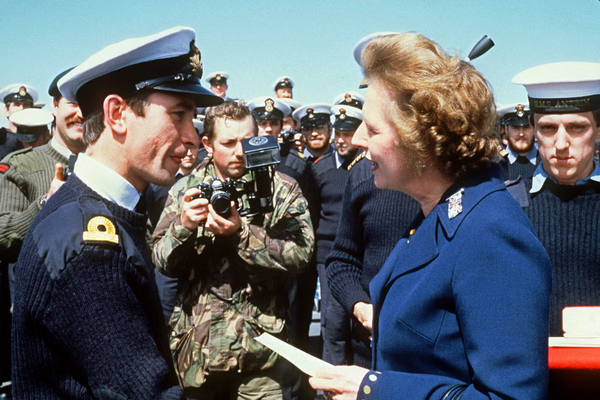
Thatcher congratulates the victors
The Argentine Junta’s Gambit
But the Falklands story has a second half, usually forgotten in American retellings. The war did not begin because Thatcher was in trouble; it began because the Argentine junta was in political peril. General Leopoldo Galtieri’s military regime was collapsing under the weight of economic catastrophe, human-rights abuses, and popular revolt. Inflation was spiraling. Industrial output had collapsed. Hundreds of thousands marched in Buenos Aires demanding democracy.
The junta needed an escape hatch, a way to convert domestic fury into patriotic unity. So the junta gambled. It seized a remote archipelago in the South Atlantic on the assumption that Britain would do nothing. The military dictatorship initiated a foreign-policy crisis to save itself. And Thatcher, through skill, luck, or historical momentum, converted that same crisis into a political resurrection.
This dual structure is essential to understanding the Falklands War, and it is essential to understanding Donald Trump’s repeated temptation to “do something about Venezuela.” Trump did not merely covet Thatcher’s triumphant outcome; he was attracted to the Argentine junta’s initiating logic. He exhibits both the desperation of Galtieri and the political narcissism of Thatcher. In the Falklands, he sees a two-stage model of political salvation: create a crisis, then win it.
Trump’s First Venezuela Temptation
Trump’s interest in invading Venezuela during his first term is not a rumor; it is one of the best-documented foreign-policy impulses of his presidency. Beginning in 2017 and escalating through 2019, Trump pressed his advisors regarding military action against Venezuela. As the Associated Press reported in 2018, Trump repeatedly asked his national-security team, “Why can’t the U.S. just simply invade the troubled country?” He returned to the subject so frequently that advisers began pre-emptively preparing talking points explaining why an invasion would be catastrophically foolish. John Kelly, then Chief of Staff, reportedly had to walk Trump back from the idea on multiple occasions.
John Bolton’s infamous legal pad note—“5,000 troops to Colombia”—was not a doodle. It was part of a broader, multi-agency evaluation of military options ranging from naval blockades to targeted strikes to full-scale regime-change operations. Trump was reportedly convinced the Venezuelan military would collapse “in a weekend.” He told aides that the Venezuelan people would “welcome us” and that Maduro’s overthrow would be “the easiest win you ever saw.” When he floated the idea to Latin American leaders, they were stunned into horrified silence.
Why this fixation? The answer lies in the duality revealed by the Falklands. Like the junta in 1982, Trump was besieged by domestic scandals, creeping economic unease, and increasingly poor approval ratings. Like Thatcher in 1982, he craved a political transformation—a defining moment of national glory that would override the failings of his administration. A quick foreign war victory could achieve this.
The Falklands pattern is seductive because it promises something no domestic policy can deliver: instant legitimacy and popular support. While Trump’s first-term ambition for a Venezuelan intervention faded under military resistance and political cost, signs of a revived temptation are accumulating rapidly. The evidence of a possible crisis is growing through deployments, proxies, and legal pretexts.
The Current U.S. Military Buildup in the Caribbean
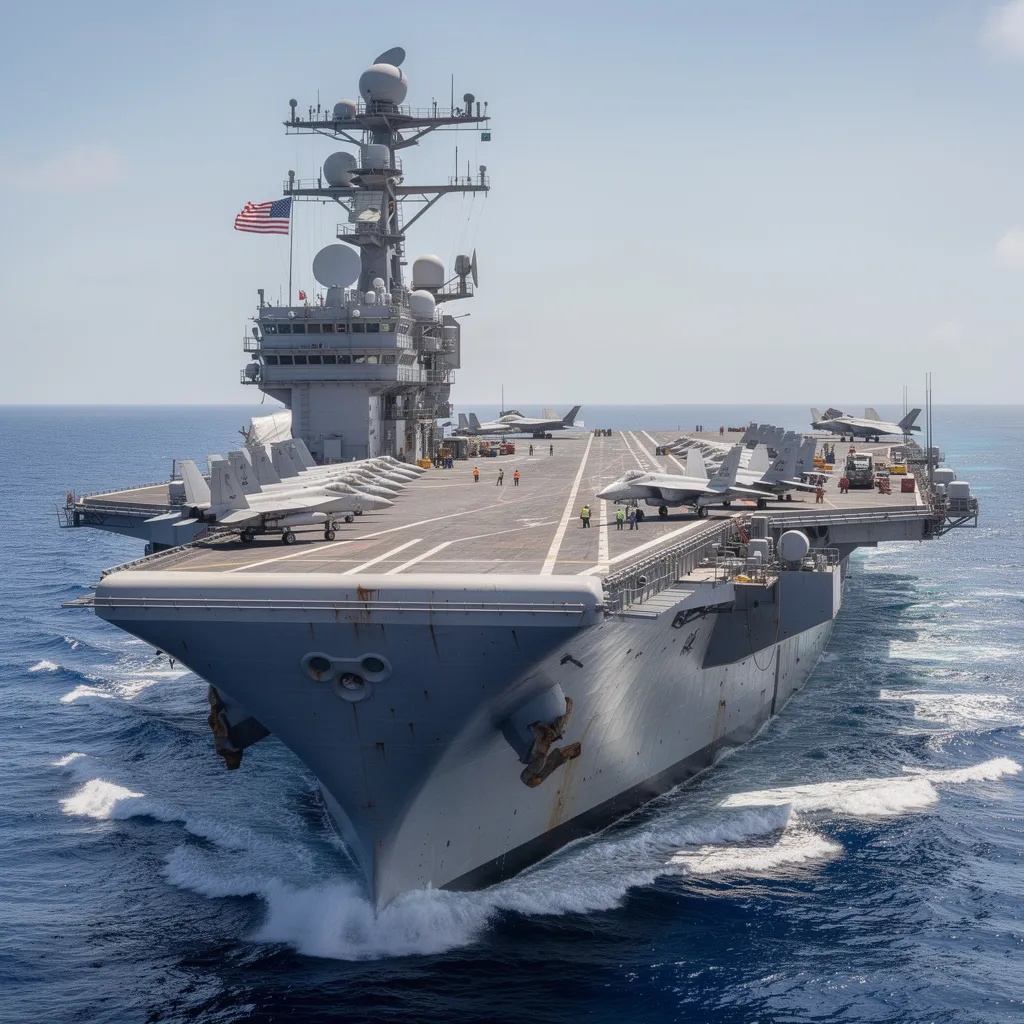
The United States has assembled a large naval, intelligence, and surveillance presence in the Caribbean Basin, officially justified as part of “expanded anti-narcotics operations.” A telling sign of escalation came in November 2025, when the U.S. deployed the Gerald R. Ford carrier strike group to the Caribbean, creating the largest U.S. naval presence in the region in decades. An aircraft carrier strike group is not a patrol asset; it is a warfighting instrument capable of airstrikes, amphibious support, and sustained offensive operations. U.S. specialized Southern Command detachments are embedded with partner forces around Venezuela’s maritime approaches. None of these assets announce themselves as “invasion forces,” and none need to. A military presence justified for drug interdiction can be repurposed overnight if a president wants it to be something else.
Enter Machado
Then there is the political front. María Corina Machado, the Venezuelan opposition figure barred from running by the Maduro regime, has become the de facto U.S.-aligned proxy for representing “true Venezuelan democracy.” Her narrative is amplified across U.S. diplomatic channels and Western media ecosystems. With Machado positioned as the legitimate face of Venezuelan democracy, Washington has an in-place justification for “defending” the will of the Venezuelan people should a confrontation escalate. In 1982, Thatcher wrapped her war in the language of defending “our people” and “our way of life.” In 2025, the language of intervention has been modernized: support for an exiled democratic leader, restoration of constitutional order, protection of human rights. While Machado does not openly call for foreign intervention, her international support network allows Washington to frame her as the legitimate democratic alternative to Maduro.

Maria Machado – Next President of Venezuela?
The Anti-Narcotics Pretext
Overlaying it all is the anti-narcotics legal frame. The U.S. has already indicted Venezuelan officials on narcotrafficking charges and labeled the Maduro government a “narco-state.” Once you define a foreign government as an organized criminal syndicate, the distance between seizing cocaine shipments and seizing oil terminals becomes very small. A naval blockade becomes an “interdiction operation.” A missile strike becomes a “counter-cartel action.” A regional military buildup becomes “drug enforcement staging.” The lawyers call it expanded rules of engagement. History calls it a pretext.
The Falklands Effect
This evolving conflict enabling arrangement, military, political, and legal, matches the structure of the Falklands crisis very closely. Not because a war is inevitable, but because the temptation is resurfacing in circumstances very similar to 1982. Trump has the means, the motive, and the opportunity to use the “Falklands Effect” to restore his political fortunes. The Falklands Effect operates in these stages:
A weakened leader seeks political revival through external military confrontation.
Military advisers or political allies propose “limited,” “surgical,” or “low-cost” options.
The leader launches an armed conflict against a vulnerable nation or group.
A quick victory restores the popularity and political power of the leader
Resort to this pattern of achieving a quick military victory to accomplish political resurrection is the temptation of diversionary war. But in the case of Venezuela, its consequences are potentially catastrophic.
Venezuela Is Not the Falklands
Venezuela is not an isolated archipelago with 1,800 residents. It is a nation of 29 million, with one of the world’s largest proven oil reserves, a large military seasoned by years of internal conflict and sanctions pressure, and a network of allies that includes Cuba, Russia, and China. Its armed forces include an estimated 120,000 active personnel and significant reserves. Venezuela’s vast geography of 916,000 square kilometers includes dense cities, jungles, and mountains, the worst possible terrain for any “quick” military action. Its political culture is one of nationalist resistance. Its population has endured two decades of sanctions and economic isolation. There would be no easy occupation, no quick surrender, and no ten-week victory.
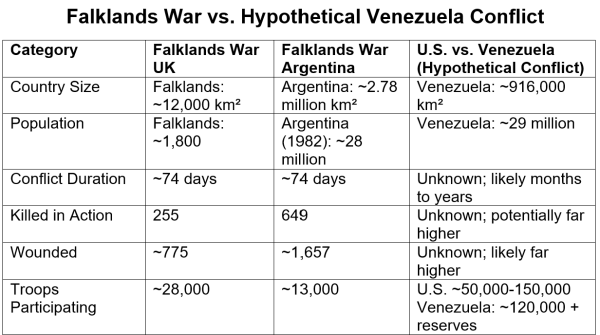
A U.S. invasion or even a “limited” set of precision strikes could trigger a refugee crisis larger than anything in the Western Hemisphere since the Colombian conflict. Oil markets would convulse. Guerrilla warfare would ignite. Regional governments, already wary and resentful of U.S. power, would be forced to respond. Russian advisers stationed in Venezuela might be targeted or killed. Chinese energy assets might be threatened. The local and global escalation possibilities are greater than anything Thatcher faced in 1982.
The Falklands war was a fluke of history: a dying Argentine dictatorship miscalculated, and a faltering British government turned the resulting conflict to its benefit. It was a rare instance where diversionary war did not turn into disaster. It is highly unlikely that the Falklands Effect would be repeated in a U.S. war against Venezuela.
War and Technological Surprise
In modern warfare, uncertainty is magnified by the introduction of new forms of advanced weaponry. The Falklands War demonstrated how a single unexpected technology can destabilize an entire military campaign. The Exocet missile, of which Argentina possessed only a handful, delivered a strategic shock far out of proportion to its numbers—sinking major British ships, crippling logistics, and forcing the Royal Navy into defensive contortions. What unnerved planners was not the scale of the threat, but the surprise: a weapon system whose lethality had been underestimated suddenly proved capable of altering the balance of the war. Had Argentina possessed even a dozen more Exocets, the British campaign could have failed.
A U.S. conflict with Venezuela risks a parallel form of technological surprise, this time from drones rather than missiles. Venezuela has assembled a patchwork fleet of Iranian-designed loitering munitions and improvised explosive drones adapted for swarm attacks. Venezuela also fields modern anti-ship weapons comparable to the Exocet, including the Chinese C-802 family and shore-based missile batteries capable of threatening attacking naval forces. Even if some of these systems suffer from poor readiness or partial integration, a limited number of functioning Venezuelan drones or anti-ship missiles could inflict disproportionate damage, repeating the Falklands lesson that an unexpected adversary capability can impose strategic costs that far exceed its size.
Conclusion
The United States now has the force posture, the political narrative, and the legal pretext to escalate a confrontation with Venezuela faster than at any time since 2019. Trump governs with fewer internal restraints, fewer dissenting advisers, and a party apparatus that treats his impulses as policy rather than improvisation. The danger is real: the Falklands War restored the power of a British prime minister, but applying the Falklands playbook to Venezuela could destabilize the Trump administration, unravel regional security across the Western Hemisphere, ignite a refugee crisis, and provoke great-power confrontation. The parallels matter because millions of lives, regional stability, and global markets could be affected by a decision taken for domestic political expediency. An impulsive attempt to invoke the Falklands Effect in Venezuela could become a political and humanitarian disaster.