“Some of the hurdles have been tackling the challenge of the need to move at pace while we have a legacy business,” says Tamas Szabo, the Group CEO of Pepperstone. Those hurdles sat at the heart of the retail broker’s expansion from traditional CFD into physical crypto. This was once a niche transition, but has since started to edge into the mainstream.
Tamas Szabo, CEO at Pepperstone
As of today, IG Group has entered the spot crypto business, while Capital.com and XTB are preparing to follow, and CMC Markets has signalled broader ambition that extends into decentralised finance. Pepperstone, meanwhile, has just launched its physical crypto business for Australian clients. “So, we have built a large standalone crypto team,” Szabo goes on to explain how the broker moved to overcome those constraints.
The Internet’s Money is Now Attracting Professional Traders
According to CryptoQuant, a blockchain analytics and on-chain data platform, trading volume on the spot cryptocurrency market reached US$18.6 trillion last year, a 9% increase year-on-year. Crypto may still be volatile, but it is no longer marginal. For much of the past decade, one firm sat squarely at the centre of this activity. At its peak in 2023, Binance, the world’s largest digital-asset exchange, handled close to 60% of all spot crypto trades, where actual ownership of assets changes hands immediately rather than via derivatives – or on the “spot”.
Recently, however, its grip has loosened.
CoinDesk data show that by December 2025, Binance’s share of global spot trading volume had fallen to around 25%, its lowest level since early 2021. The missing volume did not migrate in one neat direction. Some flowed to rival exchanges, some to decentralised platforms, and brokers are now positioning themselves to capture a share of it.
2025 crypto exchange activity in review.
Spot volume reached $18.6T (+9% YoY) while perpetuals surged to $61.7T (+29%), with Binance dominating spot, BTC perps, liquidity, and reserves.
Growth is derivative-led, and market power continues to concentrate at the top. pic.twitter.com/Om8udJJ9Qv
— CryptoQuant.com (@cryptoquant_com) January 12, 2026
“A Long-Term Conviction” for Brokers
One of the earliest mainstream brokers to take crypto seriously was eToro, now one of the world’s largest multi-asset platforms. “From the outset, eToro approached spot crypto with a long-term conviction that crypto is here to stay, adding bitcoin to the platform as early as 2013 when demand was limited, and market sentiment was highly skeptical,” says Adi Lasker Gattegno, the fintech’s Director of Liquidity Management and Crypto Operations.
Perspective matters. In 2013, Coinbase, today the world’s second-largest crypto exchange, was a fledgling startup and reported selling just US$1 million worth of bitcoin in a single month, at prices hovering above $22 per coin. That same year, the American novelist Charles Stross used bitcoin in his science-fiction Hugo Award-shortlisted novel Neptune’s Brood as a fictional interstellar currency, precisely because it was obscure enough to sound plausible in a far-future setting. Crypto was, quite literally, science fiction.
Crypto’s rise owes much to regulation. In 2018, the European Securities and Markets Authority (ESMA) clamped down on CFDs, capping leverage and restricting retail marketing. Some national watchdogs went further, steadily narrowing CFD business. In January 2026, Israel-based broker Plus500 became the latest in the trend, halting onboarding for Spanish CFD clients after the local regulator adopted one of the EU’s toughest interpretations of the rules.
Meanwhile, clearer crypto frameworks such as the EU’s MiCA and America’s GENIUS Act lent digital assets a legitimacy CFDs increasingly lack.
Adi Lasker Gattegno, Director of Liquidity Management and Crypto Operations of eToro
According to the 2025 Global State of Crypto report by the crypto exchange Gemini Trust, based on a survey of more than 7,200 consumers across the US, UK, France, Italy, Singapore and Australia, nearly one in four respondents said they owned crypto.
Supply, inevitably, has followed demand. “Our offering has grown into a holistic offering that caters to both crypto-native users and traditional retail investors within a regulated, multi-asset environment. We now support 150 crypto assets, alongside services such as staking, crypto-focused Smart Portfolios, and CopyTrader,” Gattegno says.
Toward the end of 2025, Pepperstone’s Szabo, speaking at the digital asset conference AusCryptoCon in Sydney, announced that the CFD broker would be making the leap to spot crypto in 2026, and today it launched the dedicated crypto exchange. “Internal and external research has shown that CFD traders are heavy crypto investors,” he explains part of the reasoning to FinanceMagnates.com.
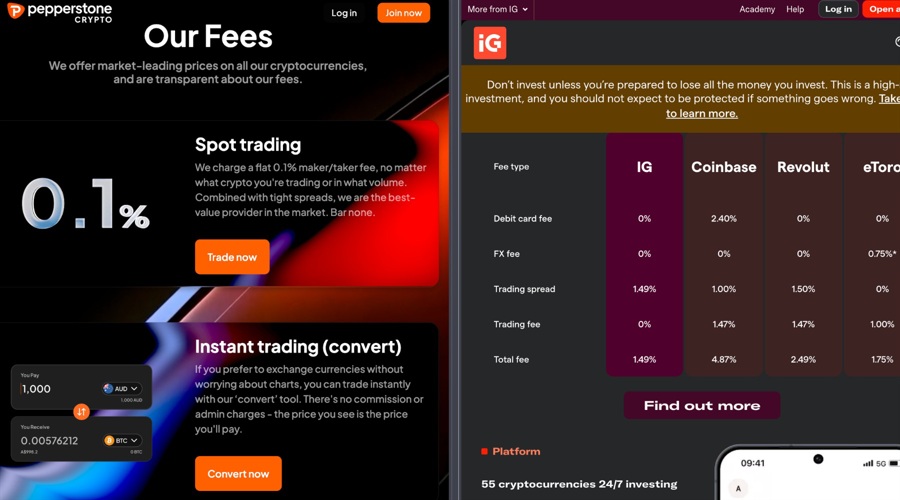
Having just launched its product, the broker plans a measured entry. The initial focus will be on adoption and client experience, built around a flat 0.1% fee, tight spreads and deep liquidity. “Over time, as we expand the product offering and the market grows, spot crypto is expected to complement our traditional products and become a meaningful part of our overall business,” Szabo adds.
Plug-and-Play Vs In-House Tech
When considering crypto expansion, brokers must first address one question: whether to build the infrastructure in-house or go with white-label solutions. Both have their advantages and disadvantages.
White-label tech infrastructure has always been part of the brokerage industry, and the same is true for crypto exchanges as well. Nowadays, a growing ecosystem of technology providers offers plug-and-play infrastructure designed to sit comfortably alongside existing CFD offerings.
Shift Markets is one such provider. Since 2019, it has developed a white-label crypto solution aimed primarily at FX and CFD brokers looking to enter digital assets without reinventing the wheel. “Our focus is less on introducing a new product in isolation, and more on enabling crypto to function as a natural extension of a broker’s existing multi-asset offering,” says Ian McAfee, the firm’s co-founder and CEO.
Out of the box, Shift’s platform provides aggregated liquidity, real-time order matching, wallet infrastructure, crypto and stablecoin funding and a full back office.
Ian McAfee, co-founder and CEO of Shift Markets
Another is B2BROKER, a global fintech whose core clientele includes banks, crypto firms and, above all, CFD brokers. “We developed a full stack of products to support crypto businesses,” says Arthur Azizov, the company’s founder and CEO. This includes its own brokerage platform, B2TRADER; spot and perpetual futures liquidity, which are coming shortly; the B2CORE back-office and CRM system; and B2BINPAY, its crypto payments and wallet-management platform.
Not everyone, however, opts for a third-party route.“Our spot crypto infrastructure is entirely in-house,” says Tamas Szabo, “leveraging 15 years of experience in CFD trading. It provides full oversight of execution quality, deep liquidity and pricing and system security.”
It’s worth mentioning that initially, IG also sought third-party infrastructure, partnering with digital trading platform Uphold. Later, though, the broker acquired Australian crypto exchange Independent Reserve, aiming to roll out crypto products for the Middle East and APAC region.
Deployment Without Reinvention
Deployment can be much smoother than what the complexity might suggest. According to both third-party tech providers, most brokers favour software-as-a-service (SaaS) models, which offer the quickest route to market. A minority opt for hybrid cloud deployments using their own teams, while fully on-premise environments are rare.
“Some brokers prefer having more control, and some in certain jurisdictions encounter regulatory requirements for controlling more of the environment,” McAfee notes.
The onboarding timelines can be brisk, owing much to automation. Azizov says that initial setup can take as little as three hours, followed by around nine days of configuration, branding and security work. From contract signing to go-live, the entire process can be completed in under ten days.
In practice, integration with existing brokerage systems is not disruptive, with API-led approaches designed to fit around established technology stacks rather than replace them outright.
The limiting factor is rarely the technology itself, but a broker’s own technical readiness and appetite for change.
For Pepperstone, spot crypto is integrated into the broker’s wider platform ecosystem, while remaining operationally and regulatorily distinct through separate web and mobile platforms. Deposits, withdrawals, and reconciliations are processed through the same secure systems.
Deep Liquidity is Necessary, But Can Be a Challenge
“The key focus areas have been ensuring deep liquidity, maintaining platform stability under peak trading, and supporting secure deposit and withdrawal processes,” says Szabo, reflecting on the challenges Pepperstone has faced in moving from CFDs to spot crypto. Indeed, crypto liquidity is not an easy equation to solve, as it is scattered across chains, exchanges and OTC desks, complicating the task of price formation. For Peppestone, it was addressed by leaning on the scale of its derivatives business. “We process over US$6 billion in crypto CFD volume each month, so we are able to support robust liquidity and reliable execution for our clients,” he explains.
For those relying on plug-and-play solutions, technology providers address liquidity by aggregating prices from major venues and delivering them to brokers’ platforms, either as external price feeds or embedded directly within a broker’s own crypto exchange.
Beyond these aggregation layers, there are also matching engines built specifically for crypto markets. One such provider is Finery Markets, a crypto-focused electronic communication network (ECN) which has also partnered with B2BROKER. According to its founder and CEO, Konstantin Shulga, the firm offers two main integration paths: access to aggregated institutional liquidity via its own ECN, or a Crypto-as-a-Service turnkey solution.
Access to the Finery’s institutional liquidity network is provided through a single integration point, combining execution with core back-office functions such as real-time reporting, position management and risk controls within one technical framework.
“The choice depends on the broker’s objectives,” he says. The ECN model suits firms seeking best execution and internalisation, while the turnkey option is designed for those wanting a rapid, zero-development launch.
Konstantin Shulga, CEO and co-founder of Finery Markets
“Execution and custodial risks remain strictly decoupled,” Shulga stresses. Brokers are free to work with any qualified custodian, with native integrations available for providers such as BitGo and Fireblocks. To solve latency issues – in crypto markets, milliseconds matter, particularly during bouts of volatility – Amazon Web Services seems to be the preferred option, as both B2BROKER and Finery Markets leverage the US giant’s network. “For optimal performance,” Azizov notes, “we usually recommend financial hubs like London to minimize latency between the platform and our liquidity providers.”
Compliance, though, is handled at arm’s length. Finery does not hold client assets, and trading is non-custodial. Because trades are bilateral, the legal contract sits directly between counterparties, allowing brokers to plug in their own KYC, transaction-monitoring tools and controls in line with local regulation.
“Brokers Should Never Outsource Their Brand, Client Relationship or Commercial Decision-Making”
Spot crypto involves real assets, real wallets and real settlement. When systems are built in-house, responsibility is clear; when functions are outsourced, clarity over who owns what becomes critical.
On Shift’s platform, brokers retain operational control over treasury management, liquidity optimisation and day-to-day monitoring. In-house teams are required for reconciliation and performance checks. The platform itself manages orders and tracks assets on a digital ledger, while connecting brokers to specialist providers for custody, liquidity, payments, KYC and AML.
B2BROKER offers a more closed-loop ecosystem in which both technical and operational components are tightly integrated. Core trading logic, pre-integrated KYC, payments and back-office systems are bundled together, supported by dedicated account managers
Arthur Azizov, founder and CEO of B2BROKER
Azizov, though, is categorical that certain things should never be outsourced. “Brokers should never outsource their brand, client relationship or commercial decision-making,” Azizov notes. “That ownership must always stay with the broker.”
“You Are No Longer Managing Contracts, You Are Managing Real Assets.”
For all the progress in tooling, moving from CFDs to spot crypto remains a conceptual leap. “Transitioning to spot trading means a fundamental change in business logic and the brokerage’s operating model,” says Azizov. Treasury management is the clearest example: CFD trading abstracts everything into a base currency and spot crypto does not. Clients can hold, transfer and withdraw real assets – bitcoin, ether, stablecoins – forcing brokers to manage multi-asset balances, on-chain flows and real-time liquidity. “You are no longer managing contracts,” B2BROKER CEO stresses. “You are managing real assets.”
McAfee agrees. Offering spot trading requires integration with custodians and the maintenance of balances across all supported cryptos. “This adds additional complexity,” he goes on, “as the broker needs to rebalance their treasury to align with user holdings, as well as maintain balances at liquidity providers – or ensure they can process end-of-day settlements in multiple currencies.”
There is also a tendency to conflate spot trading with perpetual futures, which feel more familiar to CFD brokers because they rely on similar leverage, margins and funding rates. With spot trading, though, Azivov notes, clients can only trade what they actually hold, which changes behaviour, exposure and risk management.
Regulation adds another layer of complexity, as crypto licensing regimes often differ sharply from those governing CFDs. “Finding the correct regulatory perimeter – and understanding what products can be offered in each market – is one of the most challenging aspects of such a transition,” McAfee stresses.
Sophisticated brokers, he adds, tend to ask hard questions early: which assets are supported, how balances are managed, how reconciliations work, and how risk controls operate. Only then do they turn to the regulatory maze.
“A common mistake we see is a broker not always fully assessing the quality or viability of a vendor that they chose to integrate to the platform,” McAfee notes. Another is relying on single points of failure, such as one liquidity provider, one payment rail, even one key individual. Contingency planning, Azizov says, is often an afterthought.
Many brokers also prioritise speed to market over the unglamorous work of building audit trails, permission structures and monitoring systems. Those details, however, are precisely what regulators scrutinise once a business scales.
A Convergence Afoot?
As more brokers add spot crypto, it points to a deeper shift that goes beyond technology stacks or liquidity plumbing: Does being a pure-play retail CFD broker still hold?
At the same time, crypto exchanges have been edging into traditional broker territory, often by acquisition rather than invention. Crypto.com, Coinbase and Kraken are among those that, in recent years, have bought established EU firms holding MiFID licences – ready-made passports into regulated markets.
The real question, then, is not merely whether being a pure-play CFD broker remains a sustainable model, but whether crypto and traditional derivatives are now approaching a point of convergence – technologically, commercially and, increasingly, in the eyes of clients themselves.
“While the boundaries between brokers and exchanges are evolving,” says Szabo,“ client priorities remain focused on cost, execution quality, trust and importantly great UX and ease of use. Our Australian-made, low-cost, high-liquidity model provides clarity and reliability, which we believe will continue to differentiate Pepperstone in the market.”
“Some of the hurdles have been tackling the challenge of the need to move at pace while we have a legacy business,” says Tamas Szabo, the Group CEO of Pepperstone. Those hurdles sat at the heart of the retail broker’s expansion from traditional CFD into physical crypto. This was once a niche transition, but has since started to edge into the mainstream.
Tamas Szabo, CEO at Pepperstone
As of today, IG Group has entered the spot crypto business, while Capital.com and XTB are preparing to follow, and CMC Markets has signalled broader ambition that extends into decentralised finance. Pepperstone, meanwhile, has just launched its physical crypto business for Australian clients. “So, we have built a large standalone crypto team,” Szabo goes on to explain how the broker moved to overcome those constraints.
The Internet’s Money is Now Attracting Professional Traders
According to CryptoQuant, a blockchain analytics and on-chain data platform, trading volume on the spot cryptocurrency market reached US$18.6 trillion last year, a 9% increase year-on-year. Crypto may still be volatile, but it is no longer marginal. For much of the past decade, one firm sat squarely at the centre of this activity. At its peak in 2023, Binance, the world’s largest digital-asset exchange, handled close to 60% of all spot crypto trades, where actual ownership of assets changes hands immediately rather than via derivatives – or on the “spot”.
Recently, however, its grip has loosened.
CoinDesk data show that by December 2025, Binance’s share of global spot trading volume had fallen to around 25%, its lowest level since early 2021. The missing volume did not migrate in one neat direction. Some flowed to rival exchanges, some to decentralised platforms, and brokers are now positioning themselves to capture a share of it.
2025 crypto exchange activity in review.
Spot volume reached $18.6T (+9% YoY) while perpetuals surged to $61.7T (+29%), with Binance dominating spot, BTC perps, liquidity, and reserves.
Growth is derivative-led, and market power continues to concentrate at the top. pic.twitter.com/Om8udJJ9Qv
— CryptoQuant.com (@cryptoquant_com) January 12, 2026
“A Long-Term Conviction” for Brokers
One of the earliest mainstream brokers to take crypto seriously was eToro, now one of the world’s largest multi-asset platforms. “From the outset, eToro approached spot crypto with a long-term conviction that crypto is here to stay, adding bitcoin to the platform as early as 2013 when demand was limited, and market sentiment was highly skeptical,” says Adi Lasker Gattegno, the fintech’s Director of Liquidity Management and Crypto Operations.
Perspective matters. In 2013, Coinbase, today the world’s second-largest crypto exchange, was a fledgling startup and reported selling just US$1 million worth of bitcoin in a single month, at prices hovering above $22 per coin. That same year, the American novelist Charles Stross used bitcoin in his science-fiction Hugo Award-shortlisted novel Neptune’s Brood as a fictional interstellar currency, precisely because it was obscure enough to sound plausible in a far-future setting. Crypto was, quite literally, science fiction.
Crypto’s rise owes much to regulation. In 2018, the European Securities and Markets Authority (ESMA) clamped down on CFDs, capping leverage and restricting retail marketing. Some national watchdogs went further, steadily narrowing CFD business. In January 2026, Israel-based broker Plus500 became the latest in the trend, halting onboarding for Spanish CFD clients after the local regulator adopted one of the EU’s toughest interpretations of the rules.
Meanwhile, clearer crypto frameworks such as the EU’s MiCA and America’s GENIUS Act lent digital assets a legitimacy CFDs increasingly lack.
Adi Lasker Gattegno, Director of Liquidity Management and Crypto Operations of eToro
According to the 2025 Global State of Crypto report by the crypto exchange Gemini Trust, based on a survey of more than 7,200 consumers across the US, UK, France, Italy, Singapore and Australia, nearly one in four respondents said they owned crypto.
Supply, inevitably, has followed demand. “Our offering has grown into a holistic offering that caters to both crypto-native users and traditional retail investors within a regulated, multi-asset environment. We now support 150 crypto assets, alongside services such as staking, crypto-focused Smart Portfolios, and CopyTrader,” Gattegno says.
Toward the end of 2025, Pepperstone’s Szabo, speaking at the digital asset conference AusCryptoCon in Sydney, announced that the CFD broker would be making the leap to spot crypto in 2026, and today it launched the dedicated crypto exchange. “Internal and external research has shown that CFD traders are heavy crypto investors,” he explains part of the reasoning to FinanceMagnates.com.
Having just launched its product, the broker plans a measured entry. The initial focus will be on adoption and client experience, built around a flat 0.1% fee, tight spreads and deep liquidity. “Over time, as we expand the product offering and the market grows, spot crypto is expected to complement our traditional products and become a meaningful part of our overall business,” Szabo adds.
Plug-and-Play Vs In-House Tech
When considering crypto expansion, brokers must first address one question: whether to build the infrastructure in-house or go with white-label solutions. Both have their advantages and disadvantages.
White-label tech infrastructure has always been part of the brokerage industry, and the same is true for crypto exchanges as well. Nowadays, a growing ecosystem of technology providers offers plug-and-play infrastructure designed to sit comfortably alongside existing CFD offerings.
Shift Markets is one such provider. Since 2019, it has developed a white-label crypto solution aimed primarily at FX and CFD brokers looking to enter digital assets without reinventing the wheel. “Our focus is less on introducing a new product in isolation, and more on enabling crypto to function as a natural extension of a broker’s existing multi-asset offering,” says Ian McAfee, the firm’s co-founder and CEO.
Out of the box, Shift’s platform provides aggregated liquidity, real-time order matching, wallet infrastructure, crypto and stablecoin funding and a full back office.
Ian McAfee, co-founder and CEO of Shift Markets
Another is B2BROKER, a global fintech whose core clientele includes banks, crypto firms and, above all, CFD brokers. “We developed a full stack of products to support crypto businesses,” says Arthur Azizov, the company’s founder and CEO. This includes its own brokerage platform, B2TRADER; spot and perpetual futures liquidity, which are coming shortly; the B2CORE back-office and CRM system; and B2BINPAY, its crypto payments and wallet-management platform.
Not everyone, however, opts for a third-party route.“Our spot crypto infrastructure is entirely in-house,” says Tamas Szabo, “leveraging 15 years of experience in CFD trading. It provides full oversight of execution quality, deep liquidity and pricing and system security.”
It’s worth mentioning that initially, IG also sought third-party infrastructure, partnering with digital trading platform Uphold. Later, though, the broker acquired Australian crypto exchange Independent Reserve, aiming to roll out crypto products for the Middle East and APAC region.
Deployment Without Reinvention
Deployment can be much smoother than what the complexity might suggest. According to both third-party tech providers, most brokers favour software-as-a-service (SaaS) models, which offer the quickest route to market. A minority opt for hybrid cloud deployments using their own teams, while fully on-premise environments are rare.
“Some brokers prefer having more control, and some in certain jurisdictions encounter regulatory requirements for controlling more of the environment,” McAfee notes.
The onboarding timelines can be brisk, owing much to automation. Azizov says that initial setup can take as little as three hours, followed by around nine days of configuration, branding and security work. From contract signing to go-live, the entire process can be completed in under ten days.
In practice, integration with existing brokerage systems is not disruptive, with API-led approaches designed to fit around established technology stacks rather than replace them outright.
The limiting factor is rarely the technology itself, but a broker’s own technical readiness and appetite for change.
For Pepperstone, spot crypto is integrated into the broker’s wider platform ecosystem, while remaining operationally and regulatorily distinct through separate web and mobile platforms. Deposits, withdrawals, and reconciliations are processed through the same secure systems.
Deep Liquidity is Necessary, But Can Be a Challenge
“The key focus areas have been ensuring deep liquidity, maintaining platform stability under peak trading, and supporting secure deposit and withdrawal processes,” says Szabo, reflecting on the challenges Pepperstone has faced in moving from CFDs to spot crypto. Indeed, crypto liquidity is not an easy equation to solve, as it is scattered across chains, exchanges and OTC desks, complicating the task of price formation. For Peppestone, it was addressed by leaning on the scale of its derivatives business. “We process over US$6 billion in crypto CFD volume each month, so we are able to support robust liquidity and reliable execution for our clients,” he explains.
For those relying on plug-and-play solutions, technology providers address liquidity by aggregating prices from major venues and delivering them to brokers’ platforms, either as external price feeds or embedded directly within a broker’s own crypto exchange.
Beyond these aggregation layers, there are also matching engines built specifically for crypto markets. One such provider is Finery Markets, a crypto-focused electronic communication network (ECN) which has also partnered with B2BROKER. According to its founder and CEO, Konstantin Shulga, the firm offers two main integration paths: access to aggregated institutional liquidity via its own ECN, or a Crypto-as-a-Service turnkey solution.
Access to the Finery’s institutional liquidity network is provided through a single integration point, combining execution with core back-office functions such as real-time reporting, position management and risk controls within one technical framework.
“The choice depends on the broker’s objectives,” he says. The ECN model suits firms seeking best execution and internalisation, while the turnkey option is designed for those wanting a rapid, zero-development launch.
Konstantin Shulga, CEO and co-founder of Finery Markets
“Execution and custodial risks remain strictly decoupled,” Shulga stresses. Brokers are free to work with any qualified custodian, with native integrations available for providers such as BitGo and Fireblocks. To solve latency issues – in crypto markets, milliseconds matter, particularly during bouts of volatility – Amazon Web Services seems to be the preferred option, as both B2BROKER and Finery Markets leverage the US giant’s network. “For optimal performance,” Azizov notes, “we usually recommend financial hubs like London to minimize latency between the platform and our liquidity providers.”
Compliance, though, is handled at arm’s length. Finery does not hold client assets, and trading is non-custodial. Because trades are bilateral, the legal contract sits directly between counterparties, allowing brokers to plug in their own KYC, transaction-monitoring tools and controls in line with local regulation.
“Brokers Should Never Outsource Their Brand, Client Relationship or Commercial Decision-Making”
Spot crypto involves real assets, real wallets and real settlement. When systems are built in-house, responsibility is clear; when functions are outsourced, clarity over who owns what becomes critical.
On Shift’s platform, brokers retain operational control over treasury management, liquidity optimisation and day-to-day monitoring. In-house teams are required for reconciliation and performance checks. The platform itself manages orders and tracks assets on a digital ledger, while connecting brokers to specialist providers for custody, liquidity, payments, KYC and AML.
B2BROKER offers a more closed-loop ecosystem in which both technical and operational components are tightly integrated. Core trading logic, pre-integrated KYC, payments and back-office systems are bundled together, supported by dedicated account managers
Arthur Azizov, founder and CEO of B2BROKER
Azizov, though, is categorical that certain things should never be outsourced. “Brokers should never outsource their brand, client relationship or commercial decision-making,” Azizov notes. “That ownership must always stay with the broker.”
“You Are No Longer Managing Contracts, You Are Managing Real Assets.”
For all the progress in tooling, moving from CFDs to spot crypto remains a conceptual leap. “Transitioning to spot trading means a fundamental change in business logic and the brokerage’s operating model,” says Azizov. Treasury management is the clearest example: CFD trading abstracts everything into a base currency and spot crypto does not. Clients can hold, transfer and withdraw real assets – bitcoin, ether, stablecoins – forcing brokers to manage multi-asset balances, on-chain flows and real-time liquidity. “You are no longer managing contracts,” B2BROKER CEO stresses. “You are managing real assets.”
McAfee agrees. Offering spot trading requires integration with custodians and the maintenance of balances across all supported cryptos. “This adds additional complexity,” he goes on, “as the broker needs to rebalance their treasury to align with user holdings, as well as maintain balances at liquidity providers – or ensure they can process end-of-day settlements in multiple currencies.”
There is also a tendency to conflate spot trading with perpetual futures, which feel more familiar to CFD brokers because they rely on similar leverage, margins and funding rates. With spot trading, though, Azivov notes, clients can only trade what they actually hold, which changes behaviour, exposure and risk management.
Regulation adds another layer of complexity, as crypto licensing regimes often differ sharply from those governing CFDs. “Finding the correct regulatory perimeter – and understanding what products can be offered in each market – is one of the most challenging aspects of such a transition,” McAfee stresses.
Sophisticated brokers, he adds, tend to ask hard questions early: which assets are supported, how balances are managed, how reconciliations work, and how risk controls operate. Only then do they turn to the regulatory maze.
“A common mistake we see is a broker not always fully assessing the quality or viability of a vendor that they chose to integrate to the platform,” McAfee notes. Another is relying on single points of failure, such as one liquidity provider, one payment rail, even one key individual. Contingency planning, Azizov says, is often an afterthought.
Many brokers also prioritise speed to market over the unglamorous work of building audit trails, permission structures and monitoring systems. Those details, however, are precisely what regulators scrutinise once a business scales.
A Convergence Afoot?
As more brokers add spot crypto, it points to a deeper shift that goes beyond technology stacks or liquidity plumbing: Does being a pure-play retail CFD broker still hold?
At the same time, crypto exchanges have been edging into traditional broker territory, often by acquisition rather than invention. Crypto.com, Coinbase and Kraken are among those that, in recent years, have bought established EU firms holding MiFID licences – ready-made passports into regulated markets.
The real question, then, is not merely whether being a pure-play CFD broker remains a sustainable model, but whether crypto and traditional derivatives are now approaching a point of convergence – technologically, commercially and, increasingly, in the eyes of clients themselves.
“While the boundaries between brokers and exchanges are evolving,” says Szabo,“ client priorities remain focused on cost, execution quality, trust and importantly great UX and ease of use. Our Australian-made, low-cost, high-liquidity model provides clarity and reliability, which we believe will continue to differentiate Pepperstone in the market.”