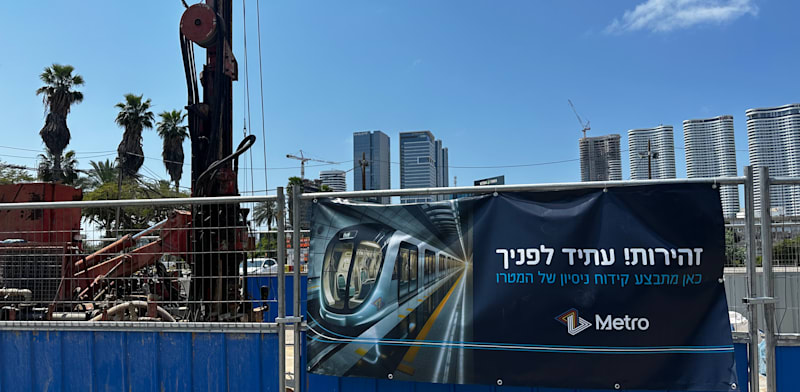
Israel’s biggest infrastructure tender, the NIS 65 billion Metro construction project, was published in November. The government has no answer, however, to the question what will happen if a Chinese company submits a bid, or even wins the contract. In fact, Israel does not have a declared policy on Chinese involvement in infrastructure projects, and no decisions have yet been made in internal discussions in the government.
The Metro tender calls for the creation of a pool of contractors that will compete for eleven infrastructure packages, each valued at billions of shekels. Senior officials at NTA Metropolitan Mass Transit have stated that no company is barred from bidding on the basis of its country of registration. At the same time, there have already been instances of pressure from senior US officials, including cases in which Israel withdrew from agreements and tenders.
For example, in the tenders for the construction of the Green and Purple light rail lines in the Dan Region, a consortium of Chinese companies competed together with Shikun & Binui and Egged. The consortium submitted the lowest bid and was expected to win, but NTA’s tender committee deemed the proposal “manipulative” and disqualified it. The committee’s decision was challenged in court, found to be professional, and the petitions were dismissed. At the same time, however, intense pressure was being exerted by the Trump administration, during his previous term, not to allow Chinese companies into infrastructure projects in Israel. The committee’s decision, even if taken on purely professional grounds, alleviated concerns among political decision-makers in Israel.
Yet alongside that rejection, Chinese companies are serving as subcontractors in the Green Line excavations and are constructing the tunnel that runs under Tel Aviv. Other Chinese companies took part in excavating the Gush Dan Red Line, on which the rolling stock is also Chinese.
Israel refrains from making statements
In Israel, officials refrain from declaring that there is a general problem with working with Chinese companies. For example, last year the China Harbour Engineering Company (CHEC) was disqualified on security grounds from the tender to build the fuels port in Haifa. The company petitioned the court, arguing that “a decision to restrict the activity of Chinese companies should be made by the government of Israel in a transparent manner, and certainly not on the basis of an ad hoc recommendation by the National Security Council.” The state’s representative responded that, “This is not a blanket disqualification; the disqualification relates to the specific tender, and any future case will be examined on its merits.” Ultimately, the petition was dismissed by consent.
RELATED ARTICLES
NIS 65b Metro tenders underway
European hostility could jeopardize Metro
NTA sees further delay in Metro launch
Another example is Jerusalem’s light rail Blue Line. Dan and Danya Cebus won the tender together with Polish rail company PESA. PESA withdrew from the project during the war, forcing the Israeli consortium to find an alternative rolling stock supplier. It turned to China Railway Rolling Stock Corporation (CRRC), which also supplies the railcars for the Gush Dan Red Line. But when the company sought approval for the contract from the accountant general at the Ministry of Finance, overt US intervention against the move began.
At the time, market sources claimed that parties seeking to push other companies into the tender had attempted to scuttle the deal by leveraging ties with the US administration. In any case, following strong US opposition, the agreement was not signed. It was ultimately agreed that the railcars would be supplied by CRRC, but from its plant in Australia, resulting in a price increase of about 20%. It is worth remarking that while the state refused to sign an agreement for the supply of railcars for Jerusalem’s Blue Line, it was simultaneously conducting negotiations with the very same company for additional railcars for Tel Aviv’s Red Line.
In 2015, Chinese company SIPG won the tender to operate the Haifa Bayport Terminal as the sole bidder. At the time, some claimed the port would be shut down during an emergency, but in fact the port continued to operate normally during the war and even under missile fire. In the case of the Ashdod Port tender, for example, there were calls not to invite SIPG – represented through an Israeli company – to discussions in which they might be exposed to security-related material. These claims were firmly rejected by people within shipping industry and the government. Ultimately, Israel’s Noy Fund acquired a 25% stake in Haifa Bayport for NIS 600 million. SIPG’s willingness to reduce its share and bring in an Israeli partner has often been interpreted as an effort to shed the “Chinese port” label that had stuck to it.
China’s workaround approach
These are just examples of the incoherence in dealings with Chinese companies operating in Israel. “Israel has no interest in saying that Chinese companies are unwelcome here, and it does have an interest in involving them in tenders,” says Galia Lavi, deputy director of the Glazer Israel-China Policy Center at the Institute for National Security Studies (INSS). “At the same time, due to the war, fewer tenders were issued, so accordingly they submitted fewer bids, and also promoted themselves less because of travel warnings against coming here. “
A study conducted by Lavi, which examined 46 tenders worth NIS 100 million or more issued between 2001 and June 2022, shows that 2019 was the peak for Chinese companies’ involvement in Israel, when they won every tender for which they bid (four in total). The year 2020 was a turning point, during which Chinese companies won only one of the four tenders they bid for. The data also show that Chinese companies have participated in and won more Israeli tenders than bidders from any other foreign country.
“Their involvement declined because of Covid, and the decline can also be attributed to the Advisory Committee for Evaluating National Security Aspects of Foreign Investments, which began work in 2020,” Lavi says. “The Chinese companies understood which way the wind was blowing, even if things weren’t said out loud, and they made fewer bids, because it costs several million dollars to compete for each tender.
“Chinese companies are taking a workaround approach. They understand that the chances of the state allowing them to win tenders for large, heavy infrastructure projects are low, so they’re positioning themselves as subcontractors instead. For example, in the Green Line construction project, they work under the developer companies; the same applies to railcars for Jerusalem’s Blue Line and to construction of power stations in the north. Chinese companies have downshifted, and completely contrary to Israel’s interests they’re bidding on fewer tenders and preferring to work as subcontractors for the winning bidders. Israel loses out twice: first, because it has less oversight, and second, because it’s more expensive.
“In my opinion, Chinese companies should not be restricted from digging a tunnel and building infrastructure. Everything is done under Israeli supervision, and I don’t see any impediment unless it’s a matter of sensitive sites. Construction work does not grant control over the assets. I also don’t see foreign companies lining up to work here.”
European companies have disappeared
Getting back to the metro tenders: the Israeli market, once characterized by European companies competing among themselves for projects in Israel, has changed in recent decades with the entry of Chinese companies; the competitive field widened and European companies often found themselves unable to compete with the lower prices offered by the Chinese. Nowadays, however, it is harder for European companies to operate in Israel because of pressure from pro-Palestinian organizations, committees, politicians, and investors.
The government is trying to expand the shrinking market and is attempting to attract companies that have not yet entered Israel. For example, NTA has already sent several delegations to South Korea and India to try to interest companies in projects here – chiefly the Metro.
Published by Globes, Israel business news – en.globes.co.il – on December 15, 2025.
© Copyright of Globes Publisher Itonut (1983) Ltd., 2025.