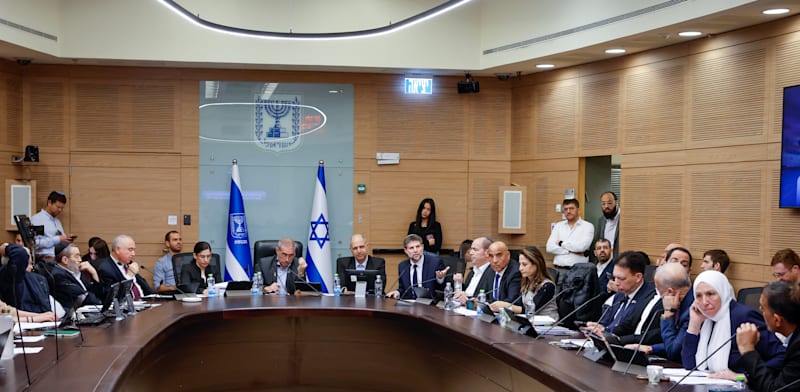
The Knesset Finance Committee, chaired by MK Hanoch Milwidsky (Likud) this morning approved the 2026 Budget for its second and third reading in the Knesset plenum.
The Finance Committee said that as part of the total budget, the government is authorized to spend about NIS 850 billion in fiscal year 2026, consisting of a regular budget of about NIS 621 billion, and a development budget and capital of NIS 228 billion. The budget for income-contingent spending for 2026 will total NIS 77 billion, and the budget for authorization to commit will be about NIS 196 billion.
The budget for calculating the spending limit will be approximately NIS 699 billion, and the payment of debts, excluding payment of debts to the National Insurance Institute, will be NIS 151.81 billion.
More than NIS 30 billion has been added to the Ministry of Defense budget as part of the revised budget, bringing it to over NIS 142 billion. The Ministry of Education budget will be nearly NIS 97 billion, the National Insurance budget nearly NIS 64 billion, and the Ministry of Health budget about NIS 63 billion.
The budget now faces the final hurdle of the second and third reading in the Knesset set for Thursday. Failure to meet the budget approval schedule by the end of the month will lead to the automatic dissolution of the Knesset.
Banks will pay NIS 3.25 billion over the next two years
Minister of Finance Bezalel Smotrich has been forced to make major concessions in his reforms in order to secure the coalition’s support. Among other things, the dairy reform, which he previously stated he would not give up, and the imposition of a property tax on vacant land have been shelved. In addition, in accordance with the recommendations of the legal advice, about two-thirds of the planned reforms in the areas of finance and infrastructure were split from the Economic Arrangements bill.
The taxation of bank profits was also cut in half compared with the original plan, a step that was officially intended to help finance war expenses and reduce the fiscal deficit. On this matter, the parties announced a compromise last Thursday. Smotrich, for his part, tried to market this as a victory, but in practice the reality is apparently the opposite. The banks agreed to pay NIS 3.25 billion over the next two years while removing the threat of legislation that would have meant a high permanent tax on excess profits.
Smotrich can mark success on one significant reform that did overcome the hurdles in the establishment of small banks to strengthen competition in the industry. In addition, the move to widen tax brackets, which would increase the net income of those earning NIS 16,000 gross per month, also remains on the table.
RELATED ARTICLES
Knesset about to pass budget already seen as irrelevant
Bank of Israel slams amended govt budget
Knesset approves first reading of 2026 state budget
On the political front, the haredi parties have withdrawn their demand making the “Conscription Law” a condition for supporting the budget, after Netanyahu and Smotrich made it clear that discussions on the subject would be postponed due to the war. On the other hand, the budget includes an allocation of over NIS 5 billion for coalition funds, most of which are intended for Torah institutions.
Published by Globes, Israel business news – en.globes.co.il – on March 23, 2026.
© Copyright of Globes Publisher Itonut (1983) Ltd., 2026.