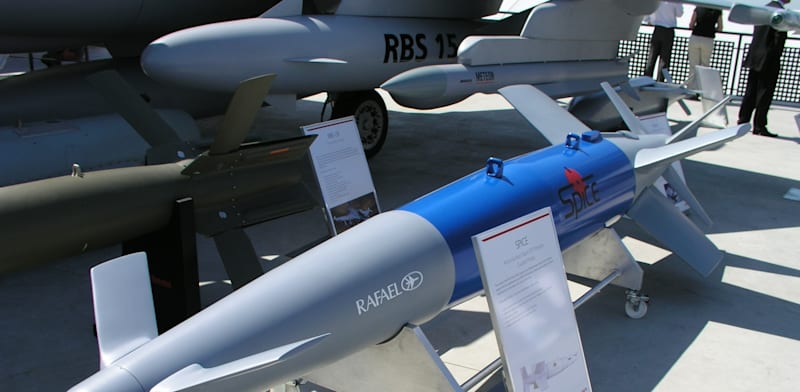
India’s Defense Acquisition Council (DAC), headed by Minister of Defense Rajnath Singh, yesterday approved extensive procurement for an overall $8.7 billion. Among the many arms included in the deal are SPICE 1000 guidance kits (SPICE 1000/Light Hail) manufactured by Israeli company Rafael Advanced Defense Systems, according to reports in the Indian media.
SPICE is a family of precise and autonomous air-to-ground weapon systems, with a range of up to 100 kilometers, with three types of bombs of different weights. SPICE 1000 weighs about 500 kilograms, and the entire system, developed by Rafael, has won the Israel Defense Prize. The uniqueness of the SPICE family is the ability to navigate and home in on the target autonomously, independently of GPS, using an electro-optical homing head that incorporates an innovative mathematical algorithm, which compares the target image to what it sees in real time and thus achieves extremely high hit accuracy of less than three meters.
India’s fighting with Pakistan in May highlighted the country’s need for arms in diverse systems in general and from Israel in particular. This was clearly reflected in early November when the Director General of the Ministry of Defense, Maj. Gen. (res.) Amir Baram, signed a memorandum of understanding (MoU) to strengthen security cooperation with his Indian counterpart, Rajesh Kumar Singh.
Israel defense industries biggest customer
According to the Stockholm International Peace Research Institute (SIPRI), India is the biggest customer of Israeli defense industries, accounting for about 34% of all exports between 2020 and 2024. Last month, the IDRW website reported that a delegation from the Indian Ministry of Defense had secretly arrived in Israel, to reach agreements that would lead to India procuring Israel Aerospace Industries (IAI) Air LORA ballistic missiles and Rafael’s Ice Breaker cruise missiles, but would also manufacture them itself.
Previous reports in India have already indicated that India wants Air LORA missiles following the great success of the Rampage missiles in the recent fighting with Pakistan. Rampage has a range of about 250 kilometers, and the Indian Air Force uses it on Sukhoi 30 and MiG 29 aircraft. Rampage is very accurate, but its range is about 150-250 kilometers, which puts Indian fighter jets at risk against Pakistani defense systems made in China. In contrast, Air LORA has a range of about 400 kilometers, and with it fighter jets can hit targets, without endangering themselves from advanced air defense systems.
Air LORA, developed at IAI’s MLM plant, is designed to hit missile sites, military bases and air defense systems. The missile weighs about 1,600 kilograms, flies at supersonic speed, and uses satellite navigation that is protected from jamming. One of its most notable advantages is the “launch and forget” method, meaning it is launched to the target and does not need to be guided along the way. Its warheads are diverse and can be designed to hit soft targets or bunkers. With a range of about 400 kilometers and a strike radius of only about ten meters, it is expected to allow India to hit any Pakistani base.
RELATED ARTICLES
India and Israel’s winning combination
IAI seen winning Indian Air Force tanker contract
Air India to resume Israel flights in January
India is also interested in the Rafael’s Ice Breaker cruise missile, which is designed for attacks at ranges of about 300 kilometers against land and sea targets. The missile is effective in all weather conditions, can function well in environments saturated with electronic warfare, and has infrared (IIR)-based navigation and missile guidance capabilities, which, through AI, can acquire and identify targets.
Published by Globes, Israel business news – en.globes.co.il – on December 30, 2025.
© Copyright of Globes Publisher Itonut (1983) Ltd., 2025.