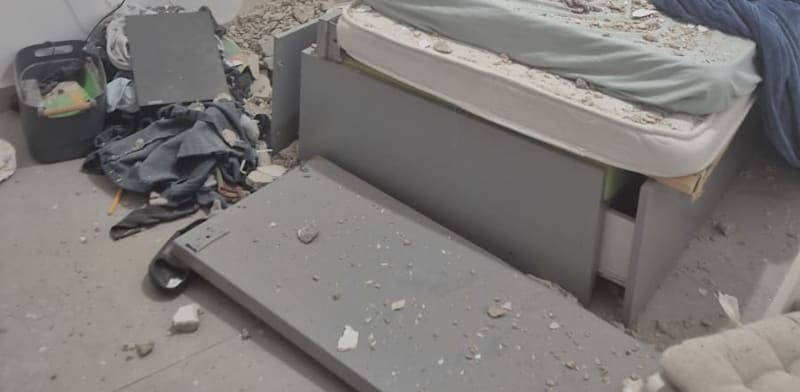
Petah Tikva has been one of the leading targets for Iranian missiles in both the current war and the campaign last June. Last year two safe rooms received direct hits from Iranian missiles and four people sheltering in them were killed, even though they had followed Home Front Command instructions. But earlier this week, on the other hand, a cluster bomb from an Iranian missile directly hit a safe room, also in Petah Tikva, but this time the lives of the babysitter and the children she was looking after were saved, due to the fact that they were in the safe room.
This raises once again the ongoing question: Is a safe room resistant to a missile strike?
Following the tragedies last year in Petah Tikva, the Home Front Command explained that this was an extreme event, and that safe rooms cannot withstand direct hits, but rather shrapnel and impact damage. Experts explain that in order to respond to a direct hit from a half-ton missile, a wall thickness of three meters of concrete is required. This does not exist in public shelters either, and if such a missile hits a public shelter, it will cause similar damage.
“The safe room stood the test well”
Lt. Col. (res.) Dr. Benny Brosh, former chief engineer of the Home Front Command and a member of the Engineers’ Union, says, “In general, safe rooms have stood the test well. At a level where, if you had asked me before, I would have estimated that the situation would have ended a little worse.”
“Think on a national level, what would have to happen, if you want, let’s say, that when the safe room went through such an event (a direct hit) nothing would happen both on a national level and on the private level of each of our homes. We would have had to pay major price increases for it, including the architectural implications of such a decision, construction areas, and more. Therefore, this is a type of risk management. After all, even the safest vehicle in the world is not designed to hit a concrete wall without causing damage that harms the passengers.”
However, if a lesson is to be drawn from this story, Brosh points out that this was a building (hit earlier this week) that underwent TAMA 38, and that plan, which received quite a bit of criticism from a planning perspective, proved its importance from a safety-security perspective. There is no doubt that the damage that would have been caused to the building would have been much greater than what was caused to it after reinforcement and protection,” he notes.
Following the incident in Petah Tikva, another question arises: Is it right that one of the walls of the building where the safe room is located should be an external wall or would it have been better to move it as a completely internal room. According to Brosh, even such (internal) buildings, which were previously commonly designed this way, did not always provide security for their occupants. Last year, people were killed in Beersheba who had such a safe room in their home,” he notes.
Published by Globes, Israel business news – en.globes.co.il – on March 26, 2026.
© Copyright of Globes Publisher Itonut (1983) Ltd., 2026.