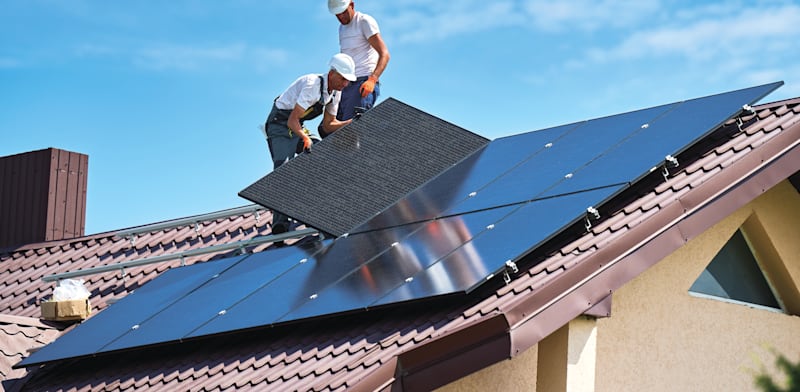
Israel Electric Corp. (IEC) is set to charge the owners of rooftop solar energy panels thousands of shekels for “systems costs,” which it has not collected in recent years for consuming electricity produced on the roofs. The charge is based on a decision by the Public Utilities Electricity Authority in March 2022, which has not been implemented so far due to delays in developing the required systems at the IEC. Since October, the IEC has begun demanding retroactive payment for the past two years.
Solar energy rooftop panels are considered a particularly profitable investment in Israel, with a return of about 15% per year on the costs of installing the system (which amounts to tens of thousands of shekels). Each kWh produced is rewarded with a particularly generous price: NIS 0.48 per kWh (compared with NIS 0.07-0.20 per kWh for a commercial ground-based solar field) and even NIS 0.54 agorot per kWh for those living in cities with more than 30,000 residents. Starting last month, rooftop solar panels have become mandatory for every house with an appropriate roof size that receives a building permit.
Electricity produced from rooftop solar energy panels can be sold to IEC’s national electricity grid or used for self-consumption at home instead of buying electricity from the grid. However, self-consumption electricity does not come for free, and according to regulations, home electricity producers must pay the electricity company “system management costs” that currently stand at NIS 0.09 for every kWh consumed. This is to finance services that the electricity company provides that enable ongoing consumption, such as balancing demand and maintaining the correct frequency of the system.
“The costs were not transparent to me”
Although the decision on the charge was made almost four years ago, the IEC did not collect them because it was required to develop computer systems that would allow this. “I was very surprised to receive this charge,” says Naomi from Herzliya, who paid NIS 181 in IEC costs for her new solar panel system (from production that earned her NIS 980, and saved her an additional NIS 1,400). According to her, these costs were not made transparent to her by the company that installed the solar panels, because at that time they were not actually collected.
In addition to the monthly amounts, the IEC is expected to demand a retroactive payment for the last two years (the maximum it is allowed to collect retroactively, by law). In a simplified calculation based on the same bimonthly payment of NIS 181 that Naomi paid, the amount for two years amounts to nearly NIS 2,200. Indeed, payments in the four-digit range are expected to arrive soon for some owners of solar energy roof panels, and some homeowners have already received phone text messages on the matter. IEC will allow the bill to be split into 24 payments.
RELATED ARTICLES
Rooftop solar panels become mandatory on new houses
All Israelis will foot bill for mandatory rooftop solar panels
New housing rooftop solar panel incentives unveiled
IEC declined to elaborate on the amount of annual income it will receive from these payments, and hence how much money it lost for the time it did not collect it in accordance with the regulation.
Estimates instead of real data
One of the problems that arises as part of the new systems payment concerns how to estimate how much of the electricity produced is actually consumed. This is because without a production meter, which most home producers do not have, and whose cost reaches thousands of shekels, electricity consumption from the home system is done “behind the meter” and is not explicitly recorded anywhere.
Therefore, the IEC is required to make a number of significant assumptions that do not always correspond to reality. For each solar roof, a “normative production” amount is determined that it is supposed to produce by each month of the year. The difference between this amount and the actual production is the amount of electricity that was supposedly consumed domestically.
In practice, Naomi, for example, says that the size of the converter installed at her home is bigger than required, and supposedly calculates for her more power than she has. In addition, some of the solar panels are not optimally oriented, so she is producing less electricity than the IEC estimated and she insists she is being charged a higher fee than she should be.
Solar panel companies are also shaken by the decision. According to Adam Kromer, CEO of GreenDays, a company that compares prices between different installers, their customers “were surprised to discover a new charge on their electricity bill starting October 2025. He added, “The charge was introduced unexpectedly and without any notice – neither on the charge itself nor on its calculation method. The charge is based on decisions and calculations, but these were not clearly published. Companies, organizations and journalists in the field received information about the change from the field.” He further says, “We were informed in the updated tariff book for January 2026 of an increase of over 12% to this tariff.”
Published by Globes, Israel business news – en.globes.co.il – on January 5, 2026.
© Copyright of Globes Publisher Itonut (1983) Ltd., 2026.