No Result
View All Result
  • Login
Monday, September 21, 2026
FeeOnlyNews.com
  • Home
  • Business
  • Financial Planning
  • Personal Finance
  • Investing
  • Money
  • Economy
  • Markets
  • Stocks
  • Trading
  • Home
  • Business
  • Financial Planning
  • Personal Finance
  • Investing
  • Money
  • Economy
  • Markets
  • Stocks
  • Trading
No Result
View All Result
FeeOnlyNews.com
No Result
View All Result
Home Financial Planning

When Clients Won’t Sell: What Actually Helps Clients Let Go (Of The Endowment Effect)

by FeeOnlyNews.com
2 months ago
in Financial Planning
Reading Time: 4 mins read
A A
0
When Clients Won’t Sell: What Actually Helps Clients Let Go (Of The Endowment Effect)
Share on FacebookShare on TwitterShare on LInkedIn


As human beings, most of us have a hard time letting go, especially in cases where we have held something for a long time and formed a personal attachment to it. From the treasured (blue) coffee mug, to the t-shirt we got at that concert, to the higher-stakes situations like the family home we’ve lived in for years, or the company stock we’ve built up over decades that made it possible to retire. The good news is that our human tendency to create attachment enables us to invest into ourselves and our community. The bad news is that it can create a resistance to change. Such an unwillingness to sell is especially problematic in situations like real estate or concentrated stock positions, which create real financial planning hazards that advisors must help their clients navigate.

In this guest post, Dr. Meghaan Lurtz, a leading expert on the psychology of financial planning and Professor of Practice at Kansas State University, explores the research behind this phenomenon (known formally as the “endowment effect”), how it typically manifests in financial planning situations with clients, and more importantly what financial advisors can actually do to help their clients get more comfortable with selling an asset that needs to be sold.

The endowment effect is complicated, though, because it’s actually driven by three different mechanisms, any one of which (or sometimes a combination thereof) may be at play in any particular situation. In some cases, it’s driven by loss aversion – the recognition that the pain of loss is twice as impactful as the joy of a comparable gain, which causes us to ask a lot more when selling something than we would ever pay to buy it. In other cases, our own identity gets tangled up into the situation… such as the concentrated stock position that was accumulated through years of employment, making it more difficult to sell since we feel that we earned it through the fruits of our labor and our success as a career professional. And sometimes, it’s simply a result of different anchor points between buyers and sellers: when we’re asked to let go we often think of the highest price it could be worth (e.g., what the most expensive property on the street ever sold for), while the buyer looks at how inexpensively it might be obtained (e.g., what the least expensive property in the area went for).

Being aware of when these dynamics are at play is important, because the emotionally driven phenomenon is not responsive to logic as a cure. Which means it’s not enough to simply know that the endowment effect is at play, and it’s especially unhelpful to communicate it that way to clients, as  suggesting that their unwillingness to sell is ‘a result of their biases’ is more likely to elicit defensiveness than a concession that they need to take action.

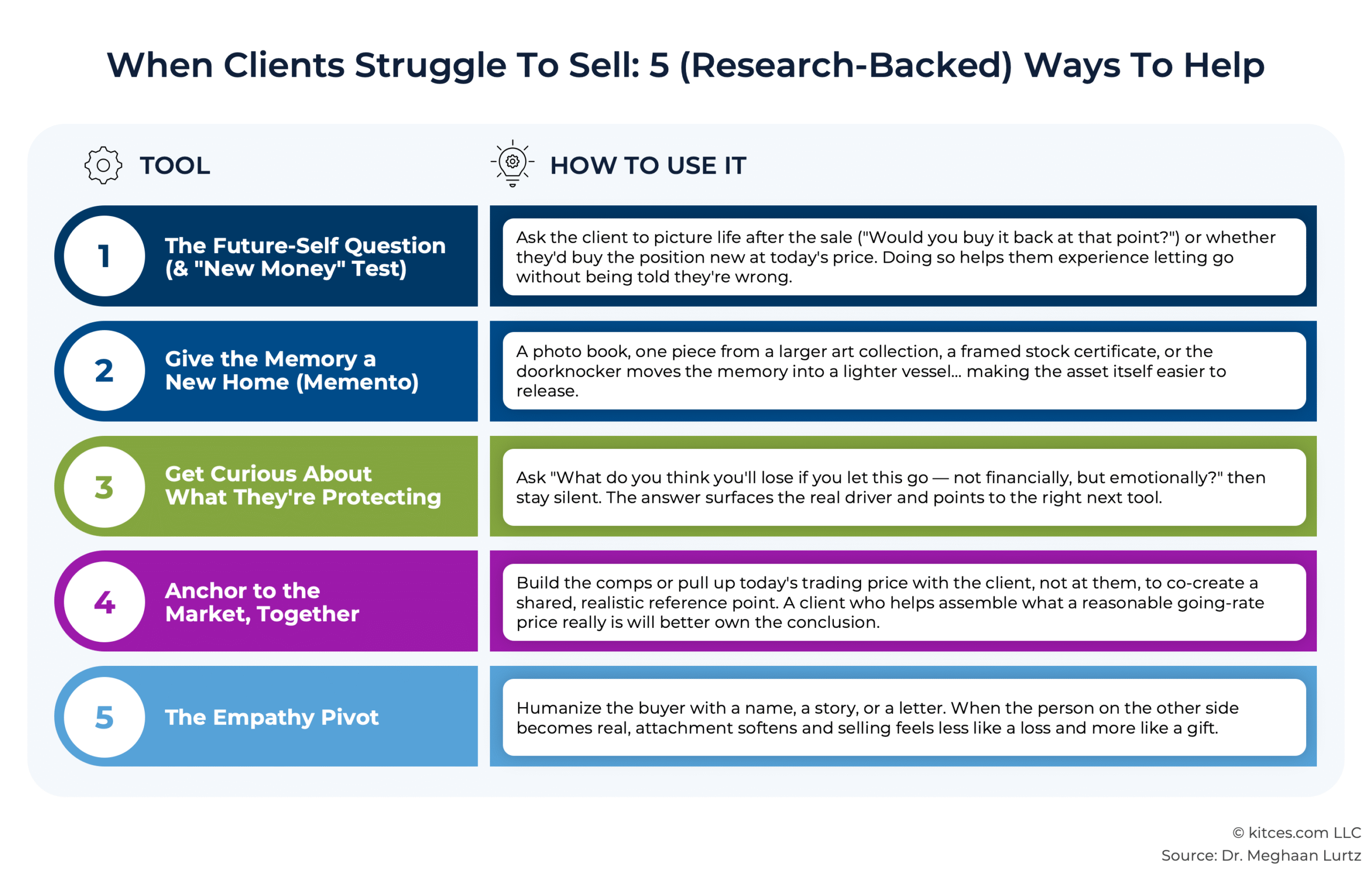
So what does work? Psychology research on the endowment effect suggests several paths. One approach is to have clients envision what their future life might look like, after a sale has already occurred, to help them get comfortable with being on the other side of the sale. Another option is to encourage them to capture a memento – from the doorknocker or a key piece of art from the family home they’re selling, to perhaps a framed stock certificate of that company stock they held so long (and are now getting ready to liquidate) – to diminish the pain of the loss by having something to keep. Other tactics include working alongside with the client to re-anchor to a realistic price in the current environment (e.g., “Let’s look together… at what comps are selling for” or “…at what price it’s trading today”), trying to help the client get familiar with who will be on the receiving end of the sale (e.g., get to know the family that’s looking to buy and move into your family home), or simply asking, “What do you think you’ll lose if you let this go – not financially, but emotionally?” so the client can surface and start thinking through their own worries.

Ultimately, the key point is to recognize that an unwillingness to sell something we’ve had a long time and/or formed an attachment to is normal, is human, and is not simply a matter of showing enough logic to ‘prove the point’ that it’s a good financial planning decision to sell (even if that really is the case). Instead, because the reality is that the endowment effect is first and foremost an emotionally driven phenomenon, helping clients unearth that emotion, name it, and do their own work to begin working through it is the better way to help them begin to let go and engage in the sale of the asset.

And if you want to go deeper on this topic, hear directly from the author on the Financial Advisor Technician podcast .

Read More…

Click the icon below to listen.


Source link

Tags: ClientsEffectendowmenthelpsSellWont
ShareTweetShare
Previous Post

How to Build Your Own Real Estate Investing Team (From Scratch)

Next Post

Ask your employees one question about AI. The silence will tell you everything

Related Posts

Ask an Advisor: What did your worst client meeting teach you?

Ask an Advisor: What did your worst client meeting teach you?

by FeeOnlyNews.com
August 7, 2026
0

Tense, difficult moments are a natural part of human interaction. For financial advisors, whether seasoned pros or new recruits, it's...

Why an employee-owned RIA took a majority stake investment

Why an employee-owned RIA took a majority stake investment

by FeeOnlyNews.com
August 7, 2026
0

Berger Financial Group, a Plymouth, Minnesota-based registered investment advisory firm that has been employee-owned since 2018, has received a majority...

Weekend Reading For Financial Planners (August 8–9)

Weekend Reading For Financial Planners (August 8–9)

by FeeOnlyNews.com
August 7, 2026
0

Enjoy the current installment of "Weekend Reading For Financial Planners" – this week's edition kicks off with the news that...

Wealth management has got junior advisors’ first 90 days covered. What happens on day 91?

Wealth management has got junior advisors’ first 90 days covered. What happens on day 91?

by FeeOnlyNews.com
August 7, 2026
0

Ask any wealth management firm what a new advisor recruit can expect in the first 90 days, and you'll likely...

How understanding brain science can boost advisors’ business

How understanding brain science can boost advisors’ business

by FeeOnlyNews.com
August 6, 2026
0

Financial planner Vanessa Martinez kicked off a discussion about the emotional, neurological and psychological sides of the profession with a...

New professional designation aims to build DAF expertise

New professional designation aims to build DAF expertise

by FeeOnlyNews.com
August 6, 2026
0

Advisors interested in serving charitably inclined clients will soon have a new designation program to consider, one focused specifically on...

Next Post
Ask your employees one question about AI. The silence will tell you everything

Ask your employees one question about AI. The silence will tell you everything

15-year-old boy opens fire on Yonkers, New York street corner kills one wounds four teens

15-year-old boy opens fire on Yonkers, New York street corner kills one wounds four teens

  • Trending
  • Comments
  • Latest
MEXC Lists Ondo Yield Asset As Tokenized Treasury Demand Grows

MEXC Lists Ondo Yield Asset As Tokenized Treasury Demand Grows

July 3, 2026
Delek Logistics Partners Reports alt=

Delek Logistics Partners Reports $0.54 EPS for Q2 FY26

August 5, 2026
Ship and Debit Automation: A 2026 Guide to Margin Protection

Ship and Debit Automation: A 2026 Guide to Margin Protection

July 30, 2026
China threatens retaliation against U.S. humanoid robot ban, says it ‘severely damages’ relations

China threatens retaliation against U.S. humanoid robot ban, says it ‘severely damages’ relations

July 29, 2026
The AI Race With China Is a Lie Told by Big Tech to Justify the Data Center Invasion

The AI Race With China Is a Lie Told by Big Tech to Justify the Data Center Invasion

July 27, 2026
Here’s When Amazon’s ROI Will Pull Ahead of Microsoft’s in the AI Cloud Spend War

Here’s When Amazon’s ROI Will Pull Ahead of Microsoft’s in the AI Cloud Spend War

July 20, 2026
Advanced Micro Devices (AMD) Price Prediction: How Much a ,000 Investment Could Be Worth by 2031

Advanced Micro Devices (AMD) Price Prediction: How Much a $5,000 Investment Could Be Worth by 2031

0
Cities holding up to 3 million people found under Amazon rain forest

Cities holding up to 3 million people found under Amazon rain forest

0
Republican Party Displacement | Mises Institute

Republican Party Displacement | Mises Institute

0
Bybit Uses Tokenised Equities as Underlyings for Structured Yield

Bybit Uses Tokenised Equities as Underlyings for Structured Yield

0
Explained: How BSE traded fewer contracts after CAS but premiums rose 75% in first week

Explained: How BSE traded fewer contracts after CAS but premiums rose 75% in first week

0
Vaxart outlines Phase IIb COVID-19 top line data in first half of 2027 backed by BARDA funding (OTCMKTS:VXRT)

Vaxart outlines Phase IIb COVID-19 top line data in first half of 2027 backed by BARDA funding (OTCMKTS:VXRT)

0
Advanced Micro Devices (AMD) Price Prediction: How Much a ,000 Investment Could Be Worth by 2031

Advanced Micro Devices (AMD) Price Prediction: How Much a $5,000 Investment Could Be Worth by 2031

August 8, 2026
Republican Party Displacement | Mises Institute

Republican Party Displacement | Mises Institute

August 8, 2026
Vanguard Chief Economist: AI and jobs, still in an ATM phase

Vanguard Chief Economist: AI and jobs, still in an ATM phase

August 8, 2026
Explained: How BSE traded fewer contracts after CAS but premiums rose 75% in first week

Explained: How BSE traded fewer contracts after CAS but premiums rose 75% in first week

August 8, 2026
Democrats’ Affordability Message Misses a Key Expense—Student Debt

Democrats’ Affordability Message Misses a Key Expense—Student Debt

August 8, 2026
Banks or NBFCs? DSP’s Preethi R S explains where she sees the best opportunities

Banks or NBFCs? DSP’s Preethi R S explains where she sees the best opportunities

August 8, 2026
FeeOnlyNews.com

Get the latest news and follow the coverage of Business & Financial News, Stock Market Updates, Analysis, and more from the trusted sources.

CATEGORIES

  • Business
  • Cryptocurrency
  • Economy
  • Financial Planning
  • Investing
  • Market Analysis
  • Markets
  • Money
  • Personal Finance
  • Startups
  • Stock Market
  • Trading

LATEST UPDATES

  • Advanced Micro Devices (AMD) Price Prediction: How Much a $5,000 Investment Could Be Worth by 2031
  • Republican Party Displacement | Mises Institute
  • Vanguard Chief Economist: AI and jobs, still in an ATM phase
  • Our Great Privacy Policy
  • Terms of Use, Legal Notices & Disclaimers
  • About Us
  • Contact Us

Copyright © 2022-2024 All Rights Reserved
See articles for original source and related links to external sites.

Welcome Back!

Sign In with Facebook
Sign In with Google
Sign In with Linked In
OR

Login to your account below

Forgotten Password?

Retrieve your password

Please enter your username or email address to reset your password.

Log In
No Result
View All Result
  • Home
  • Business
  • Financial Planning
  • Personal Finance
  • Investing
  • Money
  • Economy
  • Markets
  • Stocks
  • Trading

Copyright © 2022-2024 All Rights Reserved
See articles for original source and related links to external sites.