No Result
View All Result
  • Login
Wednesday, September 16, 2026
FeeOnlyNews.com
  • Home
  • Business
  • Financial Planning
  • Personal Finance
  • Investing
  • Money
  • Economy
  • Markets
  • Stocks
  • Trading
  • Home
  • Business
  • Financial Planning
  • Personal Finance
  • Investing
  • Money
  • Economy
  • Markets
  • Stocks
  • Trading
No Result
View All Result
FeeOnlyNews.com
No Result
View All Result
Home Cryptocurrency

NEAR Adds Staking-Based Payments For AI Compute Credits

by FeeOnlyNews.com
2 months ago
in Cryptocurrency
Reading Time: 4 mins read
A A
0
NEAR Adds Staking-Based Payments For AI Compute Credits
Share on FacebookShare on TwitterShare on LInkedIn


NEAR has launched a staking-based payment model for NEAR AI, giving users a way to lock NEAR tokens and receive monthly compute credits instead of paying through traditional cloud billing or credit-card rails.

According to the validated notes, the system gives users access to 43 hosted AI models, including models from OpenAI, Anthropic, and Google. The key detail is that tokens are not consumed. Users lock NEAR and receive compute credits proportional to their stake size.

That makes this more interesting than a simple payment integration.

NEAR is trying to tie token utility directly to AI usage. Instead of asking users to buy a token for speculative reasons, the model gives the token a role in accessing compute.

The question is whether users will actually adopt it at scale. But as a design direction, it is worth watching.

For more details, visit the official Near platform.

TL;DR

NEAR has launched staking-based compute payments for NEAR AI.
Users lock NEAR tokens and receive monthly compute credits.
The model links token utility with AI model access, but adoption still needs to be proven.

Why AI Compute Payments Are Hard

AI usage has a very real payment problem.

Users and developers often pay through cloud accounts, credit cards, subscriptions, invoices, or platform credits. That works fine in traditional software, but it does not map neatly to autonomous agents, crypto-native users, or applications that want programmable access without conventional billing.

NEAR’s model tries to solve that by using staking as the payment layer.

Instead of spending tokens directly, users lock them. The locked stake determines monthly compute credits. That creates a different relationship between token ownership and product access.

The user is not simply paying a fee. They are committing capital to the network and receiving AI compute access as a benefit.

That could make sense for developers, agent builders, or users who already hold NEAR and want a reason to use it beyond staking yield or governance.

Tokens Are Not Consumed

The fact that tokens are not consumed is important.

If the model required users to spend NEAR every time they used an AI model, it would look more like a normal pay-per-use system. Locking tokens changes the economics because users retain ownership while receiving credits.

That may make the system feel less expensive for users, though there is still an opportunity cost. Locked tokens cannot be freely used elsewhere while committed, and their market value can move.

The model therefore resembles a membership or access system backed by staking.

That is a different kind of token utility, and crypto networks have spent years searching for utility models that do not rely only on speculation or inflationary rewards.

AI Agents Need Native Payment Rails

The autonomous-agent angle is where this gets more forward-looking.

If AI agents are going to operate independently, call models, use tools, pay for services, and make decisions in software environments, they need payment rails that are programmable. Traditional billing can work for human-managed accounts, but it becomes clunky when software agents are expected to act continuously.

Crypto rails may be useful there.

A staking-based compute model could let an agent or developer environment access AI resources based on locked capital rather than repeated card payments or centralized credentials.

That is still early. There are many open questions around permissions, safety, abuse controls, cost predictability, and user experience. But the direction fits NEAR’s broader focus on AI and agent infrastructure.

Don’t Overstate Adoption Yet

The caution is simple: launch is not the same as adoption.

NEAR may have a clever compute-credit model, but the market still needs to show whether users prefer it. Developers will compare it with direct API billing, cloud credits, open-source models, enterprise contracts, and other crypto-native compute markets.

The model also needs to be clear.

How many credits does a given stake generate?

Which models are available at what cost?

How predictable are credits over time?

Can teams build around it without worrying about token volatility?

Does the system attract users who were not already in the NEAR ecosystem?

Those questions will determine whether this becomes a real use case or a niche experiment.

A More Practical Token Utility Story

What makes the NEAR AI payment model interesting is that it gives the token a practical role.

Crypto has often struggled to explain why a token needs to exist beyond governance, gas, staking, or incentives. Linking token staking to AI compute access gives NEAR a more concrete utility narrative.

That does not guarantee success. But it is more useful than vague AI branding.

If users can lock NEAR and receive compute credits for models they actually use, then the token becomes part of a product loop. That is exactly what many networks are trying to build: token demand connected to real usage rather than just market cycles.

NEAR’s staking-based compute payments are still early, but they point toward a crypto-AI model that is more practical than most of the hype around the sector.

This article is based on NEAR AI materials describing staking-based compute credits and model access.

This article was written by the News Desk and edited by Samuel Rae.

This report is based on information released by Near. at Near


Source link

Tags: AddsComputecreditsPaymentsStakingBased
ShareTweetShare
Previous Post

Leopold Aschenbrenner Situational Awareness fund: $45B to fire sale

Next Post

How to save $5,000 in 6 months

Related Posts

EU to Advance MiCA Review, Targeting Non-EU Stablecoin Rules

EU to Advance MiCA Review, Targeting Non-EU Stablecoin Rules

by FeeOnlyNews.com
August 8, 2026
0

Key TakeawaysThe EU is set to revise the MiCA framework to allow excluded foreign stablecoins like Tether to operate.This regulatory...

Coinbase CEO Brian Armstrong Says Crypto Progress Continues Despite CLARITY Act Delay

Coinbase CEO Brian Armstrong Says Crypto Progress Continues Despite CLARITY Act Delay

by FeeOnlyNews.com
August 7, 2026
0

Coinbase CEO Brian Armstrong said crypto adoption continues despite the delayed CLARITY Act, pointing to growing stablecoin use, tokenization, and...

Bybit Uses Tokenised Equities as Underlyings for Structured Yield

Bybit Uses Tokenised Equities as Underlyings for Structured Yield

by FeeOnlyNews.com
August 7, 2026
0

Bybit is expanding the role of tokenised equities on its platform by using more xStocks as underlyings for its Dual...

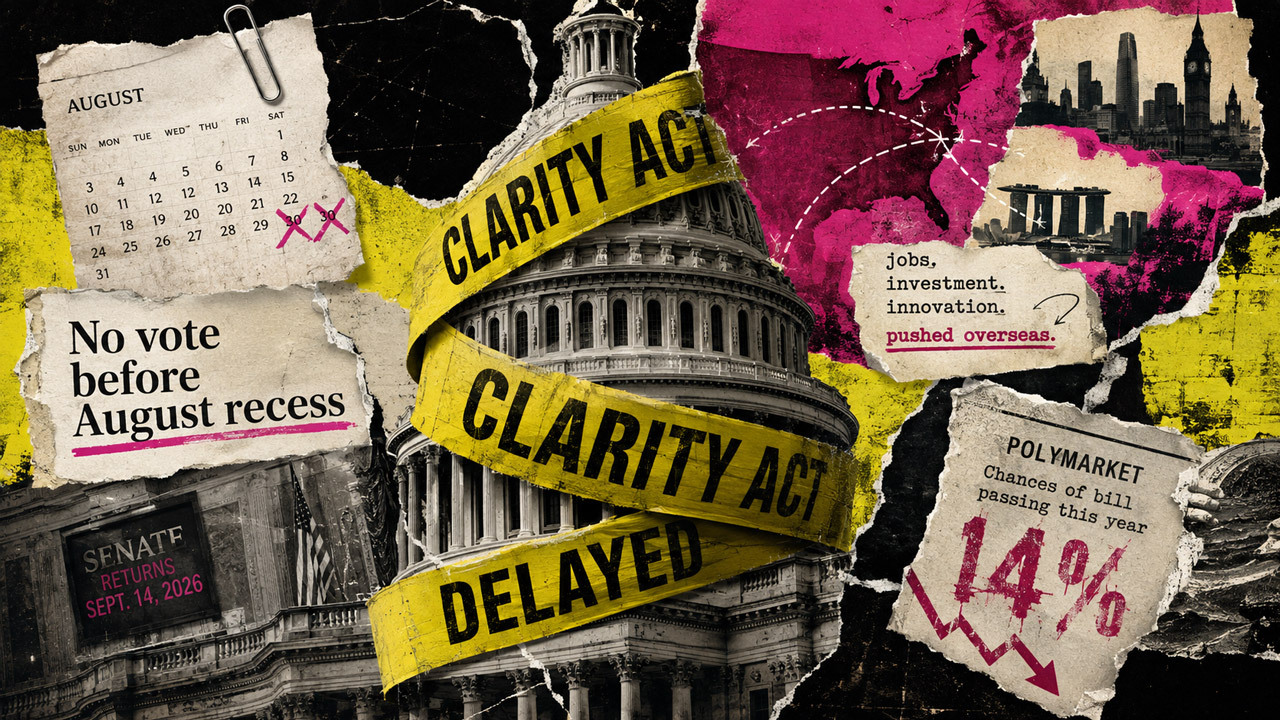
Senate abandons August CLARITY Act vote

Senate abandons August CLARITY Act vote

by FeeOnlyNews.com
August 7, 2026
0

The US Senate has abandoned plans to vote on the landmark CLARITY Act legislation before its August break.On Aug. 6,...

Reform UK Chair Calls for Probe into SBF-Linked Donation: Report

Reform UK Chair Calls for Probe into SBF-Linked Donation: Report

by FeeOnlyNews.com
August 7, 2026
0

The chairman of the UK’s Reform party has called for an investigation following reports of a $50,000 political donation linked...

MARA Reports 1M Loss While Miners Deposit 581 BTC to NYDIG

MARA Reports $611M Loss While Miners Deposit 581 BTC to NYDIG

by FeeOnlyNews.com
August 7, 2026
0

Key TakeawaysMARA’s Q2 revenue fell 27% to $174.9 million, missing Wall Street estimates by more than 16%.Riot Platforms and MARA...

Next Post
How to save ,000 in 6 months

How to save $5,000 in 6 months

Psychology says the reason the most generous person you know goes home to a silent phone isn’t bad luck — it’s that giving without ever asking for anything back reads to other people as self-sufficiency, and nobody reaches out to someone who seems fine

Psychology says the reason the most generous person you know goes home to a silent phone isn't bad luck — it's that giving without ever asking for anything back reads to other people as self-sufficiency, and nobody reaches out to someone who seems fine

  • Trending
  • Comments
  • Latest
Bitcoin and ethereum prices today, Friday, August 7, 2026: Crypto prices moving higher following July jobs report

Bitcoin and ethereum prices today, Friday, August 7, 2026: Crypto prices moving higher following July jobs report

August 7, 2026
MEXC Lists Ondo Yield Asset As Tokenized Treasury Demand Grows

MEXC Lists Ondo Yield Asset As Tokenized Treasury Demand Grows

July 3, 2026
Delek Logistics Partners Reports alt=

Delek Logistics Partners Reports $0.54 EPS for Q2 FY26

August 5, 2026
Onkure Therapeutics Releases Q2 2026 Financial Results

Onkure Therapeutics Releases Q2 2026 Financial Results

August 4, 2026
Thryv outlines M run-rate savings while revising 2026 SaaS adjusted EBITDA to M-M (NASDAQ:THRY)

Thryv outlines $60M run-rate savings while revising 2026 SaaS adjusted EBITDA to $42M-$44M (NASDAQ:THRY)

August 4, 2026
My Thoughts on Going All In

My Thoughts on Going All In

August 4, 2026
Advanced Micro Devices (AMD) Price Prediction: How Much a ,000 Investment Could Be Worth by 2031

Advanced Micro Devices (AMD) Price Prediction: How Much a $5,000 Investment Could Be Worth by 2031

0
Cities holding up to 3 million people found under Amazon rain forest

Cities holding up to 3 million people found under Amazon rain forest

0
Republican Party Displacement | Mises Institute

Republican Party Displacement | Mises Institute

0
Bybit Uses Tokenised Equities as Underlyings for Structured Yield

Bybit Uses Tokenised Equities as Underlyings for Structured Yield

0
Explained: How BSE traded fewer contracts after CAS but premiums rose 75% in first week

Explained: How BSE traded fewer contracts after CAS but premiums rose 75% in first week

0
Vaxart outlines Phase IIb COVID-19 top line data in first half of 2027 backed by BARDA funding (OTCMKTS:VXRT)

Vaxart outlines Phase IIb COVID-19 top line data in first half of 2027 backed by BARDA funding (OTCMKTS:VXRT)

0
Advanced Micro Devices (AMD) Price Prediction: How Much a ,000 Investment Could Be Worth by 2031

Advanced Micro Devices (AMD) Price Prediction: How Much a $5,000 Investment Could Be Worth by 2031

August 8, 2026
Republican Party Displacement | Mises Institute

Republican Party Displacement | Mises Institute

August 8, 2026
Vanguard Chief Economist: AI and jobs, still in an ATM phase

Vanguard Chief Economist: AI and jobs, still in an ATM phase

August 8, 2026
Explained: How BSE traded fewer contracts after CAS but premiums rose 75% in first week

Explained: How BSE traded fewer contracts after CAS but premiums rose 75% in first week

August 8, 2026
Democrats’ Affordability Message Misses a Key Expense—Student Debt

Democrats’ Affordability Message Misses a Key Expense—Student Debt

August 8, 2026
Banks or NBFCs? DSP’s Preethi R S explains where she sees the best opportunities

Banks or NBFCs? DSP’s Preethi R S explains where she sees the best opportunities

August 8, 2026
FeeOnlyNews.com

Get the latest news and follow the coverage of Business & Financial News, Stock Market Updates, Analysis, and more from the trusted sources.

CATEGORIES

  • Business
  • Cryptocurrency
  • Economy
  • Financial Planning
  • Investing
  • Market Analysis
  • Markets
  • Money
  • Personal Finance
  • Startups
  • Stock Market
  • Trading

LATEST UPDATES

  • Advanced Micro Devices (AMD) Price Prediction: How Much a $5,000 Investment Could Be Worth by 2031
  • Republican Party Displacement | Mises Institute
  • Vanguard Chief Economist: AI and jobs, still in an ATM phase
  • Our Great Privacy Policy
  • Terms of Use, Legal Notices & Disclaimers
  • About Us
  • Contact Us

Copyright © 2022-2024 All Rights Reserved
See articles for original source and related links to external sites.

Welcome Back!

Sign In with Facebook
Sign In with Google
Sign In with Linked In
OR

Login to your account below

Forgotten Password?

Retrieve your password

Please enter your username or email address to reset your password.

Log In
No Result
View All Result
  • Home
  • Business
  • Financial Planning
  • Personal Finance
  • Investing
  • Money
  • Economy
  • Markets
  • Stocks
  • Trading

Copyright © 2022-2024 All Rights Reserved
See articles for original source and related links to external sites.