No Result
View All Result
  • Login
Sunday, September 13, 2026
FeeOnlyNews.com
  • Home
  • Business
  • Financial Planning
  • Personal Finance
  • Investing
  • Money
  • Economy
  • Markets
  • Stocks
  • Trading
  • Home
  • Business
  • Financial Planning
  • Personal Finance
  • Investing
  • Money
  • Economy
  • Markets
  • Stocks
  • Trading
No Result
View All Result
FeeOnlyNews.com
No Result
View All Result
Home Cryptocurrency

FATF Says Crypto Travel Rule Adoption Is Rising, But Enforcement Still Lags

by FeeOnlyNews.com
2 months ago
in Cryptocurrency
Reading Time: 4 mins read
A A
0
FATF Says Crypto Travel Rule Adoption Is Rising, But Enforcement Still Lags
Share on FacebookShare on TwitterShare on LInkedIn


The Financial Action Task Force says more jurisdictions are putting crypto rules into law, but enforcement remains the weak point.

In its Seventh Targeted Update on the implementation of FATF standards for virtual assets and virtual asset service providers, the global watchdog reported that 83% of surveyed jurisdictions have passed legislation to implement the Travel Rule. That is up from 73% in 2025.

On paper, that looks like progress.

But the report also says only 40% of jurisdictions with Travel Rule legislation have taken supervisory or enforcement actions. In other words, more countries have rules, but far fewer are actually policing them in a meaningful way.

That gap is now the core issue.

TL;DR

FATF says 83% of surveyed jurisdictions have passed Travel Rule legislation for crypto.
Only 40% of jurisdictions with those laws have taken supervisory or enforcement actions.
The report highlights risks tied to scam centers, DPRK cyber theft, DeFi, unhosted wallets, and freeze-resistant stablecoins.

Laws Are Spreading Faster Than Enforcement

The Travel Rule is one of the most important compliance standards in crypto.

It requires virtual asset service providers to collect and transmit originator and beneficiary information for qualifying transfers. In normal language, regulators want crypto intermediaries to know who is sending and receiving funds, especially when transfers cross regulated platforms.

For years, the industry argued about whether this could work in crypto.

Now, according to FATF, most surveyed jurisdictions have at least moved the rule into law. That is a major shift from the early days when many countries were still deciding whether to regulate VASPs at all.

But legislation is only the first step.

A rule that sits on the books without supervision does not change much. Exchanges, brokers, custodians, and payment firms need guidance, inspections, enforcement risk, and technical systems. Regulators need staff and tools. Cross-border cooperation needs to function.

FATF’s numbers show that implementation is still uneven.

Why The Enforcement Gap Matters

Crypto compliance has always had a weakest-link problem.

If one country has strict rules and another does not enforce anything, illicit actors can move through the weaker jurisdiction. That creates pressure on the whole system because crypto transactions are global by design.

This is especially relevant for scams, laundering networks, ransomware groups, and state-linked hacking operations.

FATF’s report flags organized crime-linked scam centers, DPRK cyber theft, unhosted wallets, DeFi, and stablecoins designed to resist freezing as areas of concern.

Those categories show how the risk picture is changing.

It is no longer only about rogue exchanges or obvious dark-market activity. It is about large scam compounds, sophisticated cyber operations, decentralized services, wallet infrastructure, and stablecoin designs that may limit the ability of issuers or intermediaries to freeze funds.

That is a much harder environment for regulators.

DeFi Remains The Hardest Fit

DeFi is one of the most uncomfortable parts of the FATF framework.

The Travel Rule assumes there is an intermediary that can collect and transmit information. In DeFi, that intermediary may not exist in the traditional sense. A protocol may be smart contracts, frontends, governance participants, developers, validators, relayers, or a mix of all of them.

Regulators then face a difficult question: who is responsible?

If a team controls a frontend, perhaps the frontend becomes the enforcement point. If a DAO governs parameters, perhaps governance participants face pressure. If users interact directly with contracts, enforcement becomes much harder.

FATF has been pushing countries to avoid letting “decentralized” labels become a loophole. But turning that principle into practical supervision is not simple.

That is why the enforcement gap matters even more in DeFi.

Stablecoins Are Under The Microscope

Stablecoins also stand out in the report’s risk list.

They are one of crypto’s strongest use cases, but also one of the easiest tools for moving value quickly across borders. USDT, USDC, and other stablecoins have become core settlement assets for traders, businesses, remittances, DeFi users, and, at times, illicit networks.

FATF’s concern around freeze-resistant stablecoins is notable because it focuses on control.

If a stablecoin issuer can freeze addresses, regulators may pressure issuers to act against illicit funds. If a stablecoin is designed to resist freezing or lacks a clear issuer control point, that enforcement route becomes weaker.

That raises difficult questions about censorship resistance, user protection, and law enforcement access.

Crypto users often value assets that cannot be easily frozen. Regulators worry that those same features can help criminals.

That tension is not going away.

The Next Phase Is Supervision

The headline number, 83% legislative adoption, shows that crypto regulation has become mainstream. The more important number may be 40% enforcement action.

That is where the next phase will happen.

Countries will be judged less on whether they wrote rules and more on whether they supervise firms, punish violations, and cooperate across borders. Exchanges and custodians will need stronger Travel Rule systems. DeFi frontends may face more scrutiny. Stablecoin issuers will remain under pressure.

For the industry, the message is clear enough.

The compliance debate has moved beyond whether crypto should be regulated. It is now about whether existing rules are being enforced consistently enough to satisfy global standard setters.

That may not be the story traders want to hear, but it is the story that will shape how exchanges, wallets, stablecoins, and DeFi protocols operate in the next market cycle.

This article is based on FATF’s Seventh Targeted Update on virtual assets and VASPs.

This article was written by the News Desk and edited by Samuel Rae.

This report is based on information released in disclosures at primary source documentation.


Source link

Tags: AdoptionCryptoenforcementFATFlagsRisingRuletravel
ShareTweetShare
Previous Post

Meta Platforms (META) Q2 2026 Preview: EPS Est. $7.23, Reports July 29

Next Post

General Dynamics Q2 2026 Earnings Preview — July 29, Street Expects $3.97 EPS

Related Posts

EU to Advance MiCA Review, Targeting Non-EU Stablecoin Rules

EU to Advance MiCA Review, Targeting Non-EU Stablecoin Rules

by FeeOnlyNews.com
August 8, 2026
0

Key TakeawaysThe EU is set to revise the MiCA framework to allow excluded foreign stablecoins like Tether to operate.This regulatory...

Coinbase CEO Brian Armstrong Says Crypto Progress Continues Despite CLARITY Act Delay

Coinbase CEO Brian Armstrong Says Crypto Progress Continues Despite CLARITY Act Delay

by FeeOnlyNews.com
August 7, 2026
0

Coinbase CEO Brian Armstrong said crypto adoption continues despite the delayed CLARITY Act, pointing to growing stablecoin use, tokenization, and...

Bybit Uses Tokenised Equities as Underlyings for Structured Yield

Bybit Uses Tokenised Equities as Underlyings for Structured Yield

by FeeOnlyNews.com
August 7, 2026
0

Bybit is expanding the role of tokenised equities on its platform by using more xStocks as underlyings for its Dual...

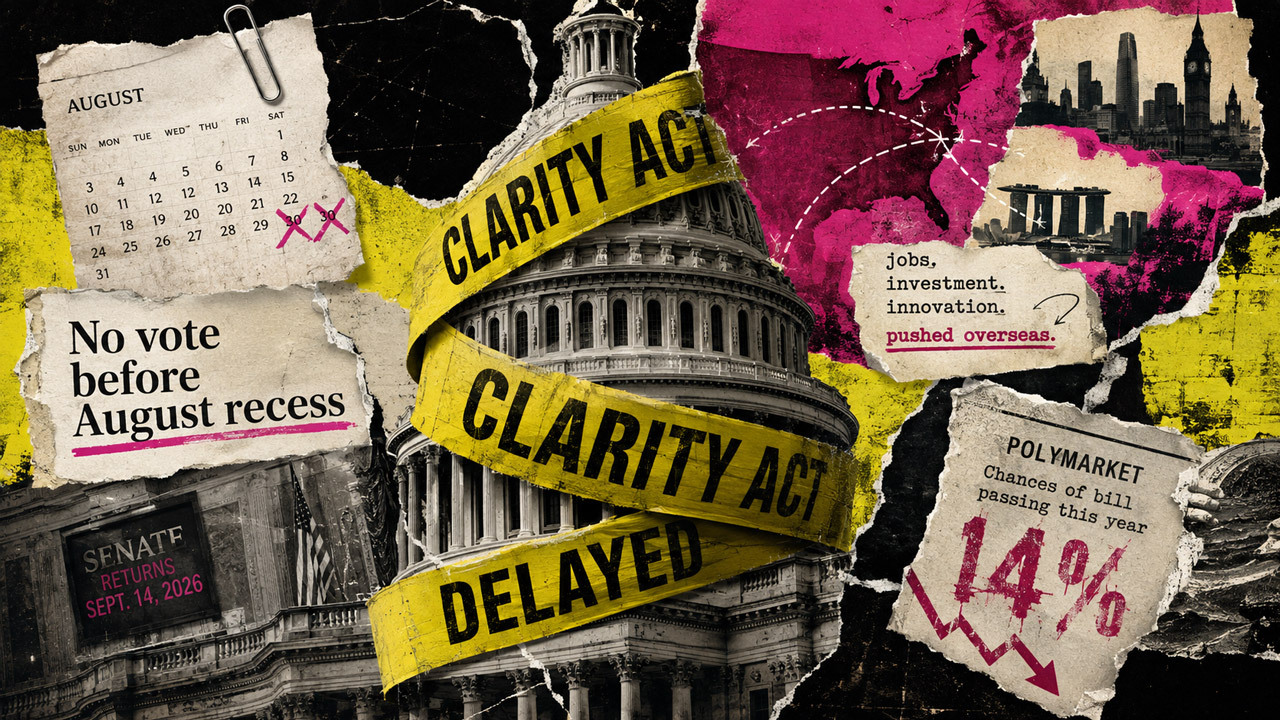
Senate abandons August CLARITY Act vote

Senate abandons August CLARITY Act vote

by FeeOnlyNews.com
August 7, 2026
0

The US Senate has abandoned plans to vote on the landmark CLARITY Act legislation before its August break.On Aug. 6,...

Reform UK Chair Calls for Probe into SBF-Linked Donation: Report

Reform UK Chair Calls for Probe into SBF-Linked Donation: Report

by FeeOnlyNews.com
August 7, 2026
0

The chairman of the UK’s Reform party has called for an investigation following reports of a $50,000 political donation linked...

MARA Reports 1M Loss While Miners Deposit 581 BTC to NYDIG

MARA Reports $611M Loss While Miners Deposit 581 BTC to NYDIG

by FeeOnlyNews.com
August 7, 2026
0

Key TakeawaysMARA’s Q2 revenue fell 27% to $174.9 million, missing Wall Street estimates by more than 16%.Riot Platforms and MARA...

Next Post
General Dynamics Q2 2026 Earnings Preview — July 29, Street Expects .97 EPS

General Dynamics Q2 2026 Earnings Preview — July 29, Street Expects $3.97 EPS

QUALCOMM (QCOM) Q3 2026 Preview: EPS Est. .23, Reports July 29

QUALCOMM (QCOM) Q3 2026 Preview: EPS Est. $2.23, Reports July 29

  • Trending
  • Comments
  • Latest
Bitcoin and ethereum prices today, Friday, August 7, 2026: Crypto prices moving higher following July jobs report

Bitcoin and ethereum prices today, Friday, August 7, 2026: Crypto prices moving higher following July jobs report

August 7, 2026
MEXC Lists Ondo Yield Asset As Tokenized Treasury Demand Grows

MEXC Lists Ondo Yield Asset As Tokenized Treasury Demand Grows

July 3, 2026
Delek Logistics Partners Reports alt=

Delek Logistics Partners Reports $0.54 EPS for Q2 FY26

August 5, 2026
Onkure Therapeutics Releases Q2 2026 Financial Results

Onkure Therapeutics Releases Q2 2026 Financial Results

August 4, 2026
Thryv outlines M run-rate savings while revising 2026 SaaS adjusted EBITDA to M-M (NASDAQ:THRY)

Thryv outlines $60M run-rate savings while revising 2026 SaaS adjusted EBITDA to $42M-$44M (NASDAQ:THRY)

August 4, 2026
My Thoughts on Going All In

My Thoughts on Going All In

August 4, 2026
Advanced Micro Devices (AMD) Price Prediction: How Much a ,000 Investment Could Be Worth by 2031

Advanced Micro Devices (AMD) Price Prediction: How Much a $5,000 Investment Could Be Worth by 2031

0
Cities holding up to 3 million people found under Amazon rain forest

Cities holding up to 3 million people found under Amazon rain forest

0
Republican Party Displacement | Mises Institute

Republican Party Displacement | Mises Institute

0
Bybit Uses Tokenised Equities as Underlyings for Structured Yield

Bybit Uses Tokenised Equities as Underlyings for Structured Yield

0
Explained: How BSE traded fewer contracts after CAS but premiums rose 75% in first week

Explained: How BSE traded fewer contracts after CAS but premiums rose 75% in first week

0
Vaxart outlines Phase IIb COVID-19 top line data in first half of 2027 backed by BARDA funding (OTCMKTS:VXRT)

Vaxart outlines Phase IIb COVID-19 top line data in first half of 2027 backed by BARDA funding (OTCMKTS:VXRT)

0
Advanced Micro Devices (AMD) Price Prediction: How Much a ,000 Investment Could Be Worth by 2031

Advanced Micro Devices (AMD) Price Prediction: How Much a $5,000 Investment Could Be Worth by 2031

August 8, 2026
Republican Party Displacement | Mises Institute

Republican Party Displacement | Mises Institute

August 8, 2026
Vanguard Chief Economist: AI and jobs, still in an ATM phase

Vanguard Chief Economist: AI and jobs, still in an ATM phase

August 8, 2026
Explained: How BSE traded fewer contracts after CAS but premiums rose 75% in first week

Explained: How BSE traded fewer contracts after CAS but premiums rose 75% in first week

August 8, 2026
Democrats’ Affordability Message Misses a Key Expense—Student Debt

Democrats’ Affordability Message Misses a Key Expense—Student Debt

August 8, 2026
Banks or NBFCs? DSP’s Preethi R S explains where she sees the best opportunities

Banks or NBFCs? DSP’s Preethi R S explains where she sees the best opportunities

August 8, 2026
FeeOnlyNews.com

Get the latest news and follow the coverage of Business & Financial News, Stock Market Updates, Analysis, and more from the trusted sources.

CATEGORIES

  • Business
  • Cryptocurrency
  • Economy
  • Financial Planning
  • Investing
  • Market Analysis
  • Markets
  • Money
  • Personal Finance
  • Startups
  • Stock Market
  • Trading

LATEST UPDATES

  • Advanced Micro Devices (AMD) Price Prediction: How Much a $5,000 Investment Could Be Worth by 2031
  • Republican Party Displacement | Mises Institute
  • Vanguard Chief Economist: AI and jobs, still in an ATM phase
  • Our Great Privacy Policy
  • Terms of Use, Legal Notices & Disclaimers
  • About Us
  • Contact Us

Copyright © 2022-2024 All Rights Reserved
See articles for original source and related links to external sites.

Welcome Back!

Sign In with Facebook
Sign In with Google
Sign In with Linked In
OR

Login to your account below

Forgotten Password?

Retrieve your password

Please enter your username or email address to reset your password.

Log In
No Result
View All Result
  • Home
  • Business
  • Financial Planning
  • Personal Finance
  • Investing
  • Money
  • Economy
  • Markets
  • Stocks
  • Trading

Copyright © 2022-2024 All Rights Reserved
See articles for original source and related links to external sites.