No Result
View All Result
  • Login
Wednesday, July 29, 2026
FeeOnlyNews.com
  • Home
  • Business
  • Financial Planning
  • Personal Finance
  • Investing
  • Money
  • Economy
  • Markets
  • Stocks
  • Trading
  • Home
  • Business
  • Financial Planning
  • Personal Finance
  • Investing
  • Money
  • Economy
  • Markets
  • Stocks
  • Trading
No Result
View All Result
FeeOnlyNews.com
No Result
View All Result
Home Financial Planning

Using Personalized Lifespan Estimation For Retirement

by FeeOnlyNews.com
10 hours ago
in Financial Planning
Reading Time: 3 mins read
A A
0
Using Personalized Lifespan Estimation For Retirement
Share on FacebookShare on TwitterShare on LInkedIn


There’s a long-standing aphorism amongst financial planners about the difficulty in doing retirement planning: if the client could just tell me the precise date they will die, I’d make them the perfect retirement plan. Yet the reality is that no one knows when they are going to pass away; while life insurance companies may be remarkably effective at estimating life expectancies for whole populations based on the law of large numbers, any individual client is a sample size of one. Which means most advisors simply plug in a “reasonably conservative” assumption to their retirement planning software, and plan from there.

In this guest post, Dr. K. Jeremy Ko of ShoreUp Retirement Solutions explores the dynamics of how advisors typically estimate a retiring client’s lifespan, and the potential impact of developing more customized estimates of life expectancy, to better estimate how much clients need to save for retirement, can safely spend in retirement, or time the onset of their Social Security benefits.

The starting point is to recognize how common it is for most advisors to simply use a standardized conservative life expectancy assumption, with one recent analysis finding that nearly 90% of advisors simply use the default age-90 or age-95 assumption already built into their financial planning software. Even though the reality is that different demographics – from income to education to race – have materially different life expectancies, varying in many cases by 10-15+ years. Which means at the least, advisors would benefit by looking to more client-demographics-specific actuarial tables than just the standard population average.

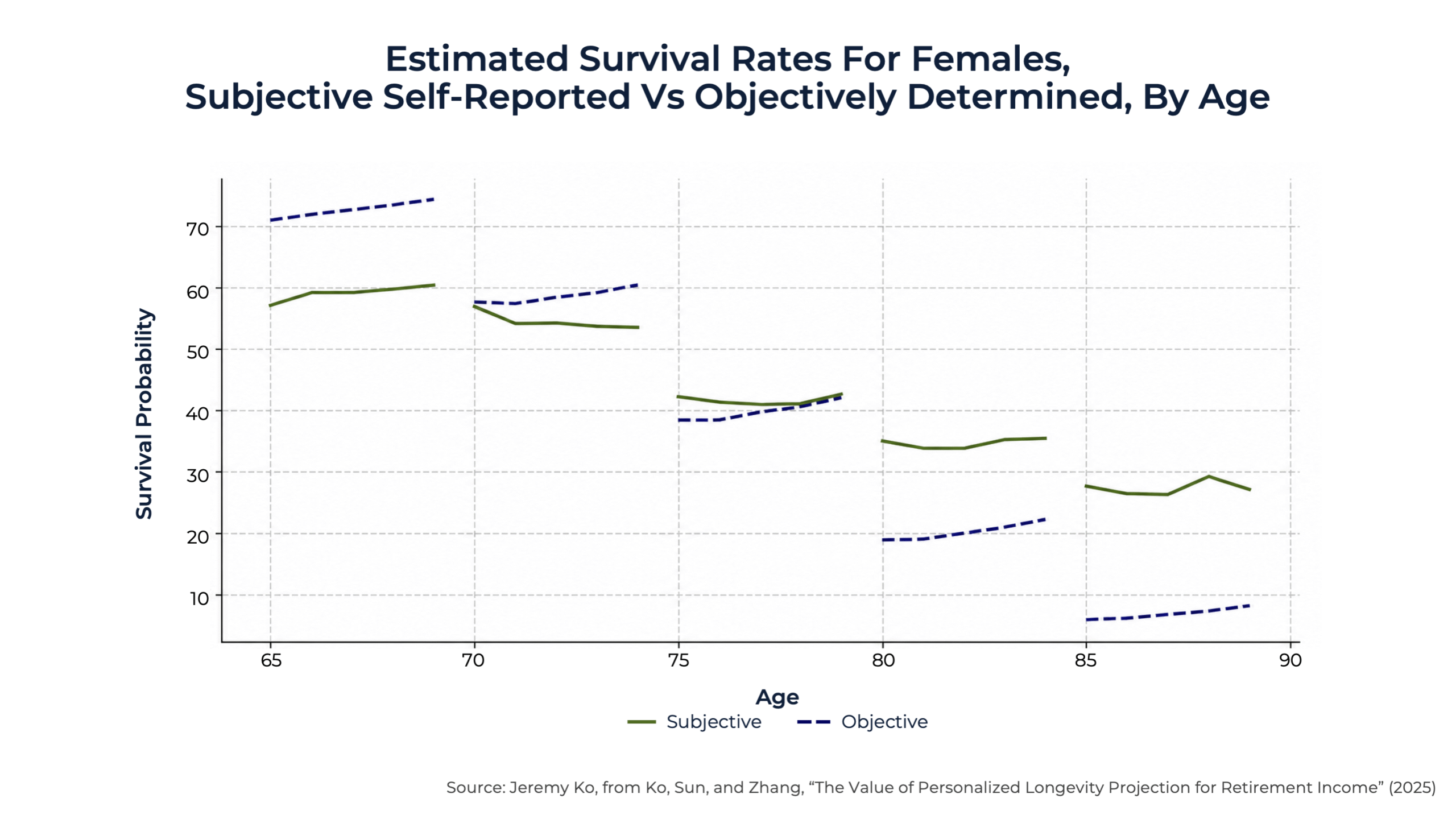
At the same time, while many advisors may prefer to ask clients what their own preference is for a life expectancy assumption, research finds that consumers also systematically misjudge their own life expectancy, with a so-called “flatness bias” that younger individuals tend to underestimate life expectancy (i.e., they don’t realize how long they may really live in retirement), while older individuals tend to overestimate life expectancy (i.e., they don’t realize how short their remaining years may be). Which is especially problematic because these client misperceptions will systematically tilt planning recommendations towards more aggressive, rather than more conservative, assumptions early in retirement.

So what’s the alternative? Using an emerging set of technology tools – from the Society of Actuaries calculator, to the University of Connecticut’s Goldenson Center of Actuarial Science, or the public version of Northwestern Mutual’s Lifespan Calculator – to craft more client-specific recommendations that take into account their individual income, educational, and health factors. Two otherwise similar clients can vary by as many as 20 years in life expectancy just on the basis of a select number of key health and other demographic factors, enough to very materially impact planning recommendations that might otherwise be overlooked if not discussed.

Another benefit of the emerging crop of technology tools is that it can make the conversations with clients easier, as advisors can either walk through the questionnaire with clients together, or offer them the opportunity to do it on their own (if the clients are otherwise uncomfortable to talk about specific family or health factors that may impact their longevity) and simply use the results from the software output itself. Recognizing that because advisors still have a conservative tilt – no one wants to see a client run out of money by underestimating life expectancy – advisors may still default to more conservative longevity estimates (such as a 90th percentile lifespan instead of using the 50th percentile median).

Ultimately, though, the key point is simply to recognize that lifespan in retirement can vary, quite significantly, based on individual health, demographic, and other factors. Merely using a broad-based conservative assumption about clients’ life expectancy – such as assuming all clients may live to age 90 or 95 – can still result in undue conservatism for clients who really aren’t in good health, and with recent medical advances may actually underestimate the life expectancy of the healthiest clients. In the end, no life expectancy tool can perfectly predict how long a client will live, but the more life expectancy assumptions are adapted to the individual client and their retirement recommendations, the more accurate the recommendations can be, even if they will never be perfect.


And if you want to go deeper on this topic, hear directly from the author on the Financial Advisor Technician podcast .

Read More…

Click the icon below to listen.


Source link

Tags: EstimationLifespanPersonalizedretirement
ShareTweetShare
Previous Post

Fortinet – FTNT: Geht da noch mehr?

Next Post

I’ve Been Writing About Money for 35 Years. Here Are 9 Things I Got Dead Wrong.

Related Posts

When clients hide money, advisors must walk fine lines

When clients hide money, advisors must walk fine lines

by FeeOnlyNews.com
July 28, 2026
0

Financial infidelity — hiding financial information from a partner — is a topic wealth advisors often have to address with...

‘As an Advisor Thinketh’ adapts a self-help classic to the profession

‘As an Advisor Thinketh’ adapts a self-help classic to the profession

by FeeOnlyNews.com
July 28, 2026
0

A financial advisor who built a large practice and independent branch has channeled an early self-help classic to create a...

What Borrowers Should Know Before Applying for a Gold Loan App

What Borrowers Should Know Before Applying for a Gold Loan App

by FeeOnlyNews.com
July 28, 2026
0

The increasing availability of a gold loan app for Android has made gold-backed borrowing more accessible across India. Borrowers can...

Why Digital Bookkeeping is Becoming Important For Business Loan Approval

Why Digital Bookkeeping is Becoming Important For Business Loan Approval

by FeeOnlyNews.com
July 28, 2026
0

Sameer runs a small electronics distribution business in Chennai with an annual turnover of ₹1.8 crore. When he applied for...

RIAs lose 5% of AUM a year. Here’s how to win it back

RIAs lose 5% of AUM a year. Here’s how to win it back

by FeeOnlyNews.com
July 27, 2026
0

As many older RIA clients withdraw assets to meet everyday expenses, firms are underemploying marketing and client referrals to offset...

How an advisor built a niche serving tax-weary transplants

How an advisor built a niche serving tax-weary transplants

by FeeOnlyNews.com
July 27, 2026
0

The high taxes in states like California, Illinois and many in the northeast spur some residents to look longingly at...

Next Post
I’ve Been Writing About Money for 35 Years. Here Are 9 Things I Got Dead Wrong.

I’ve Been Writing About Money for 35 Years. Here Are 9 Things I Got Dead Wrong.

Aluminum’s Heavyweight | Mises Institute

Aluminum’s Heavyweight | Mises Institute

  • Trending
  • Comments
  • Latest
Coffee Break: Armed Madhouse – From Spy Satellites to Peace Satellites

Coffee Break: Armed Madhouse – From Spy Satellites to Peace Satellites

July 7, 2026
US prosecutors examine LA Dodgers owner Mark Walter-linked insurers – report

US prosecutors examine LA Dodgers owner Mark Walter-linked insurers – report

July 21, 2026
Bond Vet and Small Door Merge to Form One of the Nation’s Largest Premium Veterinary Networks – AlleyWatch

Bond Vet and Small Door Merge to Form One of the Nation’s Largest Premium Veterinary Networks – AlleyWatch

July 9, 2026
House backs an emergency brake on elder fraud

House backs an emergency brake on elder fraud

June 26, 2026
Salesforce, RightCapital, And YCharts Launch Their Own New AI Capabilities (And More Of The Latest In Financial #AdvisorTech – July 2026)

Salesforce, RightCapital, And YCharts Launch Their Own New AI Capabilities (And More Of The Latest In Financial #AdvisorTech – July 2026)

July 6, 2026
Product-Market Fit Expires Every 90 Days. Here’s What to Do About It.

Product-Market Fit Expires Every 90 Days. Here’s What to Do About It.

July 15, 2026
56-year-old fast-food giant has closed over half its restaurants

56-year-old fast-food giant has closed over half its restaurants

0
J&K Bank Q1 profit slips 13% as higher provisions hit earnings

J&K Bank Q1 profit slips 13% as higher provisions hit earnings

0
Coffee Break: Ellison Empire Beseiged On All Fronts

Coffee Break: Ellison Empire Beseiged On All Fronts

0
Stuck at 10 Loans? Why Scaling Investors Need a Financing Plan From Day 1

Stuck at 10 Loans? Why Scaling Investors Need a Financing Plan From Day 1

0
Hugging Face drops in-depth hack report, while OpenAI gives us 7 bullets

Hugging Face drops in-depth hack report, while OpenAI gives us 7 bullets

0
Elliptic Report Shows How Bitcoin ATM Scams Move From Cash To On-Chain Wallets

Elliptic Report Shows How Bitcoin ATM Scams Move From Cash To On-Chain Wallets

0
Coffee Break: Ellison Empire Beseiged On All Fronts

Coffee Break: Ellison Empire Beseiged On All Fronts

July 29, 2026
5 Common Medications Linked to a Higher Risk of Bone Loss

5 Common Medications Linked to a Higher Risk of Bone Loss

July 29, 2026
Hugging Face drops in-depth hack report, while OpenAI gives us 7 bullets

Hugging Face drops in-depth hack report, while OpenAI gives us 7 bullets

July 29, 2026
Newmark Group Q2 2026: Revenue Hits 8.4M, Up 17% Year-Over-Year

Newmark Group Q2 2026: Revenue Hits $888.4M, Up 17% Year-Over-Year

July 29, 2026
Psychology says the people who never forget a face but always lose the name aren’t bad with names at all — a face connects to everything the brain knows about a person, while the name is the one detail attached to nothing, a sound with no meaning to hold onto

Psychology says the people who never forget a face but always lose the name aren’t bad with names at all — a face connects to everything the brain knows about a person, while the name is the one detail attached to nothing, a sound with no meaning to hold onto

July 29, 2026
56-year-old fast-food giant has closed over half its restaurants

56-year-old fast-food giant has closed over half its restaurants

July 29, 2026
FeeOnlyNews.com

Get the latest news and follow the coverage of Business & Financial News, Stock Market Updates, Analysis, and more from the trusted sources.

CATEGORIES

  • Business
  • Cryptocurrency
  • Economy
  • Financial Planning
  • Investing
  • Market Analysis
  • Markets
  • Money
  • Personal Finance
  • Startups
  • Stock Market
  • Trading

LATEST UPDATES

  • Coffee Break: Ellison Empire Beseiged On All Fronts
  • 5 Common Medications Linked to a Higher Risk of Bone Loss
  • Hugging Face drops in-depth hack report, while OpenAI gives us 7 bullets
  • Our Great Privacy Policy
  • Terms of Use, Legal Notices & Disclaimers
  • About Us
  • Contact Us

Copyright © 2022-2024 All Rights Reserved
See articles for original source and related links to external sites.

Welcome Back!

Sign In with Facebook
Sign In with Google
Sign In with Linked In
OR

Login to your account below

Forgotten Password?

Retrieve your password

Please enter your username or email address to reset your password.

Log In
No Result
View All Result
  • Home
  • Business
  • Financial Planning
  • Personal Finance
  • Investing
  • Money
  • Economy
  • Markets
  • Stocks
  • Trading

Copyright © 2022-2024 All Rights Reserved
See articles for original source and related links to external sites.