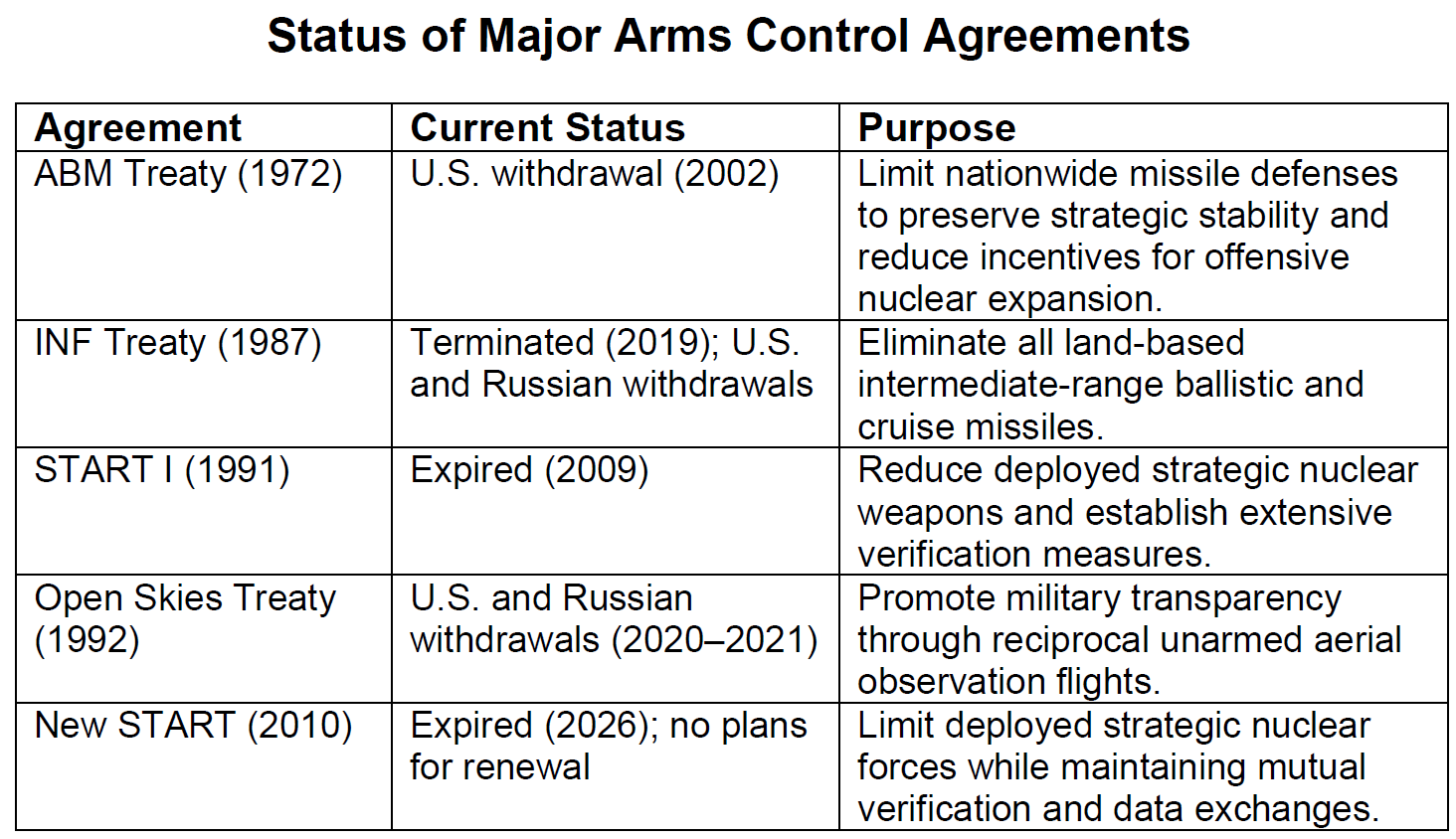
For more than half a century, arms control has been one of civilization’s principal safeguards against catastrophic war. Yet today that framework is visibly weakening. Major treaties have expired or been abandoned. Verification disputes have become increasingly contentious. New military technologies routinely outpace existing agreements, while strategic rivalry is extending into emerging domains such as cyber operations, autonomous weapons, and outer space.
The usual explanation is that international politics has become more confrontational. While true, that diagnosis is incomplete. Arms control has repeatedly encountered the same pattern of institutional erosion under widely different political circumstances. The deeper problem lies not simply in changing governments or deteriorating diplomatic relations, but in the structural dynamics of the international security system itself.
War Power possesses self-reinforcing mechanisms. Military competition generates fear; fear stimulates armament; new weapons create strategic uncertainty; uncertainty encourages secrecy; and secrecy undermines the trust upon which arms control depends. Treaties temporarily interrupt this cycle, but they seldom alter the underlying forces that continually work against them. As technological change accelerates, these pressures become even more difficult to resist.
Traditional arms control has therefore relied heavily upon imputed trust—confidence derived from diplomacy, political commitments, inspections, and judgments about national intentions. Those mechanisms have achieved important successes, but they remain vulnerable to recurring crises, technological surprise, and deliberate efforts to exploit uncertainty and fear.
This article argues that a different approach is now becoming possible. The convergence of persistent satellite observation, distributed sensing, artificial intelligence, global communications, and advanced evidence integration has created technical affordances that did not exist when most arms control institutions were designed. These technologies make it increasingly feasible to shift the balance from imputed trust toward verifiable trust—trust grounded in independently observable, continuously updated evidence rather than diplomatic assumption alone.
The future of arms control may therefore depend less upon negotiating stronger treaties than upon constructing stronger trust infrastructure. Peace Power is founded on the proposition that trust can be deliberately engineered. Its institutions are designed not merely to regulate weapons, but to continuously produce, verify, and protect the trusted knowledge upon which durable arms control ultimately depends.
Conventional discussions of military competition often focus on individual decisions—a nation’s withdrawal from a treaty, the deployment of a new weapon, or a diplomatic crisis. These events are important, but they are symptoms rather than causes. The more fundamental reality is that War Power operates as a self-reinforcing system composed of multiple feedback mechanisms that continuously strengthen one another.
Military competition naturally generates uncertainty about an adversary’s capabilities and intentions. Uncertainty encourages governments to prepare for worst-case scenarios. Those preparations frequently take the form of new weapons programs, expanded military budgets, and greater operational secrecy. Each of these responses is perceived by competitors as evidence of growing danger, prompting reciprocal measures. The result is a positive feedback loop in which fear and military capability reinforce one another.
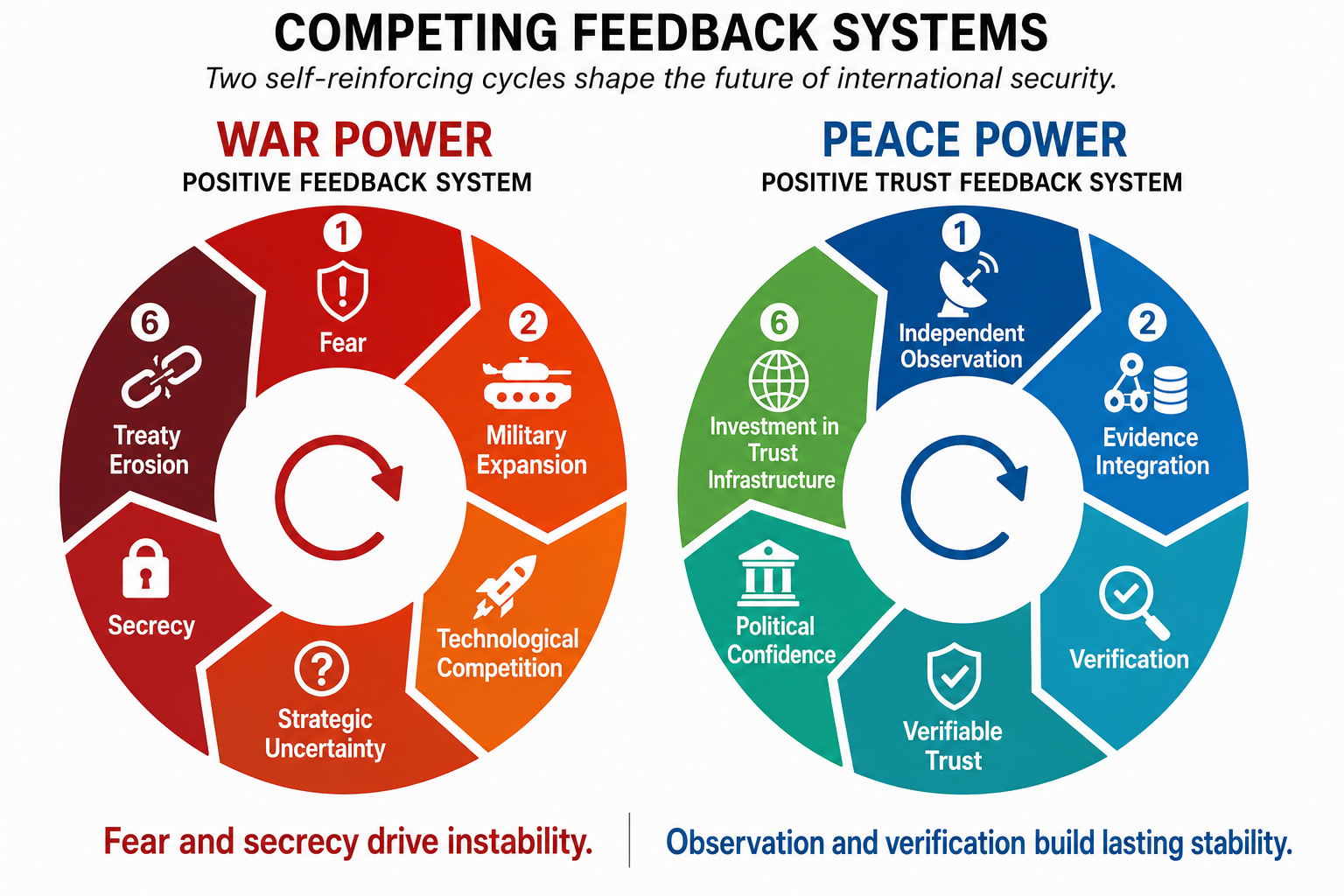
This dynamic extends well beyond military procurement. Strategic secrecy limits independent verification. Reduced verification increases uncertainty. Greater uncertainty elevates political support for intelligence gathering, military modernization, and expanded deterrence. Technological innovation introduces entirely new classes of weapons before existing treaties can adapt to them, further weakening confidence in established arms control regimes. Meanwhile, defense bureaucracies, industrial interests, and national security institutions develop organizational incentives that favor continued military competition over institutional restraint.
These reinforcing processes do not require centralized coordination. No nation needs to pursue instability as an objective. Rather, instability emerges from the cumulative interaction of individually rational responses to uncertainty. States seeking greater security often adopt measures that unintentionally reduce the security of others, producing a cycle in which every participant behaves defensively while the overall system becomes progressively less stable.
Traditional arms control has achieved notable successes by temporarily interrupting these cycles. Yet interruption is not the same as transformation. Because the underlying feedback mechanisms remain intact, treaties must continually resist forces that are persistent, adaptive, and technologically innovative. Over time, those forces tend to exploit verification gaps, generate new strategic ambiguities, and erode the confidence upon which negotiated agreements depend.
Understanding War Power as a dynamic system rather than a collection of isolated political decisions changes the nature of the problem. The central challenge is no longer simply negotiating better treaties. It is developing institutions capable of continuously generating sufficient verifiable trust to counterbalance the persistent mechanisms that otherwise drive military competition. Until those institutional counterweights exist, arms control will remain engaged in an asymmetric contest against a system that naturally regenerates the conditions arms control treaties are intended to restrain.
The Offense–Defense Arms Race Spiral
The history of modern arms control demonstrates that War Power rarely remains static. Instead, it continuously adapts to restore strategic advantage whenever new constraints or defensive capabilities emerge. The result is an enduring offense-defense spiral in which each attempt to increase security generates incentives for the next round of military innovation.
During the Cold War, strategic stability rested largely upon mutual vulnerability. The Anti-Ballistic Missile (ABM) Treaty recognized that unconstrained missile defense could destabilize deterrence by encouraging one side to believe it might eventually neutralize an opponent’s retaliatory capability. Limiting nationwide missile defenses therefore became a means of limiting offensive arms competition as well.
That equilibrium proved temporary. Advances in missile defense technology renewed interest in intercepting ballistic missiles, while offensive systems evolved to overcome those defenses through multiple independently targetable warheads, penetration aids, and increasingly sophisticated delivery systems. Most recently, maneuverable hypersonic weapons have emerged in part because they further complicate missile defense.
Each technological advance has shifted the competition rather than ending it. As hypersonic weapons challenge terrestrial missile defenses, strategic attention has turned toward mid-course interception opportunities, requiring persistent orbital sensing and proposals for space-based defensive systems. Those developments, in turn, create incentives to develop counter-space capabilities capable of destroying or neutralizing orbital assets. The arms race thus expands into yet another domain.
The pattern is remarkably consistent. Defensive innovations intended to improve security generate incentives for offensive adaptation. Those adaptations stimulate new defensive measures, which in turn encourage further offensive innovation. Arms control agreements have often slowed particular phases of this cycle, but they have rarely altered its underlying dynamics.
This historical progression reveals a broader principle. War Power does not merely produce new weapons; it continually expands military competition into every domain that offers strategic advantage. Land, sea, air, cyberspace, and now outer space all become successive arenas in which the offense-defense competition cycle unfolds. The strategic frontier advances because each technological solution creates new opportunities for competitive adaptation.
For Peace Power, this observation has profound implications. If military competition naturally migrates into every technologically relevant domain, then institutions designed to preserve peace must adapt just as rapidly. Future arms control cannot depend solely upon restricting individual weapons systems. It must also protect the information infrastructure upon which verification, transparency, and international trust increasingly depend. Otherwise, the same dynamics that have repeatedly undermined earlier treaties will simply migrate into new technological domains, carrying the cycle of competition forward once again.
Conflict in Orbital Space
For most of the Space Age, satellites were viewed primarily as military support systems. They improved communications, navigation, reconnaissance, and early warning, but they remained largely subordinate to military operations conducted elsewhere. Today that relationship is changing. Orbital systems are becoming the information infrastructure upon which both military operations and international verification increasingly depend.
This transformation creates two fundamentally different strategic futures. The first follows the familiar logic of War Power. As space-based systems become more valuable, they become more attractive military targets. Persistent orbital sensing encourages the development of counter-space weapons. Missile defense concepts stimulate interest in orbital interception. Satellite constellations invite electronic attack, cyber intrusion, dazzling, jamming, and kinetic destruction. Arms racing simply expands into orbital space.
The second path is fundamentally different. Rather than viewing orbital systems primarily as military assets, Peace Power views them as global trust infrastructure. Satellite facilities capable of independently observing missile deployments, launches, troop movements, environmental conditions, and treaty compliance generate information that no single nation can monopolize. Properly organized, they can continuously produce independently verifiable evidence that reduces uncertainty and supports diplomatic decision-making.
This distinction represents a profound change in how space is understood. The strategic value of orbital systems is no longer limited to enhancing military capability. Their greater historical significance may lie in enabling institutions capable of producing trusted knowledge on a global scale. In that sense, orbital observation becomes as important to international governance as it is to national defense.
Current international law reflects an earlier era. The Outer Space Treaty successfully established important principles, including the prohibition of placing weapons of mass destruction in orbit and the peaceful use of celestial bodies. Yet it does not explicitly protect satellites or other orbital systems from attack, nor does it recognize certain categories of space-based assets as shared international verification infrastructure. As the strategic importance of orbital information continues to grow, this omission will become increasingly significant.
Peace Power therefore suggests a broader objective than preventing the weaponization of space. It seeks to establish and protect those orbital systems whose primary purpose is the generation of trusted knowledge. Verification satellites, launch-monitoring networks, environmental sensing platforms, and other transparency-producing assets should be regarded not merely as national property, but as components of an emerging international trust architecture. Their protection serves not only the interests of individual states, but the stability of the international system itself.
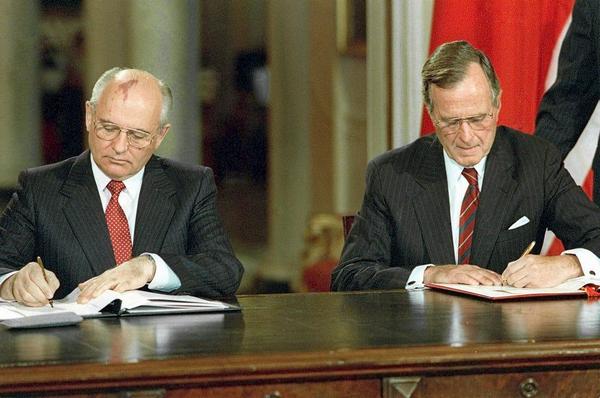
President George H. W. Bush and Soviet President Mikhail Gorbachev sign the START I Treaty in Moscow on July 31, 1991. Its successor, New START, has also expired without a successor agreement.
The Missing Element: Verifiable Trust
The strategic question confronting the twenty-first century is therefore larger than whether nations will compete in space. That competition is already underway. The more consequential question is whether humanity will also build institutions that preserve space as the world’s principal platform for independent observation and verifiable trust. The answer may determine whether outer space becomes primarily another battlefield or the informational foundation upon which a more durable system of international peace is constructed.
The recurring failure of arms control suggests that the problem is not simply the absence of trust, but the kind of trust upon which international institutions depend. Traditional diplomacy relies heavily upon imputed trust. Nations evaluate one another’s intentions through diplomatic commitments, historical relationships, intelligence assessments, negotiated inspections, and judgments about political leadership. These forms of trust have often been sufficient to achieve important agreements, but they remain inherently vulnerable to strategic deception, changing governments, technological surprise, and the uncertainties that accompany international crises.
Peace Power begins with a different premise. Rather than asking nations to become more trusting, it asks how that trust can be supported by independently verifiable evidence. This distinction fundamentally changes the nature of the problem. Trust no longer depends primarily upon confidence in another government’s intentions. Instead, it increasingly depends upon the quality, transparency, and independence of the information available to all parties.
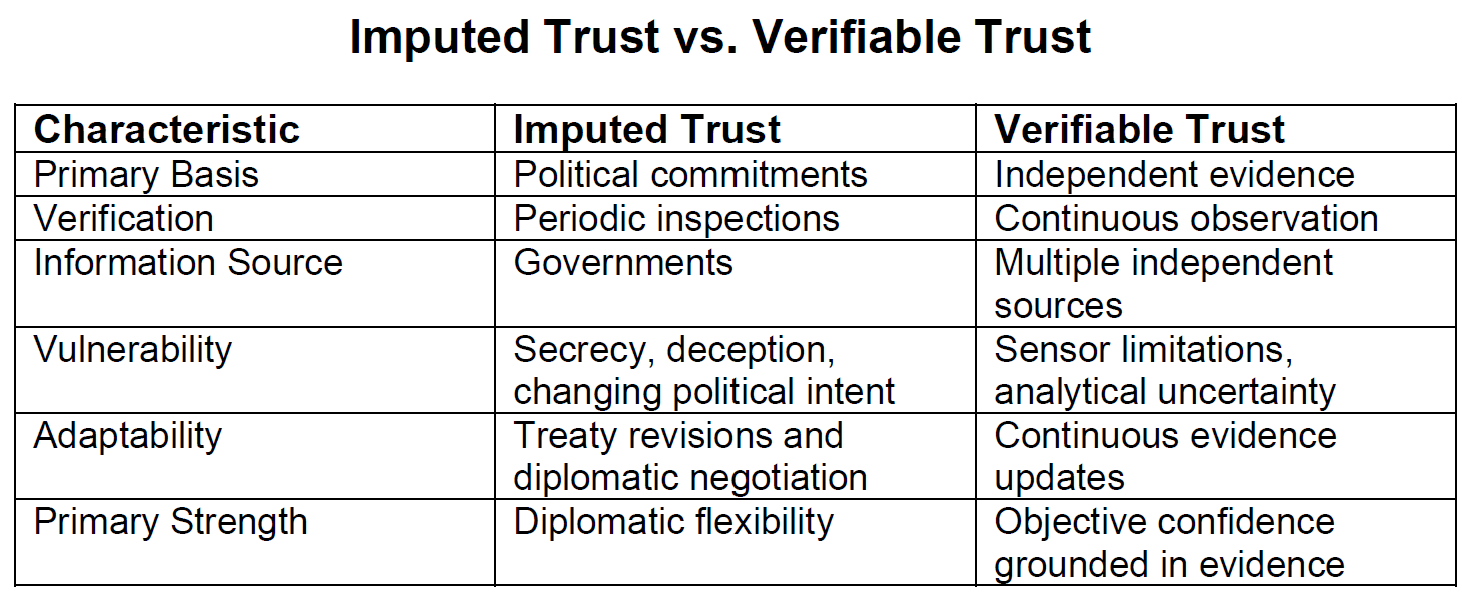
Imputed trust and verifiable trust are not opposing concepts. They are complementary components of every consequential diplomatic decision. Even the most advanced verification systems cannot eliminate uncertainty or replace political judgment entirely. Diplomacy will always require negotiation, compromise, and assessments of intent. The objective is therefore not to eliminate imputed trust, but to reduce dependence upon it wherever technological advances make verifiable trust possible.
This represents a profound historical transition. For most of human history, international institutions had little choice but to rely upon imputed trust because the necessary technical capabilities simply did not exist. Persistent global observation, distributed sensing, real-time communications, computational evidence integration, and artificial intelligence have fundamentally altered that landscape. Today, a far greater proportion of the information required for international decision-making can be independently observed, cross-validated, and continuously updated.
Civilization has repeatedly replaced judgments based primarily upon authority with judgments grounded increasingly in objective measurement. Modern engineering depends less upon intuition than upon instrumentation. Modern medicine depends less upon reputation than upon evidence. Modern science advances through reproducible observation rather than personal credibility. Peace Power proposes extending that same historical progression into international diplomacy.
The trust engineering objective is therefore both simple and ambitious: systematically shift the balance from imputed trust toward verifiable trust. As independently verifiable evidence becomes more abundant, transparent, and continuously available, diplomatic decisions become progressively less dependent upon assumptions regarding national intentions alone. Trust itself becomes more resilient because it rests upon an expanding foundation of observable reality rather than exclusively upon political confidence.
This approach does not assume that nations will become more cooperative, more altruistic, or less competitive. It assumes only that technological progress has made a different information architecture possible. By increasing the proportion of trust that can be independently verified, future institutions may become substantially more resistant to the cycles of fear, secrecy, and technological competition that have repeatedly undermined previous generations of arms control. Peace Power seeks to qualitatively transform trust by replacing imputed trust with verifiable trust wherever technological affordances make that substitution possible.
Why Peace Power Is Becoming Practical
The weakness of previous generations of arms control should not be understood as a failure of diplomacy alone. It also reflected the technological constraints of their time. Most twentieth-century treaties were negotiated in an era when independent verification was expensive, intermittent, and often available only to a handful of major powers. Because trustworthy information was scarce, international agreements necessarily depended heavily upon imputed trust.
That historical limitation is beginning to disappear. Over the past several decades, advances in sensing, communications, computation, and artificial intelligence have fundamentally altered the economics of verification. Persistent commercial satellite constellations can observe military activity with increasing frequency and resolution. Distributed sensor networks can monitor launches, environmental changes, and other treaty-relevant events across vast geographic areas. Global communications permit near real-time dissemination of observations, while artificial intelligence can integrate enormous quantities of heterogeneous evidence, identify anomalies, estimate confidence, and continuously update assessments as new information becomes available.
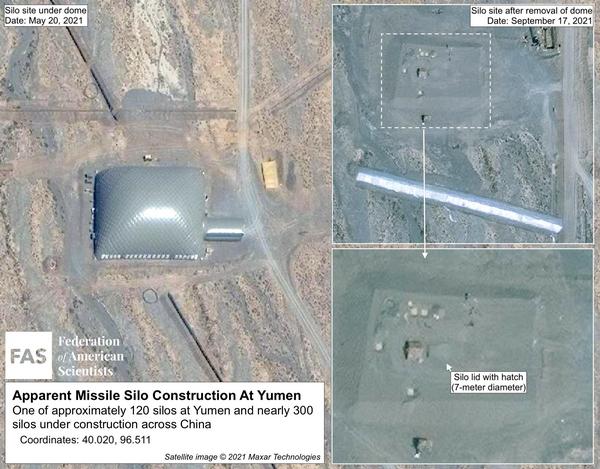
Commercial satellite imagery revealed the rapid construction of China’s Yumen missile silo field before any official confirmation.
Independent satellite- and sensor-based observation is not presented as a complete substitute for traditional verification methods. Rather, it would be one component of a broader verification architecture integrating space-based and terrestrial sensing systems, ground inspections, environmental monitoring, open-source intelligence, commercial data, and other independent streams of evidence. Peace Power seeks to strengthen arms control not by replacing established verification methods, but by integrating them within a continuously operating trust architecture capable of producing verifiable international trust.
This represents a profound shift in institutional capability. Previous arms control regimes were designed for an age of information scarcity. Trust engineering for arms control becomes practical because the twenty-first century is increasingly characterized by information abundance. The challenge is to utilize these new information resources to generate trusted knowledge that can support consequential international decisions.
Raw information alone cannot produce trust. Satellites do not resolve diplomatic disputes, and artificial intelligence cannot substitute for political judgment. Trust emerges only when evidence is gathered independently, analyzed transparently, subjected to adversarial review, and integrated within institutions whose procedures are themselves worthy of confidence. The engineering challenge is therefore not simply building better sensors or more capable algorithms. It is designing institutions that convert abundant information into verifiable trust.
This distinction is crucial. Peace Power is not a technological project masquerading as diplomacy. It is an institutional project made possible by technology. Modern technical affordances provide the raw materials, but the ultimate objective is the construction of robust international trust architectures capable of resisting the persistent dynamics that have historically undermined arms control.
The Economics of Peace Power
At this point, critics are likely to raise a practical objection. Even if Peace Power is conceptually attractive, who will pay for the global trust infrastructure it requires? The question is reasonable, but it rests upon a mistaken assumption. The proposed innovation is not a massive new international program requiring the construction of entirely new technical systems. Much of the necessary infrastructure already exists or is being developed for independent commercial, scientific, and national security purposes.
Commercial Earth-observation satellites routinely monitor the planet at resolutions once available only to major intelligence agencies. Weather satellites continuously observe the global environment. Communications networks transmit enormous volumes of information in real time. Artificial intelligence systems increasingly integrate heterogeneous data, identify anomalies, and estimate confidence. Nations already operate sophisticated launch-detection systems, navigation satellites, and reconnaissance platforms. Most of the technical components of Peace Power are therefore emerging regardless of whether they are ever assembled into a coherent trust architecture.
War Power institutions demonstrate the scale of resources already devoted to managing uncertainty. Every major military power invests heavily in intelligence collection, satellite reconnaissance, signals interception, strategic analysis, and early-warning systems. These expenditures are accepted because uncertainty is recognized as a strategic liability. Peace Power begins from the same premise but reaches a different conclusion. Instead of producing information primarily for national advantage, it seeks to transform portions of this expanding information ecosystem into mechanisms for generating internationally verifiable trust.
The comparison should not be between the cost of implementing Peace Power and the cost of doing nothing. The relevant comparison is between the cost of trust infrastructure and the far greater costs of recurring military competition. Modern fighter aircraft, missile defense systems, submarines, and strategic weapons programs each require investments measured in billions of dollars. Regional wars routinely consume hundreds of billions of dollars while inflicting enormous human suffering . Against this backdrop, investments in international verification infrastructure represent a remarkably cost-effective investment in risk reduction.
History offers numerous precedents for such investments. Civilization has repeatedly concluded that certain information systems are too valuable to remain fragmented by national boundaries. International meteorological networks, global navigation systems, aviation safety standards, scientific observatories, and public health surveillance all produce information that benefits societies globally. Their value lies not merely in collecting data but in creating trusted knowledge that enables coordinated action. Peace Power extends this principle into the domain of international security.
The ultimate question, therefore, is not whether humanity can afford to invest in institutions that generate verifiable trust. It is whether humanity can continue to afford an international system that repeatedly spends vastly greater resources managing the consequences of distrust while accepting an ever-present risk of catastrophic war. As technological affordances continue to expand, the principal barrier to Peace Power is no longer financial or technical. It is the willingness to recognize international trust infrastructure as an efficient investment that can reduce the costs of war and preparations for war.
Engineering the Future of Arms Control
The ultimate measure of any arms control system is not whether it succeeds during periods of political stability, but whether it continues to function during periods of strategic stress. History demonstrates that traditional arms control institutions often weaken precisely when they are needed most. Diplomatic trust erodes during crises, inspections become contentious, information becomes politicized, and technological surprises expose weaknesses in existing agreements. If Peace Power is to represent more than another aspirational proposal, it must be deliberately engineered to remain effective under precisely these conditions.
This requires a fundamental change in institutional philosophy. Traditional arms control has largely treated verification as a supporting activity within a diplomatic framework. Peace Power reverses that relationship. It treats the continuous production of independently verifiable knowledge as the foundation upon which diplomacy itself rests. Trust is no longer assumed to exist because agreements have been signed; it is continually regenerated through transparent evidence, independent observation, and reproducible analysis.
Such institutions must exhibit characteristics familiar to engineers responsible for designing resilient systems. They must avoid single points of failure through redundancy. They must draw upon multiple independent sources of evidence rather than relying upon any single government or sensor. Their analytical methods must be transparent, reproducible, and subject to continual review. Artificial intelligence should assist by integrating evidence, identifying anomalies, estimating uncertainty, and presenting competing hypotheses—not by replacing human political judgment.
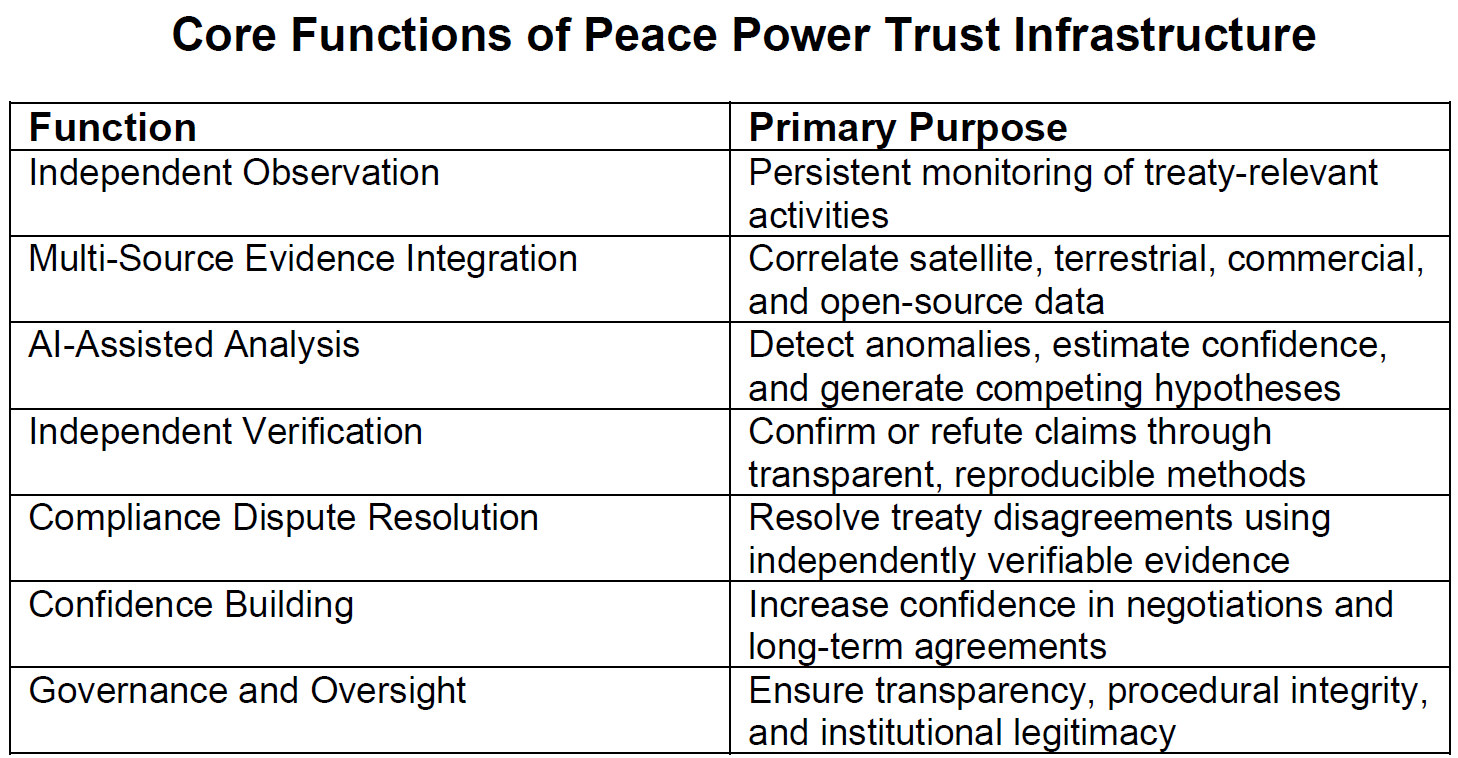
Equally important, these institutions must resist political capture. Confidence cannot depend upon the perceived neutrality of a single nation, alliance, or permanent bureaucracy. Independent scientific organizations, commercial observation systems, international experts, and transparent governance mechanisms should all contribute to the production and evaluation of evidence. Their legitimacy should derive from the quality of their methods rather than the political influence of their participants.
Future arms control agreements need not rely primarily upon episodic inspections, national intelligence assessments, or diplomatic assurances. Instead, they can increasingly rest upon continuously generated, independently verifiable evidence produced by international trust infrastructure. Verification becomes a persistent institutional capability rather than an occasional treaty obligation. Rather than constructing entirely new verification systems for each emerging technology, nations could invest in a common trust architecture capable of adapting as strategic competition evolves.
Such an architecture would also strengthen crisis management. During periods of heightened tension, governments frequently confront competing intelligence assessments, conflicting public claims, and intense political pressure. Independent verification institutions capable of rapidly producing transparent, evidence-based assessments would not eliminate disagreement, but they could substantially reduce uncertainty regarding the underlying facts. Diplomatic decisions would therefore rest upon a firmer evidentiary foundation, reducing opportunities for miscalculation and escalation.
The infrastructure that generates trust must itself become an object of protection. Verification satellites, launch-monitoring systems, shared sensing networks, and other components of global trust infrastructure are not merely national assets. They increasingly serve an international function by reducing uncertainty and supporting peaceful dispute resolution. As their importance grows, protecting these systems becomes as essential to long-term stability as protecting the treaties they support.
The defining engineering objective of Peace Power is robustness. Traditional treaties sought to restrain military competition through negotiated commitments that gradually weakened under persistent political and technological pressure. Counteracting this process of treaty failure requires building institutions whose capacity to generate verifiable trust grows steadily stronger as sensing, computation, and independent verification improve. Every attempt at deception, every verification dispute, every sensor failure, and every analytical error should become an opportunity to refine methods, strengthen procedures, and improve future performance. Like successful scientific institutions, resilient trust architectures should become more capable through continuous testing and correction.
Peace Power therefore does not promise a world without conflict. Nations will continue to pursue competing interests, technological innovation will continue to reshape military affairs, and strategic rivalry will remain a permanent feature of international politics. Its objective is more practical and more achievable: to ensure that these inevitable competitions occur within an information environment increasingly grounded in verifiable knowledge rather than speculation, secrecy, and fear. By continually producing, protecting, and renewing verifiable trust, Peace Power offers a pathway toward arms control that is not merely renewed, but fundamentally transformed.
Conclusion
International arms control has helped reduce the risks of catastrophic conflict in the modern era, yet its repeated cycles of erosion demonstrate a serious structural weakness. Traditional treaties have depended largely upon imputed trust operating within an international system continuously shaped by fear, secrecy, technological competition, and self-reinforcing military dynamics. However skillfully negotiated, such agreements have repeatedly struggled against forces that were stronger, more persistent, and more adaptive than the institutions designed to restrain them.
The challenge facing the twenty-first century is therefore larger than negotiating new treaties. It is redesigning the institutional foundations upon which durable arms control depends. Peace Power begins with a simple proposition: the quality of trust can be transformed. Wherever technological affordances make it possible, imputed trust can increasingly be replaced by verifiable trust generated through independent observation, transparent analysis, continuous verification, and robust international trust infrastructure.
This transformation does not eliminate diplomacy, political judgment, or national interests. It changes the environment within which those inevitable realities operate. Just as science, engineering, medicine, and commerce have progressively replaced judgments based primarily upon authority with judgments increasingly grounded in independently verifiable evidence, international diplomacy can follow the same historical trajectory. Peace Power extends that civilizational evolution into one of humanity’s most consequential domains.
The technologies required to begin this transition are no longer speculative. Persistent observation, distributed sensing, artificial intelligence, global communications, and advanced evidence integration are already reshaping the world’s information environment. The remaining challenge is institutional. We must decide whether these emerging capabilities will be organized primarily to intensify military competition or to strengthen the production of trusted knowledge upon which peaceful cooperation depends.
The ultimate question, therefore, is not whether humanity can afford to invest in institutions that generate verifiable trust. It is whether humanity can continue to sustain an international system that repeatedly spends vastly greater resources managing the consequences of distrust while exposing civilization to the possibility of planetary catastrophe.
The rebuilding of international arms control will require more than stronger agreements. It will require stronger institutions—institutions deliberately engineered to produce, protect, and continually renew verifiable trust despite the persistent forces that seek to undermine it. The twentieth century taught us the need to limit weapons. The twenty-first century may require humanity to master a more fundamental task: engineering the trust that strengthens those limits and allows them to endure. Engineering trust may become the defining institutional innovation through which the twenty-first century learns not merely to deter war, but to govern enduring peace.