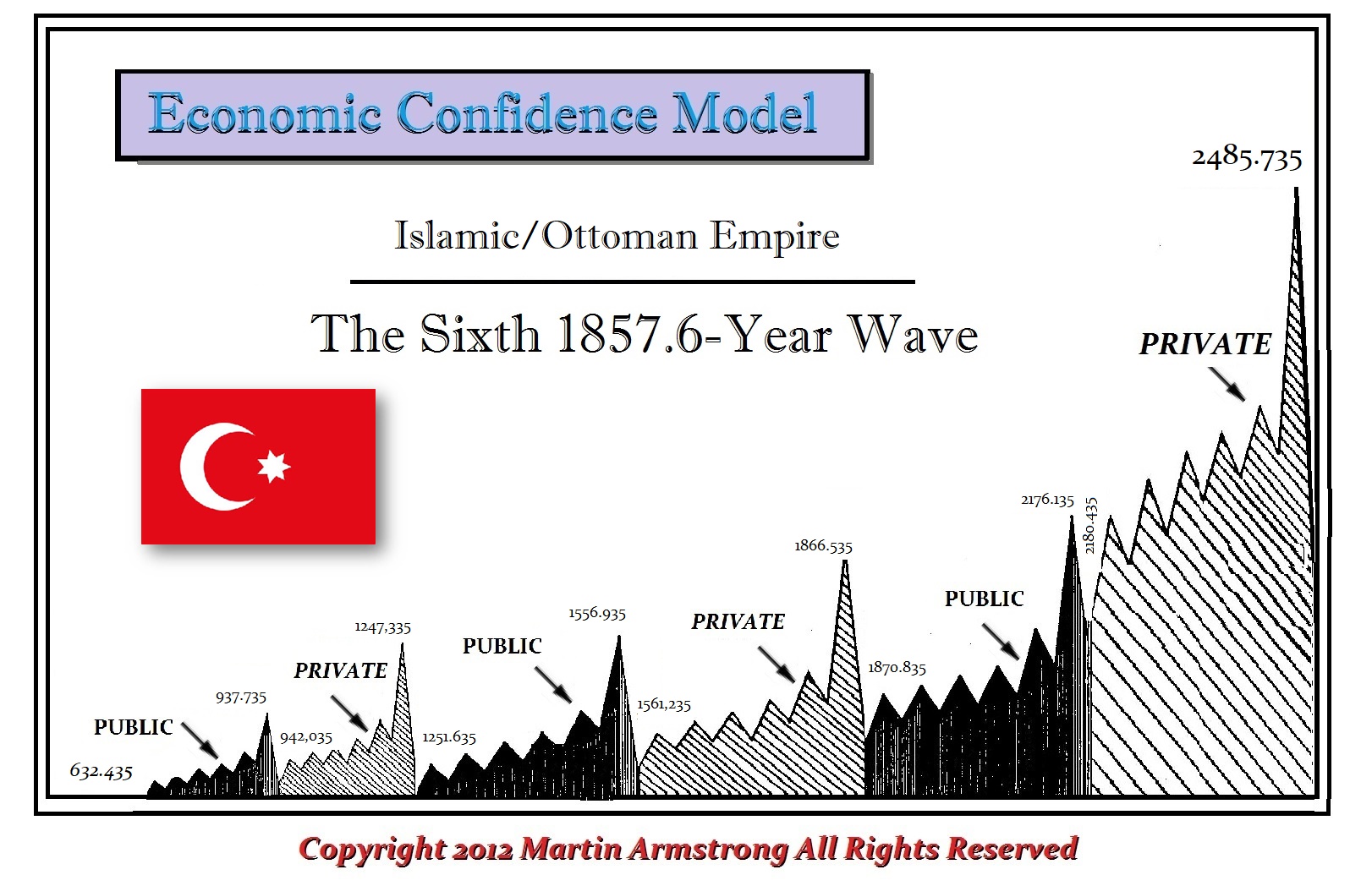
For years, I have warned that analysts have been looking in the wrong direction. Everyone obsesses over Russia, China, Iran, or even North Korea, while ignoring one nation that has quietly been positioning itself to become the dominant regional power. That nation is Turkey.
You cannot understand today’s geopolitical landscape unless you understand that the Ottoman Empire ruled much of the Middle East, North Africa, and southeastern Europe for centuries. Those ambitions never simply vanished.
Turkey possesses one of NATO’s largest armed forces and controls perhaps the single most strategic piece of geography on earth, the Bosporus and Dardanelles. Every major power has sought influence over that region for centuries because whoever controls the gateway between the Black Sea and the Mediterranean possesses leverage that cannot be replicated elsewhere.
What is becoming increasingly obvious is that Ankara no longer views Israel as merely another country in the region. The rhetoric has become increasingly direct, and European politicians are beginning to acknowledge that the conflict extends far beyond Gaza.
According to the report from Pars Today, Turkish Foreign Minister Hakan Fidan declared after the NATO summit that “The policies of Netanyahu’s government are not only our problem; they are also a burden on Tel Aviv, the region, and international security, and they constitute a threat to all of them.” He added that European leaders are “increasingly recognizing the threat posed by Israel, but have not yet found a way to confront it.”
Fidan went even further regarding Syria, stating, “We are not sure that Israel wants to see a stable, strong, transformed, and prosperous Syria.” When asked whether Israel seeks to destabilize Syria, his response was blunt: “When you look at the past and present behavior patterns of the Israeli cabinet toward the countries of the region, the answer is yes.” In another speaking engagement, Fidan warned that Israel is a security problem for the whole world.
These are extraordinary statements coming from the foreign minister of a NATO member. Even within Europe, criticism of Netanyahu has become far more common than it was only a few years ago. Governments that once hesitated to publicly challenge Israeli policy are increasingly voicing concern over the regional consequences of continued military escalation. Whether they act upon those concerns remains another question entirely, but politically the conversation has unquestionably shifted.
This is why I have repeatedly warned that Turkey must never be underestimated. The mainstream press still views Turkey as simply another NATO member. That is a serious mistake. Turkey has its own agenda. It is building influence throughout Central Asia, strengthening ties across the Muslim world, expanding its military-industrial base, and positioning itself as the indispensable bridge between Europe, Asia, and the Middle East. Nations that once lived under Ottoman rule are once again becoming areas where Ankara seeks influence.
The Neocons continue to believe they can micromanage the Middle East indefinitely. They fail to appreciate that every military intervention rearranges the regional balance of power. Remove one rival, and another immediately rises to fill the vacuum. That has been the lesson of history from Rome to the British Empire. It never changes.
The computer has consistently shown that the War Cycle is not confined to Ukraine or Russia. The entire region stretching from Eastern Europe through the Middle East is becoming increasingly interconnected. Israel’s confrontation with its neighbors, Europe’s growing internal divisions, the instability in Syria, and Turkey’s expanding regional ambitions are all pieces of the same geopolitical puzzle.
Those who continue to analyze each crisis in isolation will never understand what is unfolding. The world is entering a period where old empires, old rivalries, and old borders once thought settled are returning to the forefront. Turkey has been preparing for that reality for years. The rest of the world is only beginning to notice.