Forrester’s Agentic Commerce Framework Guides Your Strategy
The Hype Around “Agentic Commerce” Is Deafening; How Real Is It?
Yes, answer engines like ChatGPT have cracked open new possibilities for how consumers shop. But no one’s AI shopping assistant is running off to buy their groceries autonomously… yet.
That doesn’t mean digital business leaders can ignore agentic commerce. The goal is to prepare now for the moment when it becomes truly viable. How? By understanding where we really stand today, focusing on strategy over urgency, and doubling down on the fundamentals that will matter when agentic commerce finally goes mainstream.
What’s Real Right Now?
Most “agentic” experiences are still conversational. Chat-based product discovery and recommendations are widespread, but humans still drive decisions and checkout in most cases.
True autonomy is rare. Very few consumers allow agents to complete tasks or purchases without direct oversight, and even fewer do so regularly. B2B use cases are gaining traction but are still rare and in early stages.
Hype is running ahead of behavior. Market narratives assume agent-led buying is happening broadly. However, consumer trust and adoption are still limited, with uneven adoption across demographics.
The market is visibly volatile. Major players (like Google and OpenAI) are experimenting in public, with features appearing and disappearing as they learn.
Are Answer Engines The New Commerce “Front Door?”
Yes, to a point, but with promising results. Consumers increasingly start product research in answer engines, even if they finish elsewhere. But completing the order elsewhere means answer engines are referring traffic to merchant websites, and that traffic tends to convert very well.
Answer engines are reshaping discovery, but not checkout yet. There’s a growing separation between the shopping (browsing) process and the purchase itself. Most commerce-related value from answer engines today comes from comparison and guidance, not native transactions. This may begin to shift meaningfully as Google rolls out its Universal Cart this summer; time will tell.
Their popularity requires brands to adjust strategies. Brands must decide whether and where to participate; based on their fit for both owned and non-owned conversational commerce experiences.
How To Prepare Now: Forrester’s Agentic Commerce Framework
Even as agentic commerce is still maturing, now is the time to lay the groundwork. Forrester’s new Agentic Commerce Framework provides the path forward.
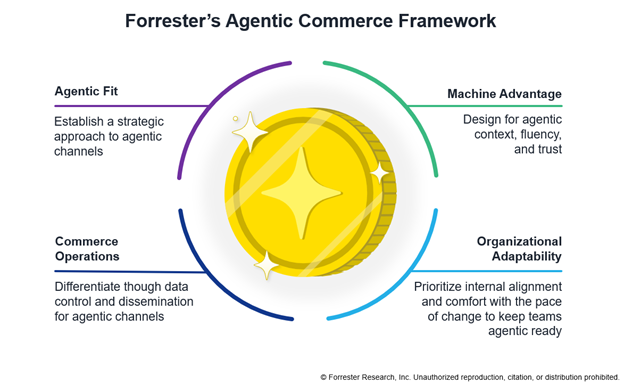
Take these pragmatic steps now:
Evaluate your “agentic fit.” Not every brand or product will benefit equally from answer engine selling. Assess whether your customers are experimenting with conversational commerce, and whether your brand and products are a fit for non-owned conversational channels.
Watch for our upcoming research, “Death of the Retail Website,” a collaboration with Joe Stanhope, which focuses on how retail sites need to change to adapt to the new ways consumers want to shop, followed later this summer by our “Opportunity Assessment: Answer Engine Selling.”
Build a Machine Advantage to get AI agents to favor your brand. The key to influencing AI crawlers and agents is to develop a content strategy that targets machines, built on schemas, comprehensive product information, and at the right level of topical depth to establish authority. Brands will gain competitive advantage in era of machines by establishing content programs focused on increasing context, fluency, and trust in each interaction with an AI agent.
Align your organization and focus on adaptability. The biggest barriers to pivoting into new strategies are internal silos and an immovable culture. Agentic commerce will require tight coordination between digital business teams, IT, marketing, customer service, and even legal. Start breaking down walls now. Set shared goals and foster a culture of continuous experimentation and learning.
Revamp operational commerce processes for this new world. It’s time to reevaluate operations. That includes how you treat operational data itself (like inventory and delivery info) as well as the operational approach to new requirements for agentic commerce.
Stay tuned for detailed research from Chuck Gahun and Joe Cicman on how to design and pressure test a distributed commerce strategy for social and agentic commerce.
Bonus recommendations:
Experiment in your owned channels first. You don’t have to wait for a tech giant’s answer engine to start surfacing your catalog. Leverage assistive AI on your own site or app to let customers ask questions in natural language and to provide them guided product recommendations.
Engage tech partners on protocols, payments, and policy. The future of agent-led buying and selling will depend on industry-wide solutions for trust, identity, and payments. Stay close to emerging standards and be ready to adapt your processes.
The Bottom Line: Agentic commerce is on the horizon, but it’s not an overnight revolution. The gap between marketing buzz and current reality is exactly where digital leaders must operate strategically, right now.
Get educated on this evolving space, prepare your content and teams, and experiment with these emerging experiences. By focusing on readiness and thoughtful action now, you won’t need to chase the hype. You’ll be prepared to capitalize on agentic commerce as it gradually becomes a viable, trusted part of the digital commerce landscape.
Read more in the full State of Agentic Commerce report and dive deeper into consumer adoption of conversational commerce experiences in our data overview report.
Don’t forget to attend Forrester’s CX Forum East in New York City (which is sold out — hope you’re already registered!) or West in San Francisco (still some spaces available!) and watch the replay of our State of Agentic Commerce webinar to whet your appetite until then!