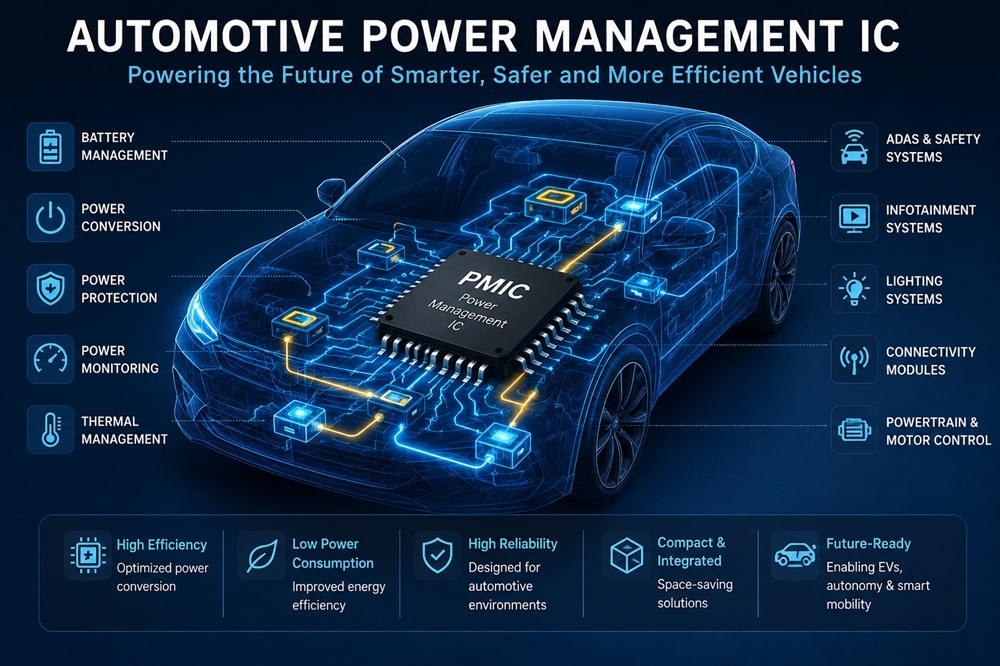
The automotive industry is rapidly evolving toward electrification, connected mobility, and intelligent vehicle architectures. As vehicles integrate more advanced electronics, the demand for efficient power distribution and voltage regulation is increasing significantly. Automotive power management integrated circuits (PMICs) are becoming essential for managing energy flow across infotainment systems, battery management systems, ADAS platforms, and electric powertrains.
According to BISResearch, the automotive PMIC market is projected to grow $20,297.9 million by 2035 from $6,160.5 million in 2024, growing at a CAGR of 11.11% during the 2025-2035.
Why is Vehicle Electrification Increasing Demand for Automotive PMICs?
The rapid growth of electric vehicles (EVs) and hybrid electric vehicles (HEVs) is one of the biggest drivers for the automotive power management IC market. Electrified vehicles require sophisticated power regulation systems to efficiently manage battery performance, charging cycles, and energy distribution.
Modern EV architectures rely heavily on PMICs for:
Voltage conversion
Battery monitoring
Thermal management
Power sequencing
Energy optimization
Additionally, automakers are integrating more electronic subsystems into vehicles, increasing the number of power domains that need efficient management. This trend is accelerating demand for compact, highly integrated PMIC solutions across passenger and commercial vehicles.
Request A Sample for Automotive Power Management IC Market – Focus on Product, Application, and Country Analysis and Forecast, 2025-2035
How are ADAS and Digital Cockpits Transforming the Market?
Advanced driver-assistance systems (ADAS), digital cockpits, and connected infotainment platforms are reshaping automotive electronics. These technologies require stable and highly efficient power delivery to support processors, sensors, displays, and communication modules.
As automotive computing power scales upward, PMICs are evolving into multifunctional semiconductor components capable of supporting:
Multi-rail voltage regulation
High-density power conversion
Thermal efficiency
Low power consumption
The shift toward zonal and domain-based vehicle architectures is also increasing the complexity of automotive power management systems, creating opportunities for next-generation PMIC innovation.
What Key Trends are Shaping the Automotive PMIC Industry?
One of the major trends in the market is the increasing integration of power management functions into single-chip solutions. Semiconductor companies are focusing on compact and energy-efficient PMICs that reduce system complexity while improving reliability.
Other emerging trends include:
Adoption of silicon carbide (SiC) and gallium nitride (GaN) technologies
Growth of high-voltage vehicle platforms
Rising demand for smart power management
Expansion of autonomous driving technologies
Supply chain localization initiatives
The market is also witnessing growing collaboration between automotive OEMs and semiconductor manufacturers to ensure long-term supply chain stability and component availability.
What Challenges and Opportunities Exist in the Market?
Despite strong growth potential, the automotive PMIC market faces several challenges. Automotive-grade semiconductors require long qualification cycles, strict reliability standards, and advanced thermal management capabilities. Supply chain disruptions and semiconductor shortages have also highlighted vulnerabilities within the automotive electronics ecosystem.
However, these challenges are creating new opportunities for:
Localized semiconductor manufacturing
Advanced packaging technologies
AI-enabled power optimization
Integrated power architectures
Next-generation EV platforms
As software-defined vehicles become more common, PMICs will play a critical role in enabling efficient and intelligent vehicle energy management systems.
Click Here to Download the ToC
Conclusion
The automotive power management IC market is becoming a foundational segment within the broader automotive semiconductor industry. Growing electrification, rising ADAS deployment, and increasing digitalization are driving demand for highly efficient power management solutions across vehicle platforms. As automakers continue transitioning toward connected and autonomous mobility, automotive PMICs are expected to remain critical for improving energy efficiency, system reliability, and vehicle performance in the coming decade.