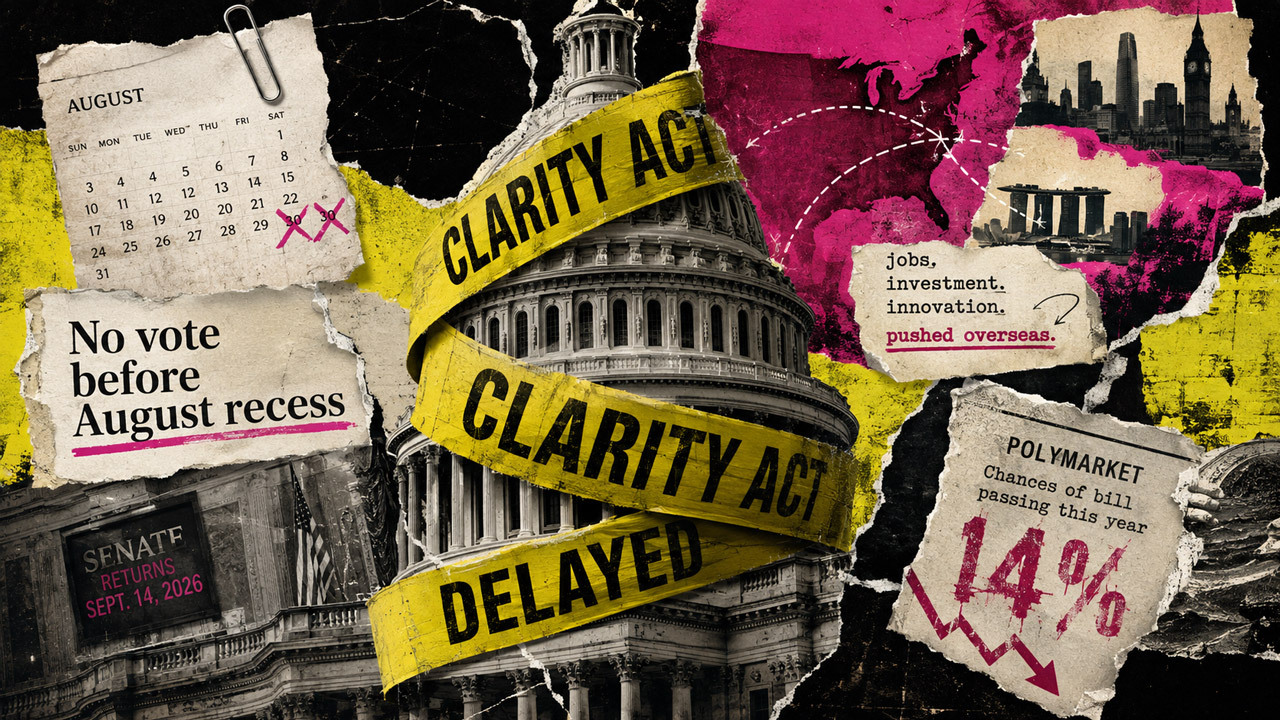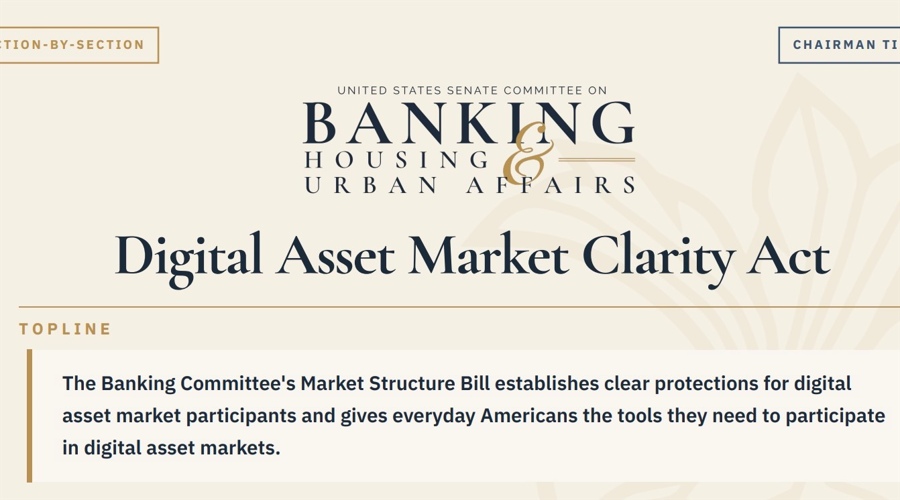
With the Senate Banking Committee releasing a new 309-page draft of the CLARITY Act this week ahead of Thursday’s markup, now is the time to break down what the bill would actually do.
What CLARITY Actually Is
The CLARITY Act (H.R. 3633) is a US crypto market structure bill designed to create clearer federal rules for digital assets and resolve years of conflict between the SEC and the CFTC over who regulates the industry.
Passed by the House in 2025, the bill would formally divide oversight between securities regulators and commodity regulators, ending much of the legal uncertainty that has shaped the US crypto market for years.
The SEC/CFTC Jurisdictional Split
Right now, two regulators – the SEC and the CFTC – both claim authority over crypto, and nobody has been sure which rules apply to which assets.
For years, the two agencies have taken overlapping positions on digital assets, with the SEC arguing that many tokens function as securities while the CFTC has pushed for a larger role overseeing commodity-style crypto markets.
In practice, the overlap often left exchanges and trading platforms facing competing interpretations and potentially duplicative compliance obligations.
The CLARITY Act is designed to formally divide responsibilities between the two agencies, giving the SEC oversight of digital asset securities while expanding the CFTC’s authority over digital commodity spot markets.
The bill also requires the two agencies to jointly define key terms, determine how mixed platforms should be regulated, and establish rules for delisting assets.
Digital Commodity vs. Security: Where the Line Gets Drawn
In practice, the classification question comes down largely to how a token derives its value. Under §103 of the bill, a digital commodity is a digital asset whose value is “intrinsically linked” to the use of the blockchain to which it relates.
If a token instead depends mainly on the efforts of a central team – the model covered by §201, which defines investment contract assets – it is more likely to be treated as a security.
A project does not become a digital commodity simply by calling itself decentralised. The bill introduces a “maturity” test designed to measure how much control the founding team still has over the network.
To qualify for the CFTC framework, no insider group can control more than 20% of voting power or hold more than 20% of the token supply. For older blockchains that already existed before the bill, at least half of all tokens must be held outside the founding team.
The bill also allows crypto projects to raise money under securities rules without automatically classifying their tokens as securities forever.
In practice, this means a project could initially sell tokens to investors under SEC oversight, while later allowing those same tokens to qualify as digital commodities if the network becomes sufficiently decentralised.
Which Companies Are Directly Affected by the CLARITY Act
The bill mainly targets the companies that sit between crypto users and the market: exchanges, brokers, trading platforms, and stablecoin firms.
Crypto trading platforms such as Coinbase and Kraken would have to register with the CFTC as digital commodity exchanges and follow new rules around customer asset protection, market surveillance, reporting, and anti-money-laundering controls.
Futures commission merchants (FCMs) and designated contract markets (DCMs) – the futures-focused firms already regulated by the CFTC – would also be brought into the updated digital commodity framework under the bill’s Commodity Exchange Act amendments.
For alternative trading systems (ATSs), the bill takes a lighter approach: under §304, SEC-registered ATSs may trade digital commodities upon notification to the CFTC rather than full dual registration, provided oversight across the two agencies remains consistent. Broker-dealers, custodians, and ETF issuers could find it easier to expand crypto-related products under a clearer regulatory framework.
The bill focuses mainly on centralised intermediaries rather than ordinary wallet users, blockchain validators, or many open-source software developers, which are largely carved out of the framework.
What Changes for Stablecoin Issuers
The CLARITY Act will define how stablecoins fit into the broader crypto market structure, affecting operations of stablecoin issuers such as Circle, Tether, and Paxos.
The bill largely leaves stablecoin issuance rules to the separate GENIUS Act enacted in 2025. CLARITY instead focuses on how stablecoins are traded and used across regulated crypto platforms.
One of the biggest debates around the bill involves yield-bearing stablecoins that pay users interest simply for holding a token. On May 1, 2026, Senators Thom Tillis and Angela Alsobrooks proposed a compromise that would restrict crypto firms from offering returns that function too much like traditional bank deposits.
In practice, that could force stablecoin companies to rethink some business models built around passive yield products. Instead of paying users simply for holding a stablecoin, firms may need to tie rewards more closely to trading activity, liquidity provision, or other on-chain services.
Coinbase and other crypto firms have also pushed back against parts of the proposed stablecoin framework, particularly around restrictions tied to yield-bearing products and reserve requirements.
We submitted our response to the @USOCC’s proposed rules for permitted payment stablecoin issuers (PPSIs). We appreciate the work that the Administration is doing to ensure that GENIUS stablecoins gain broad adoption, and the US leads in digital innovation. To that end, we made… pic.twitter.com/ho8qJkQ9o8
— Faryar Shirzad 🛡️ (@faryarshirzad) May 6, 2026
Where It Sits in the Legislative Pipeline
The CLARITY Act still faces several major hurdles before it can become law. The immediate question is not a final Senate vote, but whether the bill can first advance through committee markup.
Despite the remaining hurdles, some lawmakers argue momentum is building. Senator Cynthia Lummis described the latest compromise language on stablecoin yield as “the culmination of months of hard work,” adding that lawmakers were “closer than ever to getting the CLARITY Act across the finish line.”
This finalized, bipartisan text is the culmination of months of hard work to deliver a compromise on yield we can all live with. We are closer than ever to getting the Clarity Act across the finish line. https://t.co/8vF7tzpxpy
— Senator Cynthia Lummis (@SenLummis) May 4, 2026
Supporters of the bill argue that clearer market structure rules are necessary to keep crypto activity inside the United States rather than pushing it offshore. Faryar Shirzad, chief policy officer at Coinbase, described the planned Senate markup as a “big step forward,” adding that “clear market structure rules are essential for protecting consumers, supporting innovation, and ensuring this technology develops in the United States rather than offshore.”
Big step forward.
Appreciate @SenatorTimScott and the Senate Banking Committee moving toward markup of the CLARITY Act on May 14.
Clear market structure rules are essential for protecting consumers, supporting innovation, and ensuring this technology develops in the United… pic.twitter.com/ngqCOZmJZi
— Faryar Shirzad 🛡️ (@faryarshirzad) May 8, 2026
Here is where it actually stands as of May 12, 2026:
House: Passed 294-134 in July 2025.Senate Banking Committee: Released a new 309-page draft on May 12, 2026. Committee members have until close of business May 13 to file amendments, with a markup scheduled for Thursday, May 14.Senate Agriculture Committee: Passed its own related bill, the Digital Commodity Intermediaries Act, out of committee on January 29, 2026.Reconciliation: The two Senate committee versions must be merged, then that merged bill must pass the full Senate with a 60-vote threshold.House re-vote: Any Senate-approved text that differs from H.R. 3633 must go back to the House.
Earlier versions of the Senate draft also faced criticism from Coinbase CEO Brian Armstrong, particularly around stablecoin rewards and SEC authority, although he later welcomed compromise talks on the legislation.
We agree. Thank you @SecScottBessent for saying it. It’s time to pass the Clarity Act.
Grateful for all the bipartisan work among Senators and staff over the past several months to make this a strong bill. https://t.co/jHoZ1bfLVZ pic.twitter.com/YBKebDkq8B
— Brian Armstrong (@brian_armstrong) April 10, 2026
What the CLARITY Act Would Not Do
The CLARITY Act would still leave several major areas of crypto regulation unresolved. It would not determine how digital assets are taxed. Even if a token qualifies as a digital commodity under the bill, the IRS could still apply separate tax rules.
The bill also does not directly regulate most decentralised finance (DeFi) protocols, particularly those operating without centralised custodians or issuers.
It would not replace existing state-level crypto licensing rules, meaning companies could still face overlapping federal and state requirements.
The SEC could also continue pursuing enforcement cases involving conduct that took place before the law’s effective date, or against assets that continue to be treated as securities. NFTs and digital collectibles are largely outside the bill’s focus and are excluded from the digital commodity definition.
The bill also includes a separate provision preventing the Federal Reserve from issuing or testing a central bank digital currency (CBDC), although that is not central to the broader market structure framework.
FAQ (Frequently Asked Questions)
Does this mean Bitcoin and Ether are officially commodities?
Not yet. The bill creates a process for determining which assets qualify as digital commodities under the §103 criteria, but regulators would still need to finalize the rules. Bitcoin would very likely meet the maturity thresholds – no single group controls 20% of voting power or supply. Ether’s status remains more debated.
When is the actual vote?
There is no confirmed Senate floor vote yet. The next major step is a Senate Banking Committee markup, which had been targeted for May 2026 but was not officially scheduled at publication time.
Does CLARITY replace the need to register with the SEC?
Only partly. Some crypto trading activity would move under CFTC oversight, while token fundraising could still fall under SEC rules.
What happens if the bill fails?
The current system would remain in place: overlapping oversight, state-level licensing, and regulation through enforcement actions.
Does this affect crypto held in personal wallets?
Not directly. The bill largely protects self-custody and peer-to-peer transfers.
What is the connection to the GENIUS Act?
GENIUS focuses on stablecoin issuance parameters, including reserves, licensing, redemption rights. CLARITY focuses on how digital assets, including stablecoins, trade across the broader crypto market. The two bills are designed to interlock, but the stablecoin yield question has been the main source of friction between them.
With the Senate Banking Committee releasing a new 309-page draft of the CLARITY Act this week ahead of Thursday’s markup, now is the time to break down what the bill would actually do.
What CLARITY Actually Is
The CLARITY Act (H.R. 3633) is a US crypto market structure bill designed to create clearer federal rules for digital assets and resolve years of conflict between the SEC and the CFTC over who regulates the industry.
Passed by the House in 2025, the bill would formally divide oversight between securities regulators and commodity regulators, ending much of the legal uncertainty that has shaped the US crypto market for years.
The SEC/CFTC Jurisdictional Split
Right now, two regulators – the SEC and the CFTC – both claim authority over crypto, and nobody has been sure which rules apply to which assets.
For years, the two agencies have taken overlapping positions on digital assets, with the SEC arguing that many tokens function as securities while the CFTC has pushed for a larger role overseeing commodity-style crypto markets.
In practice, the overlap often left exchanges and trading platforms facing competing interpretations and potentially duplicative compliance obligations.
The CLARITY Act is designed to formally divide responsibilities between the two agencies, giving the SEC oversight of digital asset securities while expanding the CFTC’s authority over digital commodity spot markets.
The bill also requires the two agencies to jointly define key terms, determine how mixed platforms should be regulated, and establish rules for delisting assets.
Digital Commodity vs. Security: Where the Line Gets Drawn
In practice, the classification question comes down largely to how a token derives its value. Under §103 of the bill, a digital commodity is a digital asset whose value is “intrinsically linked” to the use of the blockchain to which it relates.
If a token instead depends mainly on the efforts of a central team – the model covered by §201, which defines investment contract assets – it is more likely to be treated as a security.
A project does not become a digital commodity simply by calling itself decentralised. The bill introduces a “maturity” test designed to measure how much control the founding team still has over the network.
To qualify for the CFTC framework, no insider group can control more than 20% of voting power or hold more than 20% of the token supply. For older blockchains that already existed before the bill, at least half of all tokens must be held outside the founding team.
The bill also allows crypto projects to raise money under securities rules without automatically classifying their tokens as securities forever.
In practice, this means a project could initially sell tokens to investors under SEC oversight, while later allowing those same tokens to qualify as digital commodities if the network becomes sufficiently decentralised.
Which Companies Are Directly Affected by the CLARITY Act
The bill mainly targets the companies that sit between crypto users and the market: exchanges, brokers, trading platforms, and stablecoin firms.
Crypto trading platforms such as Coinbase and Kraken would have to register with the CFTC as digital commodity exchanges and follow new rules around customer asset protection, market surveillance, reporting, and anti-money-laundering controls.
Futures commission merchants (FCMs) and designated contract markets (DCMs) – the futures-focused firms already regulated by the CFTC – would also be brought into the updated digital commodity framework under the bill’s Commodity Exchange Act amendments.
For alternative trading systems (ATSs), the bill takes a lighter approach: under §304, SEC-registered ATSs may trade digital commodities upon notification to the CFTC rather than full dual registration, provided oversight across the two agencies remains consistent. Broker-dealers, custodians, and ETF issuers could find it easier to expand crypto-related products under a clearer regulatory framework.
The bill focuses mainly on centralised intermediaries rather than ordinary wallet users, blockchain validators, or many open-source software developers, which are largely carved out of the framework.
What Changes for Stablecoin Issuers
The CLARITY Act will define how stablecoins fit into the broader crypto market structure, affecting operations of stablecoin issuers such as Circle, Tether, and Paxos.
The bill largely leaves stablecoin issuance rules to the separate GENIUS Act enacted in 2025. CLARITY instead focuses on how stablecoins are traded and used across regulated crypto platforms.
One of the biggest debates around the bill involves yield-bearing stablecoins that pay users interest simply for holding a token. On May 1, 2026, Senators Thom Tillis and Angela Alsobrooks proposed a compromise that would restrict crypto firms from offering returns that function too much like traditional bank deposits.
In practice, that could force stablecoin companies to rethink some business models built around passive yield products. Instead of paying users simply for holding a stablecoin, firms may need to tie rewards more closely to trading activity, liquidity provision, or other on-chain services.
Coinbase and other crypto firms have also pushed back against parts of the proposed stablecoin framework, particularly around restrictions tied to yield-bearing products and reserve requirements.
We submitted our response to the @USOCC’s proposed rules for permitted payment stablecoin issuers (PPSIs). We appreciate the work that the Administration is doing to ensure that GENIUS stablecoins gain broad adoption, and the US leads in digital innovation. To that end, we made… pic.twitter.com/ho8qJkQ9o8
— Faryar Shirzad 🛡️ (@faryarshirzad) May 6, 2026
Where It Sits in the Legislative Pipeline
The CLARITY Act still faces several major hurdles before it can become law. The immediate question is not a final Senate vote, but whether the bill can first advance through committee markup.
Despite the remaining hurdles, some lawmakers argue momentum is building. Senator Cynthia Lummis described the latest compromise language on stablecoin yield as “the culmination of months of hard work,” adding that lawmakers were “closer than ever to getting the CLARITY Act across the finish line.”
This finalized, bipartisan text is the culmination of months of hard work to deliver a compromise on yield we can all live with. We are closer than ever to getting the Clarity Act across the finish line. https://t.co/8vF7tzpxpy
— Senator Cynthia Lummis (@SenLummis) May 4, 2026
Supporters of the bill argue that clearer market structure rules are necessary to keep crypto activity inside the United States rather than pushing it offshore. Faryar Shirzad, chief policy officer at Coinbase, described the planned Senate markup as a “big step forward,” adding that “clear market structure rules are essential for protecting consumers, supporting innovation, and ensuring this technology develops in the United States rather than offshore.”
Big step forward.
Appreciate @SenatorTimScott and the Senate Banking Committee moving toward markup of the CLARITY Act on May 14.
Clear market structure rules are essential for protecting consumers, supporting innovation, and ensuring this technology develops in the United… pic.twitter.com/ngqCOZmJZi
— Faryar Shirzad 🛡️ (@faryarshirzad) May 8, 2026
Here is where it actually stands as of May 12, 2026:
House: Passed 294-134 in July 2025.Senate Banking Committee: Released a new 309-page draft on May 12, 2026. Committee members have until close of business May 13 to file amendments, with a markup scheduled for Thursday, May 14.Senate Agriculture Committee: Passed its own related bill, the Digital Commodity Intermediaries Act, out of committee on January 29, 2026.Reconciliation: The two Senate committee versions must be merged, then that merged bill must pass the full Senate with a 60-vote threshold.House re-vote: Any Senate-approved text that differs from H.R. 3633 must go back to the House.
Earlier versions of the Senate draft also faced criticism from Coinbase CEO Brian Armstrong, particularly around stablecoin rewards and SEC authority, although he later welcomed compromise talks on the legislation.
We agree. Thank you @SecScottBessent for saying it. It’s time to pass the Clarity Act.
Grateful for all the bipartisan work among Senators and staff over the past several months to make this a strong bill. https://t.co/jHoZ1bfLVZ pic.twitter.com/YBKebDkq8B
— Brian Armstrong (@brian_armstrong) April 10, 2026
What the CLARITY Act Would Not Do
The CLARITY Act would still leave several major areas of crypto regulation unresolved. It would not determine how digital assets are taxed. Even if a token qualifies as a digital commodity under the bill, the IRS could still apply separate tax rules.
The bill also does not directly regulate most decentralised finance (DeFi) protocols, particularly those operating without centralised custodians or issuers.
It would not replace existing state-level crypto licensing rules, meaning companies could still face overlapping federal and state requirements.
The SEC could also continue pursuing enforcement cases involving conduct that took place before the law’s effective date, or against assets that continue to be treated as securities. NFTs and digital collectibles are largely outside the bill’s focus and are excluded from the digital commodity definition.
The bill also includes a separate provision preventing the Federal Reserve from issuing or testing a central bank digital currency (CBDC), although that is not central to the broader market structure framework.
FAQ (Frequently Asked Questions)
Does this mean Bitcoin and Ether are officially commodities?
Not yet. The bill creates a process for determining which assets qualify as digital commodities under the §103 criteria, but regulators would still need to finalize the rules. Bitcoin would very likely meet the maturity thresholds – no single group controls 20% of voting power or supply. Ether’s status remains more debated.
When is the actual vote?
There is no confirmed Senate floor vote yet. The next major step is a Senate Banking Committee markup, which had been targeted for May 2026 but was not officially scheduled at publication time.
Does CLARITY replace the need to register with the SEC?
Only partly. Some crypto trading activity would move under CFTC oversight, while token fundraising could still fall under SEC rules.
What happens if the bill fails?
The current system would remain in place: overlapping oversight, state-level licensing, and regulation through enforcement actions.
Does this affect crypto held in personal wallets?
Not directly. The bill largely protects self-custody and peer-to-peer transfers.
What is the connection to the GENIUS Act?
GENIUS focuses on stablecoin issuance parameters, including reserves, licensing, redemption rights. CLARITY focuses on how digital assets, including stablecoins, trade across the broader crypto market. The two bills are designed to interlock, but the stablecoin yield question has been the main source of friction between them.