No Result
View All Result
  • Login
Friday, May 1, 2026
FeeOnlyNews.com
  • Home
  • Business
  • Financial Planning
  • Personal Finance
  • Investing
  • Money
  • Economy
  • Markets
  • Stocks
  • Trading
  • Home
  • Business
  • Financial Planning
  • Personal Finance
  • Investing
  • Money
  • Economy
  • Markets
  • Stocks
  • Trading
No Result
View All Result
FeeOnlyNews.com
No Result
View All Result
Home Cryptocurrency

DeFi’s Next Chapter Hinges on Breaking the Loop of Speculation, Leverage, and Inflated Yields

by FeeOnlyNews.com
20 hours ago
in Cryptocurrency
Reading Time: 11 mins read
A A
0
DeFi’s Next Chapter Hinges on Breaking the Loop of Speculation, Leverage, and Inflated Yields
Share on FacebookShare on TwitterShare on LInkedIn


The promise of decentralized finance was once a clarion call
for a democratic financial revolution. It envisioned a world where the rigid,
exclusionary walls of traditional banking would be replaced by transparent,
automated, permissionless systems. As we move through 2026, that early optimism
has given way to a more sober reality.

Singapore
Summit: Meet the largest APAC brokers you know (and those you still don’t!)

While the technology remains
powerful, the economic foundations of most DeFi lending protocols are still
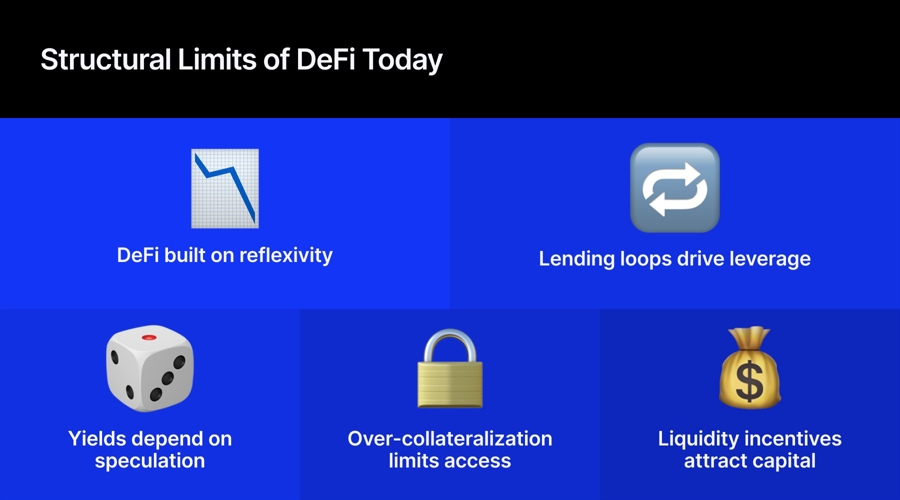
structurally weak. Much of the system operates on reflexivity, where value is
borrowed from the future to support the present. Without a shift from internal
speculation toward external utility, the ecosystem risks long-term irrelevance.

At the core of the problem is the circular nature of DeFi
lending. In traditional finance, loans fund productive activity that generates
real economic output. In DeFi, lending is largely recursive. Users deposit
volatile assets, borrow stablecoins, and
often recycle them back into the same assets.

This creates leverage loops that
function in bull markets but produce no real economic surplus. Yield is driven
not by productivity, but by demand for leverage among speculators, making the
system heavily dependent on rising asset prices.

Inflationary Tokens Attract Mercenary Liquidity

This fragility is reinforced by inflationary tokenomics.
Many protocols rely on liquidity mining incentives paid in governance tokens to
attract capital. This creates mercenary liquidity that
constantly chases the highest yield.

These tokens often have limited real
utility, meaning their value depends heavily on future buyers. When prices
fall, yields collapse, liquidity exits, and protocols can spiral quickly. The
collapse of Iron Finance in 2021 illustrated this dynamic clearly, as its
partially collateralized stablecoin system broke down rapidly once confidence
eroded.

Over-Collateralization Limits Real Access

Capital inefficiency is another structural flaw. Traditional
banking extends credit based on trust and repayment history, while DeFi is overwhelmingly
over-collateralized. Borrowers must lock up more value than they receive, often
making the system unusable for those who actually need capital.

A small
business in an emerging market cannot access DeFi credit if it requires holding
150% collateral in volatile crypto assets. As a
result, the system favors capital-rich speculators rather than real economic
participants.

Automated Liquidations Amplify Market Stress

Systemic risk is further amplified by liquidation cascades.
Smart contracts automatically liquidate positions when collateral falls below
thresholds. In volatile markets, these forced sales push prices lower,
triggering further liquidations in a feedback loop.

The collapse of the
Terra/Luna ecosystem in 2022 showed how quickly this can escalate. Anchor
Protocol’s unsustainable yield attracted massive inflows, but once the
stablecoin
Stablecoin

Unlike other cryptocurrencies like Bitcoin and Ethereum, stablecoins are cryptocurrencies that have been designed to keep a stable value. Placing a greater emphasis on stability over volatility can be a huge draw for some investors. Many individuals can be turned off from large swings and uncertainty presented by cryptos relative to other traditional assets.Stablecoins control for this volatility by being pegged to another cryptocurrency, fiat money, or to exchange-traded commodities, including

Unlike other cryptocurrencies like Bitcoin and Ethereum, stablecoins are cryptocurrencies that have been designed to keep a stable value. Placing a greater emphasis on stability over volatility can be a huge draw for some investors. Many individuals can be turned off from large swings and uncertainty presented by cryptos relative to other traditional assets.Stablecoins control for this volatility by being pegged to another cryptocurrency, fiat money, or to exchange-traded commodities, including
Read this Term
peg failed, cascading liquidations wiped out tens of billions and
spread contagion across the broader market.

Real World Assets Stabilize Yield Base

To become sustainable, DeFi must integrate real-world
assets. Closed-loop crypto economies cannot sustain themselves indefinitely.
Lending protocols need exposure to external sources of yield such as government
debt, trade finance, and private credit.

MakerDAO, now rebranded as Sky
Protocol, has already moved heavily into U.S. Treasuries and private credit,
creating more stable income streams during downturns. This shifts protocols
closer to blockchain
Blockchain

Blockchain comprises a digital network of blocks with a comprehensive ledger of transactions made in a cryptocurrency such as Bitcoin or other altcoins.One of the signature features of blockchain is that it is maintained across more than one computer. The ledger can be public or private (permissioned). In this sense, blockchain is immune to the manipulation of data, making it not only open but verifiable. Because a blockchain is stored across a network of computers, it is very difficult to tamp

Blockchain comprises a digital network of blocks with a comprehensive ledger of transactions made in a cryptocurrency such as Bitcoin or other altcoins.One of the signature features of blockchain is that it is maintained across more than one computer. The ledger can be public or private (permissioned). In this sense, blockchain is immune to the manipulation of data, making it not only open but verifiable. Because a blockchain is stored across a network of computers, it is very difficult to tamp
Read this Term
-based investment structures, though concerns remain that
much of the value still depends on off-chain systems rather than fully on-chain
economic logic.

Credit Systems Replace Collateral Dependence

Another key evolution is decentralized identity and on-chain
credit scoring. Moving beyond over-collateralized lending is essential for real
adoption. Zero-knowledge proofs allow borrowers to demonstrate creditworthiness
without revealing sensitive data, enabling risk assessment based on financial
history rather than collateral alone.

DeFi is inevitable, but only if it can support the existing financial system.

Real-world assets are giving the industry the chance it needs to find its footing in traditional market structure. https://t.co/XP6NjHEu0Q

— Plume (@plumenetwork) April 29, 2026

This could eventually allow DeFi to
extend credit to real businesses in emerging markets, bringing productive
activity onto the blockchain instead of purely speculative flows.

Modular Design Reduces Systemic Contagion

Protocol design also needs to become more modular. Early
DeFi systems relied on shared liquidity pools, which are highly vulnerable to
contagion. Newer models are introducing isolated markets where failures are
contained rather than spreading across the entire system. Aave has already
taken steps in this direction with isolation modes and risk segmentation.

Combined with better insurance mechanisms and improved smart contract security,
these changes could make DeFi more resilient and attractive to institutional
capital.

Speculative Culture Undermines Stability

We must also recognize that sustainability is as much about
human behavior as it is about code. The culture of “get rich quick”
schemes and astronomical annual percentage yields must be replaced by a culture
of risk-adjusted returns and long-term value creation.

Regulatory clarity will
play a vital role here. While some in the crypto space fear
oversight, a clear legal framework provides the certainty needed for legitimate
businesses to build on-chain. When investors can distinguish between a
high-risk speculative play and a regulated, asset-backed lending product, the
market will naturally gravitate toward the more sustainable options.

Meanwhile, watch out for the falling yields. Do not be
caught by surprise.

The promise of decentralized finance was once a clarion call
for a democratic financial revolution. It envisioned a world where the rigid,
exclusionary walls of traditional banking would be replaced by transparent,
automated, permissionless systems. As we move through 2026, that early optimism
has given way to a more sober reality.

Singapore
Summit: Meet the largest APAC brokers you know (and those you still don’t!)

While the technology remains
powerful, the economic foundations of most DeFi lending protocols are still
structurally weak. Much of the system operates on reflexivity, where value is
borrowed from the future to support the present. Without a shift from internal
speculation toward external utility, the ecosystem risks long-term irrelevance.

At the core of the problem is the circular nature of DeFi
lending. In traditional finance, loans fund productive activity that generates
real economic output. In DeFi, lending is largely recursive. Users deposit
volatile assets, borrow stablecoins, and
often recycle them back into the same assets.

This creates leverage loops that
function in bull markets but produce no real economic surplus. Yield is driven
not by productivity, but by demand for leverage among speculators, making the
system heavily dependent on rising asset prices.

Inflationary Tokens Attract Mercenary Liquidity

This fragility is reinforced by inflationary tokenomics.
Many protocols rely on liquidity mining incentives paid in governance tokens to
attract capital. This creates mercenary liquidity that
constantly chases the highest yield.

These tokens often have limited real
utility, meaning their value depends heavily on future buyers. When prices
fall, yields collapse, liquidity exits, and protocols can spiral quickly. The
collapse of Iron Finance in 2021 illustrated this dynamic clearly, as its
partially collateralized stablecoin system broke down rapidly once confidence
eroded.

Over-Collateralization Limits Real Access

Capital inefficiency is another structural flaw. Traditional
banking extends credit based on trust and repayment history, while DeFi is overwhelmingly
over-collateralized. Borrowers must lock up more value than they receive, often
making the system unusable for those who actually need capital.

A small
business in an emerging market cannot access DeFi credit if it requires holding
150% collateral in volatile crypto assets. As a
result, the system favors capital-rich speculators rather than real economic
participants.

Automated Liquidations Amplify Market Stress

Systemic risk is further amplified by liquidation cascades.
Smart contracts automatically liquidate positions when collateral falls below
thresholds. In volatile markets, these forced sales push prices lower,
triggering further liquidations in a feedback loop.

The collapse of the
Terra/Luna ecosystem in 2022 showed how quickly this can escalate. Anchor
Protocol’s unsustainable yield attracted massive inflows, but once the
stablecoin
Stablecoin

Unlike other cryptocurrencies like Bitcoin and Ethereum, stablecoins are cryptocurrencies that have been designed to keep a stable value. Placing a greater emphasis on stability over volatility can be a huge draw for some investors. Many individuals can be turned off from large swings and uncertainty presented by cryptos relative to other traditional assets.Stablecoins control for this volatility by being pegged to another cryptocurrency, fiat money, or to exchange-traded commodities, including

Unlike other cryptocurrencies like Bitcoin and Ethereum, stablecoins are cryptocurrencies that have been designed to keep a stable value. Placing a greater emphasis on stability over volatility can be a huge draw for some investors. Many individuals can be turned off from large swings and uncertainty presented by cryptos relative to other traditional assets.Stablecoins control for this volatility by being pegged to another cryptocurrency, fiat money, or to exchange-traded commodities, including
Read this Term
peg failed, cascading liquidations wiped out tens of billions and
spread contagion across the broader market.

Real World Assets Stabilize Yield Base

To become sustainable, DeFi must integrate real-world
assets. Closed-loop crypto economies cannot sustain themselves indefinitely.
Lending protocols need exposure to external sources of yield such as government
debt, trade finance, and private credit.

MakerDAO, now rebranded as Sky
Protocol, has already moved heavily into U.S. Treasuries and private credit,
creating more stable income streams during downturns. This shifts protocols
closer to blockchain
Blockchain

Blockchain comprises a digital network of blocks with a comprehensive ledger of transactions made in a cryptocurrency such as Bitcoin or other altcoins.One of the signature features of blockchain is that it is maintained across more than one computer. The ledger can be public or private (permissioned). In this sense, blockchain is immune to the manipulation of data, making it not only open but verifiable. Because a blockchain is stored across a network of computers, it is very difficult to tamp

Blockchain comprises a digital network of blocks with a comprehensive ledger of transactions made in a cryptocurrency such as Bitcoin or other altcoins.One of the signature features of blockchain is that it is maintained across more than one computer. The ledger can be public or private (permissioned). In this sense, blockchain is immune to the manipulation of data, making it not only open but verifiable. Because a blockchain is stored across a network of computers, it is very difficult to tamp
Read this Term
-based investment structures, though concerns remain that
much of the value still depends on off-chain systems rather than fully on-chain
economic logic.

Credit Systems Replace Collateral Dependence

Another key evolution is decentralized identity and on-chain
credit scoring. Moving beyond over-collateralized lending is essential for real
adoption. Zero-knowledge proofs allow borrowers to demonstrate creditworthiness
without revealing sensitive data, enabling risk assessment based on financial
history rather than collateral alone.

DeFi is inevitable, but only if it can support the existing financial system.

Real-world assets are giving the industry the chance it needs to find its footing in traditional market structure. https://t.co/XP6NjHEu0Q

— Plume (@plumenetwork) April 29, 2026

This could eventually allow DeFi to
extend credit to real businesses in emerging markets, bringing productive
activity onto the blockchain instead of purely speculative flows.

Modular Design Reduces Systemic Contagion

Protocol design also needs to become more modular. Early
DeFi systems relied on shared liquidity pools, which are highly vulnerable to
contagion. Newer models are introducing isolated markets where failures are
contained rather than spreading across the entire system. Aave has already
taken steps in this direction with isolation modes and risk segmentation.

Combined with better insurance mechanisms and improved smart contract security,
these changes could make DeFi more resilient and attractive to institutional
capital.

Speculative Culture Undermines Stability

We must also recognize that sustainability is as much about
human behavior as it is about code. The culture of “get rich quick”
schemes and astronomical annual percentage yields must be replaced by a culture
of risk-adjusted returns and long-term value creation.

Regulatory clarity will
play a vital role here. While some in the crypto space fear
oversight, a clear legal framework provides the certainty needed for legitimate
businesses to build on-chain. When investors can distinguish between a
high-risk speculative play and a regulated, asset-backed lending product, the
market will naturally gravitate toward the more sustainable options.

Meanwhile, watch out for the falling yields. Do not be
caught by surprise.


Source link

Tags: BREAKINGChapterDeFishingesinflatedLeverageLoopSpeculationyields
ShareTweetShare
Previous Post

Financial advisors face a ‘cliché crisis’ in marketing

Next Post

Osaic re-ups capital with $2B infusion from Reverence, Bain, Ares

Related Posts

CEO Behind .7 Billion Crash Banned From Crypto, But How Will This Work?

CEO Behind $4.7 Billion Crash Banned From Crypto, But How Will This Work?

by FeeOnlyNews.com
May 1, 2026
0

Celsius founder Alexander Mashinsky, who was responsible for the $4.7 billion 2022 crypto crash, has been banned from crypto. This...

US Debt Nears T GDP Mark for First Time Since 1946, Validating Bitcoin

US Debt Nears $39T GDP Mark for First Time Since 1946, Validating Bitcoin

by FeeOnlyNews.com
May 1, 2026
0

Key Takeaways: U.S. national debt topped 100% of GDP for the first time since 1946, eclipsing the nation’s entire annual...

Bitcoin Price Action Favors Bears But Profit Taking Overwhelms Each Rally

Bitcoin Price Action Favors Bears But Profit Taking Overwhelms Each Rally

by FeeOnlyNews.com
May 1, 2026
0

Bitcoin (BTC) traders pushed the price to $77,400, but data suggests profit-taking may thwart the bull's goal of turning the...

Crypto hacks hit record high in April 2026, impacting Bitcoin, Ethereum sentiment

Crypto hacks hit record high in April 2026, impacting Bitcoin, Ethereum sentiment

by FeeOnlyNews.com
April 30, 2026
0

## Market Snapshot Bitcoin Price Predictions for April 30 are priced at 0.9% YES, with recent market activity showing decreased...

Dogecoin Just Entered A New Market With This Latest Move, But Will It Make A Difference?

Dogecoin Just Entered A New Market With This Latest Move, But Will It Make A Difference?

by FeeOnlyNews.com
April 30, 2026
0

Trusted Editorial content, reviewed by leading industry experts and seasoned editors. Ad Disclosure Dogecoin is now being packaged for institutional...

CLARITY Act: Senate Banking Republicans Yet to Secure Full Support Ahead Markup

CLARITY Act: Senate Banking Republicans Yet to Secure Full Support Ahead Markup

by FeeOnlyNews.com
April 30, 2026
0

In the latest CLARITY Act update, Senate Banking Republicans have yet to secure full support from all Republicans on the...

Next Post
Osaic re-ups capital with B infusion from Reverence, Bain, Ares

Osaic re-ups capital with $2B infusion from Reverence, Bain, Ares

US Prescription Spending Could Top  Trillion. GLP-1s Lead the Way

US Prescription Spending Could Top $1 Trillion. GLP-1s Lead the Way

  • Trending
  • Comments
  • Latest
The 27 Largest US Funding Rounds of March 2024 – AlleyWatch

The 27 Largest US Funding Rounds of March 2024 – AlleyWatch

April 17, 2026
Wells Fargo Transfer Partners: What to Know

Wells Fargo Transfer Partners: What to Know

April 16, 2026
Week 14: A Peek Into This Past Week + What I’m Reading, Listening to, and Watching!

Week 14: A Peek Into This Past Week + What I’m Reading, Listening to, and Watching!

April 6, 2026
The 16 Largest Global Startup Funding Rounds of March 2026 – AlleyWatch

The 16 Largest Global Startup Funding Rounds of March 2026 – AlleyWatch

April 21, 2026
LPL’s Mariner Advisor Network deal fuels already hot year for RIA M&A

LPL’s Mariner Advisor Network deal fuels already hot year for RIA M&A

April 16, 2026
Royal Caribbean, Bank of America Launching New Credit Cards

Royal Caribbean, Bank of America Launching New Credit Cards

March 31, 2026
Mint Mobile: Cell Phone Plans just /Month!

Mint Mobile: Cell Phone Plans just $10/Month!

0
Psychology suggests people who consume self-improvement content obsessively without ever changing their lives aren’t lazy or lacking discipline, they’re getting the feeling of forward motion without the terror of actually becoming someone different, and the content is the coping mechanism, not the cure

Psychology suggests people who consume self-improvement content obsessively without ever changing their lives aren’t lazy or lacking discipline, they’re getting the feeling of forward motion without the terror of actually becoming someone different, and the content is the coping mechanism, not the cure

0
The Top TV and Radio Stations in Kenya – Q1 2026

The Top TV and Radio Stations in Kenya – Q1 2026

0
The Luck Fallacy and Luck Egalitarianism

The Luck Fallacy and Luck Egalitarianism

0
Forget Big Tech: Small businesses will hire nearly 1 million grads in 2026

Forget Big Tech: Small businesses will hire nearly 1 million grads in 2026

0
Fannie Mae and Freddie Mac Will Allow Rent and Utility Payments to Influence Credit Scores, Making Rent-to-Own Deals for Tenants More Feasible for Landlords

Fannie Mae and Freddie Mac Will Allow Rent and Utility Payments to Influence Credit Scores, Making Rent-to-Own Deals for Tenants More Feasible for Landlords

0
Mint Mobile: Cell Phone Plans just /Month!

Mint Mobile: Cell Phone Plans just $10/Month!

May 1, 2026
The Luck Fallacy and Luck Egalitarianism

The Luck Fallacy and Luck Egalitarianism

May 1, 2026
Forget Big Tech: Small businesses will hire nearly 1 million grads in 2026

Forget Big Tech: Small businesses will hire nearly 1 million grads in 2026

May 1, 2026
Psychology suggests people who consume self-improvement content obsessively without ever changing their lives aren’t lazy or lacking discipline, they’re getting the feeling of forward motion without the terror of actually becoming someone different, and the content is the coping mechanism, not the cure

Psychology suggests people who consume self-improvement content obsessively without ever changing their lives aren’t lazy or lacking discipline, they’re getting the feeling of forward motion without the terror of actually becoming someone different, and the content is the coping mechanism, not the cure

May 1, 2026
Fannie Mae and Freddie Mac Will Allow Rent and Utility Payments to Influence Credit Scores, Making Rent-to-Own Deals for Tenants More Feasible for Landlords

Fannie Mae and Freddie Mac Will Allow Rent and Utility Payments to Influence Credit Scores, Making Rent-to-Own Deals for Tenants More Feasible for Landlords

May 1, 2026
Meta (META) Posts 33% Revenue Growth and Raises Capex Guidance by B

Meta (META) Posts 33% Revenue Growth and Raises Capex Guidance by $10B

May 1, 2026
FeeOnlyNews.com

Get the latest news and follow the coverage of Business & Financial News, Stock Market Updates, Analysis, and more from the trusted sources.

CATEGORIES

  • Business
  • Cryptocurrency
  • Economy
  • Financial Planning
  • Investing
  • Market Analysis
  • Markets
  • Money
  • Personal Finance
  • Startups
  • Stock Market
  • Trading

LATEST UPDATES

  • Mint Mobile: Cell Phone Plans just $10/Month!
  • The Luck Fallacy and Luck Egalitarianism
  • Forget Big Tech: Small businesses will hire nearly 1 million grads in 2026
  • Our Great Privacy Policy
  • Terms of Use, Legal Notices & Disclaimers
  • About Us
  • Contact Us

Copyright © 2022-2024 All Rights Reserved
See articles for original source and related links to external sites.

Welcome Back!

Sign In with Facebook
Sign In with Google
Sign In with Linked In
OR

Login to your account below

Forgotten Password?

Retrieve your password

Please enter your username or email address to reset your password.

Log In
No Result
View All Result
  • Home
  • Business
  • Financial Planning
  • Personal Finance
  • Investing
  • Money
  • Economy
  • Markets
  • Stocks
  • Trading

Copyright © 2022-2024 All Rights Reserved
See articles for original source and related links to external sites.