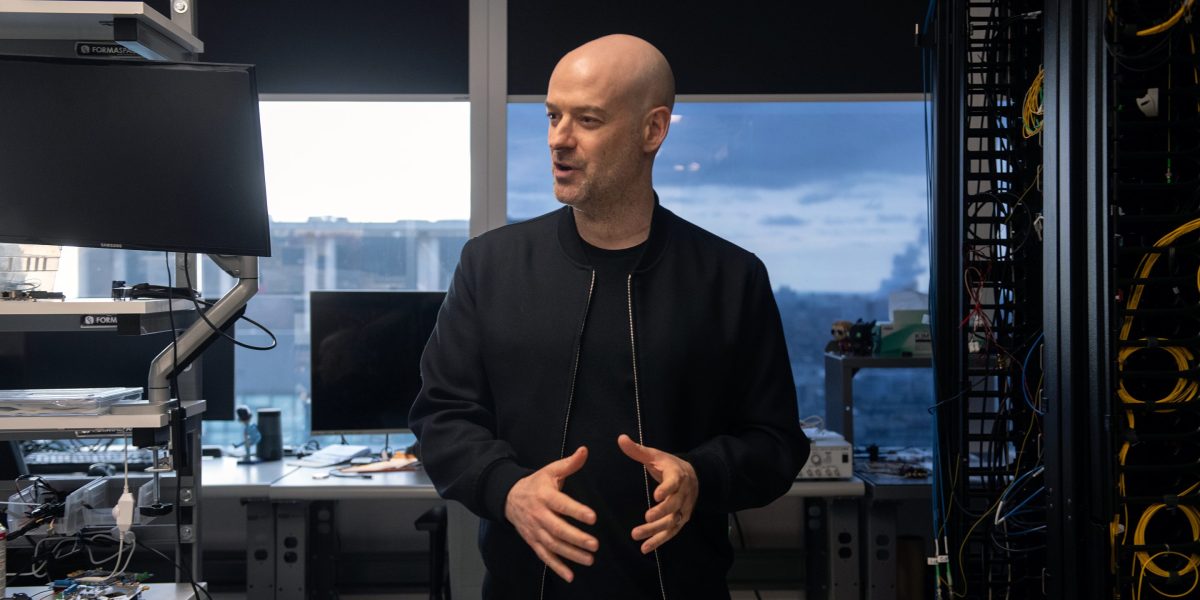
Christian Weedbrook, a film school dropout turned CEO of Xanadu Quantum Technologies, was minted a billionaire in a matter of days thanks to Nvidia endorsing quantum computing as the future of AI.
Last week, Nvidia announced Ising, a family of open-source quantum AI models promising to address major bottlenecks in quantum computing, particularly in calibration and error correction. By addressing barriers to growing quantum processing as part of AI infrastructure expansion, Nvidia gave credibility to quantum computing as the future of AI expansion.
Following the announcement, Xanadu’s stock rallied about 250% to a peak of $32.67 per share. With a 15.6% stake in the company, Weedbrook’s net worth skyrocketed to $1.5 billion within five days of the announcement, according to Bloomberg which cited market data and regulatory filings. Xanadu’s share price has since come back to Earth, but remains more than double its original valuation prior to the announcement.
How Xanadu became a quantum computing giant
Founded in 2016 by Weedbrook, Xanadu is working to build the first quantum data center by 2030, using light in photonic quantum computers to be able to perform computations at room temperature. The company went public in March after merging with publicly traded blank-check firm Crane Harbor Acquisition Corp. and IPO’d.
While traditional computing uses binary bits like 0 or 1 to represent data, quantum computing uses qubits, which can exist as both 0 and 1 simultaneously, exponentially increasing computational power and providing a powerful tool for increasing the speed at which AI is trained. Currently valued at about a $1 billion industry, quantum computing has the potential to become a $198 billion market by 2040, according to Jefferies analyst Kevin Garrigan.
While other public quantum computing companies such as IonQ and Rigetti benefitted from Nvidia’s open-sourcing announcement, Xanadu’s surge, topping a $16 billion valuation, made it one of Canada’s most valuable publicly traded tech companies.
Xanadu did not immediately respond to Fortune’s request for comment.
Who is Christian Weedbrook?
Before Weedbrook saw his net worth jump to 10 digits, he was a math nerd who, at 23, was working part-time at a video store and filming television commercials (as well as short films posted to YouTube) in between early morning shifts stocking groceries. The Australian native flunked out of his first year of film school not once, but twice, and took four years of odd jobs before ultimately deciding to return to university to study math.
“I’d exhausted every other option,” Weedbrook told The Globe and Mail. “I thought ‘I’ll just go back to something I was okay in–math. I don’t know where this will head, I’ll just see.’”
Weedbrook would go on to earn his quantum information theory PhD at the University of Queensland and study as a postdoctoral fellow at MIT. In 2014, Weedbrook went from physicist to entrepreneur, founding Cipher Q, a quantum security company. But after investors told him they’d rather invest in quantum computing than security, Weedbrook went on to launch Xanadu two years later in Toronto.
While Weedbrook sought early backing for the company, his first chip failed, and he faced eviction three times.
His luck changed when he secured assistance from University of Toronto’s Creative Destruction Lab, an incubator, in Xanadu’s early days. The company built momentum and demonstrated “quantum advantage” by performing a task in milliseconds compared to a supercomputer (which would have taken 9,000 years to perform the same task). Released in 2018, Xanadu’s open-source software library PennyLane, named after Weedbrook’s affinity for the Beatles, reached 35,000 active users as of March filings. Prior to its IPO last month, Xanadu secured $287 million in government financial aid for its data center plans.
“You can guarantee we’re working the hardest” out of all quantum computer developers, Weedbrook said in The Globe and Mail interview. “It’s all about getting to this vision.”