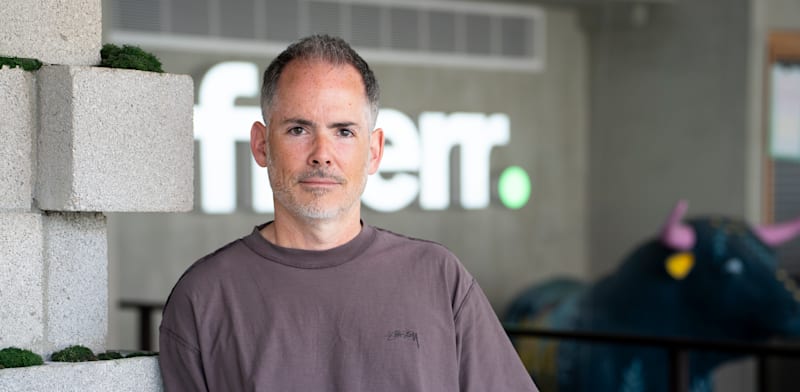
Micha Kaufman has been flying light aircraft for the past 30 years. He has tried his hand at most types of aviation: helicopters, Cessna planes, Piper planes, and challenging ultralight aircraft. He says that he gets a feeling of freedom and optimism in both flying and entrepreneurship, together with constant focus and alertness for what might go wrong.
This intensive pastime, however, also gives him a perspective of Israel. “From high above,” he tells “Globes” in an exclusive interview, “The country isn’t divided into tribes. The big cities, the small villages, and the Druze communities are located close to one another. You realize everything below is a very small thing that behaves as if it were many things.”
Kaufman, 55, is the founder of tech company Fiverr (NYSE: FVRR), which he has managed for 16 years, and he is still running on full throttle. It sometimes appears that he is conducting a frenetic battle to prove something. The veteran CEO, a pioneer of the Israeli internet industry, is in the middle of a multi-year struggle to restore investors’ confidence in the company whose share has lost almost half of its value this year.
With one hand, he is seeking a stable place for Fiverr in the AI storm that has overtaken the software market and with the other, he is waging a campaign to transform the Israeli company.
Over the past four years, he has personally invested millions of dollars in those suffering from combat stress reaction (CSR), equipping soldiers on reserve duty, the struggle to free Israeli hostages, Holocaust survivors, and the tech protest against judicial reform.
He says that the trigger for his awakening was the skits making fun of high tech on the Eretz Nehederet satirical TV show. “I was invited to a night meeting of tech executives. They said that they were being ridiculed. People came to the meeting with a feeling that they were being victimized. I listened and then said, ‘We fully deserve all these jokes. Try to explain that your company provides 20 flavors of ice cream because Google provides 30 flavors. Nobody wants to hear about that.’
“What I saw was a sector representing less than 15% of the job market that generates over half of the taxes paid in Israel and Israel’s industrial exports. Its wealth is concentrated in a few hands. Some people enjoy wealth with no limitations, but what about the rest?”
Replace the education system
One of the things that Kaufman did out of the necessity to bring about change when the time comes is likely to replace the education system, or so he promises. Together with Wix president Nir Zohar, his partner in these social initiatives, and educators Shirley Rimon Bracha and Liza Ben Hamo, he founded the Next Generation Foundation. They were joined by fellow tech protestors Meta Israel CEO Adi Soffer Teeni and Tal Barnoach, a general partner in the Disruptive AI fund (they joined forces with investors regarded as conservative, such as PICO Venture Partners fund cofounder Elie Wurtman).
RELATED ARTICLES
Fiverr hits historic low amid AI fears
Fiverr to lay off 30% of workforce
Fiverr leases space on Wix campus
What is involved is a chain of youth villages designed for teenagers starting at age 15 and continuing until military draft age from the geographically and social periphery. These young people are housed in glamping tents. Six-week mechinot (educational preparatory programs) are conducted in these villages including educational experiences reflecting liberal values, a connection to Judaism, critical thinking, and Zionism.
“There is a problem with educational preparatory programs in Israel,” Kaufman says. “At most, one of every 200 children who want to participate is accepted – and very few if any of them are from the periphery. I wanted to change this.
“In such a small country, why is there such a thing as a periphery? People have been talking about these gaps for 70 years and they had 60 years to remedy the situation. So what is the problem? It’s a question of priorities. Perpetuating poverty seems to be the easy thing to do.”
He says that after 20 pilot programs, “We arrived at a winning formula – short privately funded preparatory programs that require neither postponement of military service nor spending by the state or the Ministry of Defense.”
Kaufman wants to house at least 17,000 young people a year in each village. The first such village was founded at Aaronsohn Farm in Atlit. The fund is now planning to establish villages in northern Israel, the Maalei Jerusalem area, and southern Israel. Each village can cost as much as $10 million a year, most of which comes from his own money and that of his partners in the venture.
“Our only chance of putting things right is through the younger generation. That is why I’m making my biggest investment today in education. An almost absolute majority of my liquid capital is being spent on philanthropy.”
The Next Generation Foundation is planning to expand its educational initiatives to ages 3 to 30 and provide frameworks of technological education mixed with Zionism and values. “This is the biggest educational project in Israel in a decade,” Kaufman adds.
“Globes”: Some of the children coming to the village remember you as a key figure in the demonstration. Some of their parents call you a Kaplanist (a demonstrator on Kaplan St. in Tel Aviv). What do you have to say to them?
Kaufman: “What does being a Kaplanist mean? This is nothing but empty spin and rhetoric. Do they want to talk? Do they want to ask what I was doing on Kaplan St. with an Israeli flag? Why I fought? I’ll be glad to answer.
Most of these young people come from the development towns, are modern Orthodox, or are haredim. You are trying to educate them in liberal values.
“This is what they are familiar with from home. Part of the idea, however, is to put the girl from the religious school in Jerusalem together with the boy from Lod and the kibbutz kid from the north, so that they understand that they are really the same thing. They have different opinions, all right, but how do you make the different parts of the puzzle into a single picture?
“If I had to choose one thing that young people would take with them from the village, it would be critical thinking. The young people have lost it. They get everything from TikTok in ten-second parcels and accept these messages as facts. I tell them, ‘Think twice who is talking to you, who this person is, what is behind him, what the ideological idea is.’
“Everyone talks very similarly about defense and makes the same mistakes. Look at October 7, 2023, look at what they said about the elimination of the Iranian nuclear program and Hezbollah. But where is the fundamental discussion about the periphery, the cost of living, education, governance, true reform of the judicial system?
“The high-tech people are the biggest reformers in Israeli society. We are constantly reforming our business, but let’s talk about reform in education, the police, cutting the number of government ministries by two thirds, and universal service – military, civilian, or national. Let’s talk about rights and obligations, the rule of law, the ability of young women to go around at night without fear. Let’s talk about old people, about Holocaust survivors.”
You are Nir Zohar’s partner in many enterprises. Why didn’t you join his initiative to acquire Channel 13?
“I received no such proposal and the truth is that I have no interest in owning part of a TV channel. Nir and I are partners not because he is part of the high-tech campaign, but because he is a very close friend and my biggest partner in philanthropy. Fiverr, Wix, monday.com (and also Wiz) are companies whose executives set up foundations and decided to invest millions of their own money in philanthropy. They have amazing social achievements to their credit and it’s making me optimistic.”
Convinced that the market is too pessimistic
Kaufman was born in 1971 on Kibbutz HaHotrim and grew up in a collective children’s house “which explains quite a bit of my personality,” he jokes. In the army he was a deputy commander of a Dvora-class fast patrol boat in the regular army and in reserve duty.
His first career was as an intellectual property lawyer specializing in patents, trademarks, and investment transactions. Then he crossed the lines and founded three startups in different sectors: data security, online shopping, and medical equipment. “I regard them as tuition – the places where I learned from my mistakes.”
He founded Fiverr 16 years ago and has managed it ever since. He now faces a challenge there – the war with Wall Street investors. Fiverr makes a profit and has an impressive pile of cash. Until recently, it was raising revenue forecasts every quarter. The investors, however, had trouble accepting its place in an era in which Claude, Google, and Open AI are frequently releasing software capable of consigning veteran companies to the wastebasket.
Fiverr was born and prospered as a digital marketplace for freelancers. In a market in which AI can do everything, some believe that the need for programmers, animators, and paid broadcasters will decline.
Kaufman, who founded the company after the 2008 banking crisis, when many young people were thrown on the gig market after being fired, is confident that the company is even more relevant to the current era. “What excites me – and that’s not easy after 16 years – is the ability to think about what the next decade, the next 50 years, and even the next century will look like. Companies will be smaller, but there will be many more of them. Instead of the absolute status of a full-time or part-time employee or a freelancer, the job model will be much more fluid. I think that freelancers will also get shares or options and that wages will be paid by the task or the result, not necessarily by the hour.”
He maps the professionals at the head of Fiverr’s platform: AI installers in organizations, AI-based video specialists, chat engines advertising consultants, and vibe coding specialists for hire, mainly programmers trained in using platforms such as the Israeli Base44 or Swedish Lovable.
“Even in the era of tools that enable people and small organizations to do simple things by themselves, when you try to build something complex without technological, product, or design knowhow, the likelihood that you will finish the project is less than 10%. Even if you managed to build 60% or 70% of the product using an AI engine, you need professionals to release it to the public, let it to grow, add uses and capabilities, and especially to make sure that it will be safe with no security breaches.
“Just try once to produce by yourself a video at the level of TV or Superbowl advertising. Achieving that level will require spending hundreds of hours working with AI and that is only the basis. You need to understand creativity, audiences, and how to construct scenes that can generate emotion and grab people by the gut. You need to understand color, composition, the position. In short, you need people who really understand.
“Right now, there are maybe 100 experts in the world who know how to produce such a video and I think that about 15 of them are already in Fiverr. These are no more $5 jobs like they were in 2010. These projects start at $5,000 and the average cost is $20,000-$30,000.”
For Kaufman, AI is not a threat. On the contrary – it directs the employee and the manager to the most important thing – strategic and critical thinking. “I didn’t really see a profession disappearing, but I certainly saw certain types of expertise disappearing. If we take content writing, design, or almost any digital profession, the mediocre people were driven out a long time ago. Anyone who is good has to try much harder and those who are really good are the ones who stay around. The profession itself isn’t disappearing, but its entry threshold has risen sharply.
“Freelancers are the ones who are surviving this relatively well. They are more agile and adaptive because they have to constantly fight to survive. They learn quickly, introduce automation, work fewer hours on the same job, charge the same price and make more money.”
According to Kaufman, if the worldwide space for freelancers grows, Fiverr will have a future in the new era: “One of our big advantages is that for 16 years, we have collected billions of interactions between customers and talents with tens of millions of deals in more than 700 categories. No one else in the world has this data and that is what we’re building our models on.”
How to turn AI into a competitive edge
Kaufman is quite persuasive, but the market is moving in its own direction. About two months ago in its 2025 financial results, Fiverr reported high operating efficiency, a profit margin that outperformed expectations, and impressive growth in average spending per customer. The number of buyers who spent over $10,000 on the platform increased by 7%.
Nevertheless, the company failed to meet revenue guidance and provided a negative forecast for 2026. Fiverr’s revenue, which was $430 million last year, is now projected to reach $380-$420 million.
The investors responded by pushing the company’s market cap down to an all-time low of $370 million, 97% below its 2021 peak and down 48% since the start of the year. The Oppenheimer investment house lowered its target price for the share from $30 to $15 because of concern about the rise of AI.
The multiples are also especially low – the company’s share is being traded at a 2.2 multiple on earnings before interest, taxes, depreciation, and amortization (EBITDA). The share of competitor Upwork has fallen at a similar rate, but the iShares Expanded Tech-Software Sector ETF index (IGV) has dropped only 30% since the beginning of the year.
How frustrating do you find the investors’ failure to realize the company’s potential?
“I’m not frustrated because I can’t control this. The market is like the weather. You can look at it, but you can’t manage it. What is ruling the market now is anxiety, a deep existential fear at the idea that in another few years, there will no longer be a job market resembling the one we know. I believe this is a mistake. People’s need to work with people will not vanish. We’re simply still unable to imagine the professions that will emerge.
“The only way to cope with fear is results, to show that we’re achieving growth, not becoming extinct. When the market sees this, it will calm down and maybe even go too far in the other direction like during Covid, when the company was traded at an $11 billion market cap, I said that it was inflated and over-optimistic. Now it’s over-pessimistic, but if some of the shareholders behave a little like a flock of sheep and the market is infected by fear, there’s nothing I can do about it. I say this as the company’s biggest shareholder.”
Put the investors aside for a minute. Take an AI giant like Anthropic, which is launching a new update every week. The fear is that in the future, all the software will be bought from it, not from dozens of software providers.
“I’ll say honestly that I don’t know where it will lead, but if there is a visible process, it is self-cannibalization of AI companies, whether it’s Anthropic, OpenAI, or Gemini. These companies are driving their own value down to near-zero prices.
“OpenAI is losing billions of dollars a year. According to studies, Anthropic is losing $200 on every license sold for $20 and $2,000 on every $200 license. This industry is in a mad dash to the bottom. While it is supposedly destroying other industries, it is burning itself up from inside. The beneficiaries right now are the hardware players because the infrastructure for all this must be built.”
Kaufman is not oblivious to the changes that AI has wrought for the company that he manages. “At the organizational level, it has forced us to do a reset. Some of the diseases of corporations even before this era were that they became too big with too many executive layers.”
As early as September, Kaufman initiated a reorganization that included an overhaul of departments and 250 layoffs. “We didn’t do it because everyone was talking about AI. We did it because it’s the only way to stay competitive in an environment in which everything moves quickly and no one really knows what the future will be like.
“Cutting the staff by 30% was terrible on a personal level. It was not done out of distress; the company is making a profit and has a lot of money in the bank. We decided to streamline the structure, performance, and profitability. At the time, it was perceived as radical, but six months later, it’s clear that everyone is moving in this direction.”
What does Fiverr’s recovery plan actually consist of and how long will it take?
“The new situation requires fewer people and more technology with people in the loop. We decided to focus on talent capable of using this technology in a more extreme way. At the same time, we flattened the organizational structure, including the elimination of three managerial levels, which is a lot.
“In addition, the aim is to put the spotlight on a group of people with great expertise that is showing a historic double-digit percentage increase in Fiverr of nearly 20%. 2026 will be a turnaround year and we’ll start growing again in 2027-2028. When they see that this important part is leading the company upwards, the share will rise once again.”
Like his colleagues in companies such as Wix and monday.com, Kaufman admits that the coding profession is undergoing profound changes following the introduction of AI-based code generators. “When you boil it down, people and businesses are looking for a competitive edge. Today, everyone has access to the same tools, so the question is what distinguishes me from them. The answer is expertise, experience, and the capability that I have developed over time.
“But developers who were the best in their field four years ago, who wrote clear and effective code, solved difficult problems elegantly, and were able to combine open code libraries within complex systems have become the underdog almost overnight. They are now being forced to abandon a decade of habits and become radically better developers than others.
“In an AI world, they have to bring not the code itself, but the thinking that constituted their excellence: a strategic approach to tasks, architectonic thinking, understanding of large-scale activity, stability, and safety.
“The challenge is to restrain themselves from writing code even when the solution is completely obvious. Instead of adding periods and commas themselves, they must explain to the agent (an AI assistant) that there is a bug, what the correct and effective solution is, and let the agent do it. If they don’t learn to work this way, it will never improve and they will also be left behind.
“As a CEO, I can’t hide reality. Changes occur so quickly that there is no time to deny or prettify them. I compare this to a deer standing on the road in front of a car’s headlights. It hasn’t got a week to get used to it but must move immediately.”
In talking about AI, Kaufman also issues a warning: “If you consider the internet as something that has to be fed, it already contains more synthetic content than human content. This content is fed back into models and every bias in AI generates additional biased content, which creates more mistaken confidence. It’s a dangerous loop.
“Take conspiracy theories, for example. If you create enough content around a spurious idea, such as the world is flat, and construct broad statistical dispersal around it, the model will start treating it as true simply because there is a lot of it.”
“We know what happens when people forget”
Holocaust Memorial Day leads Kaufman to talk about another project with which he is preoccupied and is cooperating with Zohar from Wix and other tech industry leaders. Through a philanthropic organization he founded named Colors, they are funding delegations of Holocaust survivors to the March of the Living at the death camps in Poland.
“My connection to the Holocaust comes from a completely different direction,” he explains. “My parents grew up in Argentina and experienced the mass escape of Nazis to that country. They saw the Nazi youth movements with their own eyes. Anti-Semitism was very strong in Buenos Aires. It was a significant part of their adolescence there.” They immigrated to Israel to fight in the Six-Day War, “but by the time they got here, the war had already ended.”
An average of 8,000 people take part in the March of the Living each year, only half of whom are Jews – many from countries like the US, Canada, and Mexico, but only a few Holocaust survivors come from Israel. Last year, Kaufman and his partners in the project also arranged flights for released hostages and widows and orphans from the October 7, 2023 war.
Kaufman flew several of the survivors to a special ringing of the bell at the New York Stock Exchange. He planned to increase the delegation size several times over this year to fill a jumbo jet, but the war thwarted all these plans.
“We know what happens when people forget,” he says. “They forget the Holocaust, the Yom Kippur War, and they will forget October 7, God forbid. I’m very worried that this has already happened to us.”
It seems as if you have become a welfare bureau. Is that a goal that you set for yourself?
“First of all, there is a basic Jewish idea of solidarity. I experienced an awakening event on October 7 in which the first thing that occurred to me was, ‘Where were you for over a decade? The Jewish communities around the Gaza Strip were being attacked every day and you were stopping to drink coffee on your way to the office.’ It’s not as if the situation in southern Israel didn’t interest me; I simply didn’t do anything. It was a time for soul searching in which I thought, ‘We’re people with a voice. We have been lucky and we have the means and the ability to influence things.'”
Most of us don’t feel a need to save a different victim of injustice every evening.
“I’m not sure that’s correct. Take more or less any Israeli, put a uniform on him, and he will suddenly think like that. Why should someone from Tel Aviv who wears a uniform go and risk himself to protect a specific border? Because he’s a citizen of this country. You can’t just sit back and enjoy the benefits of this. You can’t just enjoy the rights without fulfilling the obligations. This is also a very basic idea.”
You have been in your job for almost 17 years. Do you have any thoughts about stepping down?
“This is a legitimate question that every CEO has to ask himself. Do I have the desire and energy and am I the right person to continue leading the company for at least another year or two? I take a few days to think about it every year. As of now, I come back every time with a positive answer. It excites and interests me. I’m doing things I never did before. I don’t feel depleted and I’m the right man for the job, but I don’t feel that this will always be the answer.”
Published by Globes, Israel business news – en.globes.co.il – on April 20, 2026.
© Copyright of Globes Publisher Itonut (1983) Ltd., 2026.