Updated on April 15th, 2026 by Nathan Parsh
Boston Pizza Royalties Income Fund (BPZZF) has two appealing investment characteristics:
#1: It is a high-yield stock based on its 5.8% dividend yield.Related: List of 5%+ yielding stocks.
#2: It pays dividends monthly instead of quarterly.Related: List of monthly dividend stocks
You can download our full Excel spreadsheet of all 118 monthly dividend stocks (along with metrics that matter, like dividend yield and payout ratio) by clicking on the link below:

Boston Pizza Royalties Income Fund’s combination of a high dividend yield and a monthly dividend payments makes it appealing to individual investors who focus on income.
But there’s more to the company than just these factors. Keep reading this article to learn more about Boston Pizza Royalties Income Fund.
Business Overview
Boston Pizza Royalties Income Fund is an open-ended royalty trust whose sole purpose is to receive royalties from Boston Pizza restaurants and distribute them to unitholders in the form of monthly distributions. The fund generates revenue through indirect ownership of trademarks used by Boston Pizza International Inc. This ownership grants the trust a 4% royalty on the gross revenue generated by the Boston Pizza restaurants in the royalty pool.
Additionally, the trust enjoys a 1.5% distribution income based on its ownership stake, linked once more to the top-line sales of the royalty pool participants.
Since the fund’s inflows depend on each restaurant’s gross sales, it is not impacted by fluctuations in these restaurants’ or other intermediaries’ bottom lines. Essentially, the fund plays no part in the day-to-day running of each restaurant, which translates to two significant advantages.
First, the fund can act as an excellent inflation hedge, benefiting from increased revenue as Boston Pizza restaurants raise their prices over time, irrespective of any impact on each location’s profitability.
Second, the fund’s royalty revenues primarily affect its bottom line, with only minor administrative expenses. The fund does not make investments and has zero non-essential expenses that could affect its net income and, thus, unitholder distributions.
Boston Pizza reported its fourth-quarter results on February 13th, 2026. Franchise sales increased 4.3% for quarter, which continued the company’s recent performance of strong results. Distributable cash earnings per share of $0.37 was up from $0.35 cents reported in the same quarter of last year.
Earlier in 2025, Boston Pizza reported a favorable non-cash item related to the fair value of the fund’s investment in BP Canada LP, in other words the value of its royalty stream. We are excluding that from our view of the firm’s economics and making our EPS estimate based on the company’s distributable cash flow, which offers a solid representation of the earnings of its underlying restaurants and its ability to pay its dividend.
Fourth-quarter sales were surprisingly strong despite economic headwinds in Canada, and we think the company can grow earningsmodestly in 2026 as well. We expect earnings-per-share of $1.12 for the year, which would be a 4.7% improvement from 2025.
The fund declared several distribution increases during the year, with the most recent announcement coming in March. The expected payout ratio for 2026 is 96%.
Boston Pizza’s strong performance in 2025 was underpinned by effective promotions that helped navigate macroeconomic challenges. The company’s management remains optimistic about continued growth in 2025, focusing on enhancing customer experiences and supporting franchisees. The fund will maintain its strategy of leveraging operational excellence and innovation to ensure sustainable long-term growth. We expect annual earnings-per-share growth of 3.0% through 2031.
Growth Prospects
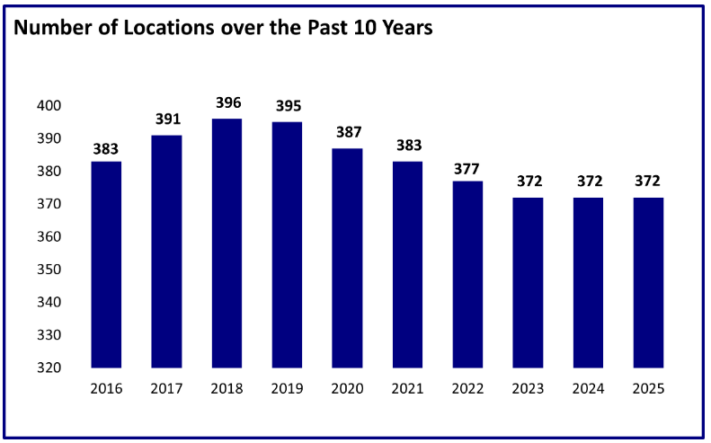
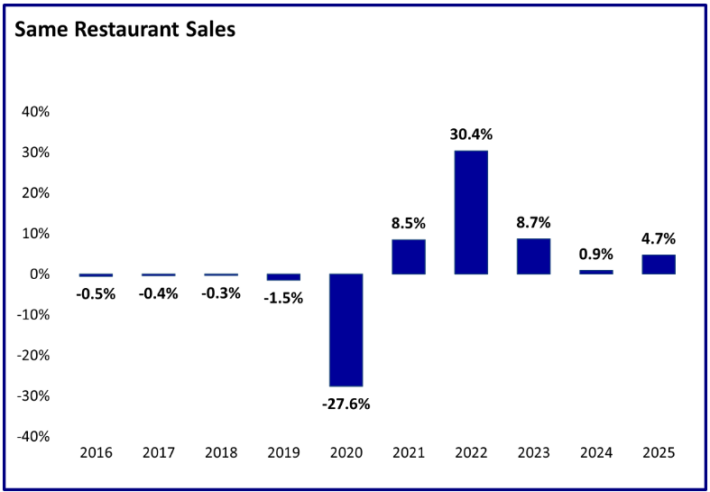
Due to its structure, Boston Pizza Royalty Income Fund’s growth prospects are solely determined by two factors. The first is the number of franchised restaurants in its royalty pool, while the other is the rate at which same-restaurant sales grow.
The number of restaurants has been continuously declining since 2018, when the total number of Boston Pizza restaurants peaked at 396. The declining number of restaurants can be attributed to some locations being unprofitable for franchises and the COVID-19 pandemic, which notably impacted all franchises during 2020 and 2021. The number of locations have been very stable in recent years.
Source: Investor Relations
Regarding the second factor, Boston Pizza’s same-restaurant sales have rebounded significantly following their slump during the COVID-19 pandemic. A notable factor that could keep boosting same-restaurant sales moving forward is Boston Pizza’s inexpensive offerings, which are likely to experience increased demand as consumers opt for more affordable food during an uncertain or recessionary environment.
Source: Investor Relations
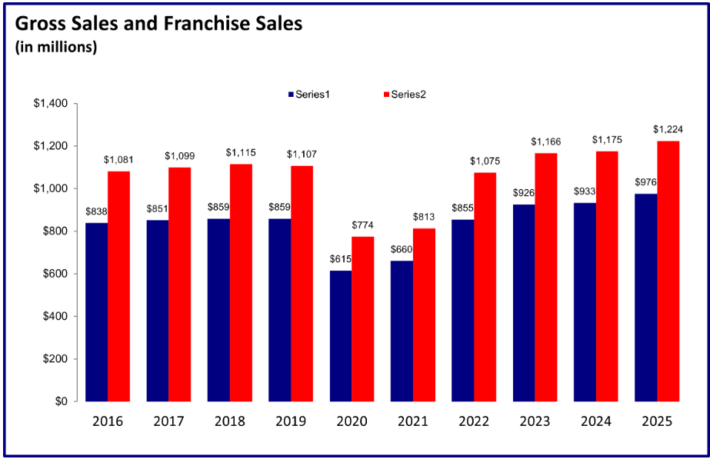
Despite the declining number of Boston Pizza restaurants, the notable increase in same-store sales over the past few years has led to steady growth.
Source: Investor Relations
Dividend & Valuation Analysis
Over the years, Boston Pizza Royalty Income Fund has averaged payout ratio of nearly 100%, essentially distributing its net income to unitholders, which aligns with its purpose. In 2025, the fund’s payout ratio was 95%, paying out $1.02 in distributions per unit out of the $1.07 in distributable cash per unit.
Investors should not expect distribution increases or “cuts,” but they should expect each year’s total distributions per unit to vary based on the underlying sales of Boston Pizza franchisees.
Barring unforeseen events like the COVID-19 pandemic, investors can generally expect a stable distribution level year over year. Boston Pizza restaurants tend to generate steady sales annually, and the fund does not incur any non-essential expenses that could impact net income and ultimately affect the level of payouts.
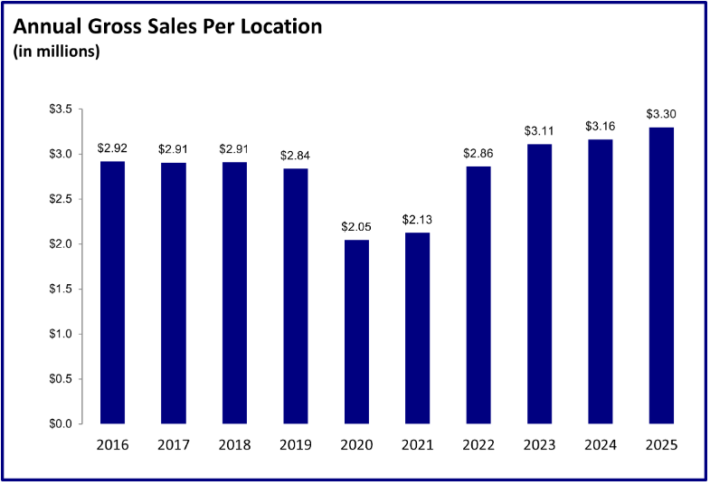
As you can see, annual gross sales per Boston Pizza location tend to be incredibly stable under normal circumstances. The notable decline in 2020 and 2021 was due to severe lockdowns, which are extreme events. Yet, sales quickly normalized once lockdowns ended.
Source: Investor Relations
Also, management attempts to distribute available funds equally each quarter to ensure consistent monthly payouts.
The current monthly distribution of C$0.12 translates to an annualized rate of C$1.44. In U.S. dollars, we expect dividends per share of ~$1.07 for 2025.
Shares of Boston Pizza Royalty Income Fund currently trade at 16.4x our EPS estimates for the year. This is above our target price-to-earnings ratio of 11.0 Reverting to our target by 2031 would reduce annual returns by 7.7% over this period.
Combined with our projected EPS growth rate of 3.0% and the current yield of 5.8%, total annual returns are forecasted to be 1.9% over the next five years.
Final Thoughts
Boston Pizza Royalty Income Fund is a unique investment vehicle. Its frictionless revenue model and purpose of distributing the entirety of its earnings, along with the highly attractive frequency of its monthly payouts, make it a highly enticing pick for income-oriented investors.
The dividend yield is not entirely reliable in the sense that extraordinary events could affect the revenues of Boston Royalty Franchisees and the fund’s cash flows. That said, excluding such severe events, investors should expect hefty distribution levels and, thus, very high yields, albeit with minor variations between quarters.
Finally, we believe the trust could perform very well and continue to distribute substantially during a recession, as consumers are likely to favor its affordable menu. This was demonstrated during the Great Financial Crisis when the fund’s annual distribution levels remained rock-solid.
Overall, we believe that Boston Pizza Royalty Income Fund can be a fitting pick for income investors seeking substantial yields and a lack of correlation with the broader market’s performance. However, shares earn a hold rating due to low projected annual returns over the next five years.
Don’t miss the resources below for more monthly dividend stock investing research.
And see the resources below for more compelling investment ideas for dividend growth stocks and/or high-yield investment securities.
Thanks for reading this article. Please send any feedback, corrections, or questions to [email protected].